


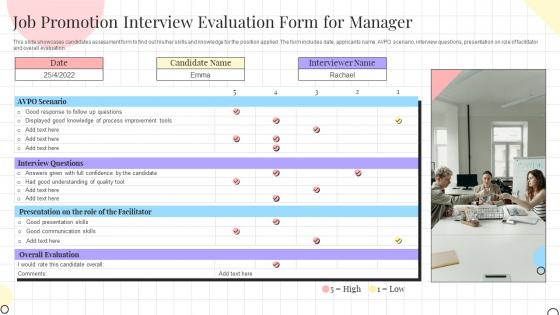
Job Promotion Interview Evaluation Form For Manager




Try Before you Buy Download Free Sample Product
 Impress Your
 Audience
 100%
100% Editable
 Save Hours
 of Time


This slide showcases candidates assessment form to find out his her skills and knowledge for the position applied. The form includes date, applicants name, AVPO scenario, interview questions, presentation on role of facilitator and overall evaluation.
People who downloaded this PowerPoint presentation also viewed the following :
Job Promotion Interview Evaluation Form For Manager with all 6 slides:
Use our Job Promotion Interview Evaluation Form For Manager to effectively help you save your valuable time. They are readymade to fit into any presentation structure.





FAQs for Job Promotion Interview Evaluation
Key skills and competencies for job promotion interviews include leadership capabilities, strategic thinking, communication effectiveness, problem-solving abilities, and technical expertise relevant to the elevated role. These assessments enable organizations to evaluate candidates through behavioral questioning, scenario-based discussions, and performance metric reviews, with many companies finding that comprehensive evaluation frameworks ultimately deliver better promotion decisions and enhanced organizational growth.
Evaluation forms help ensure fair promotion selection by standardizing criteria, documenting decision rationale, and providing consistent assessment frameworks across all candidates. These structured tools enable organizations to minimize unconscious bias, maintain transparency in their selection process, and create defensible promotion decisions, with many companies finding that systematic evaluation significantly enhances objectivity while reducing potential discrimination claims.
Effective leadership potential assessment includes evaluating communication skills, decision-making abilities, team collaboration experience, strategic thinking capabilities, and conflict resolution approaches. These evaluation methods streamline promotion decisions by observing situational responses, reviewing past team outcomes, and assessing cultural alignment, with many organizations finding that structured behavioral interviews ultimately deliver more accurate leadership predictions and stronger internal advancement success.
Organizational values and culture can be incorporated by including behavioral competencies, cultural fit assessments, leadership alignment metrics, and value-based scenario evaluations within promotion criteria. Many companies integrate culture-specific questions, peer feedback mechanisms, and values demonstration examples into their evaluation forms, ensuring promoted employees embody organizational principles while delivering strategic outcomes, ultimately strengthening workplace culture and long-term organizational success.
Key behavioral traits include leadership potential, strategic thinking, adaptability, decision-making under pressure, collaboration skills, and emotional intelligence. These competencies enable candidates to navigate complex challenges, inspire teams, and drive organizational growth, with many companies finding that assessing communication style, problem-solving approach, and cultural alignment ultimately delivers stronger promotional success rates.
Measuring employee performance achievements for promotions involves evaluating quantitative metrics like sales targets, project completion rates, and KPIs, alongside qualitative factors such as leadership capabilities, team collaboration, and strategic thinking. Organizations increasingly use structured evaluation forms that compare current performance against role requirements for the target position, with many companies finding that this comprehensive approach streamlines promotion decisions while ensuring candidates demonstrate measurable impact and growth potential.
Peer feedback provides valuable insights into collaborative skills, teamwork effectiveness, leadership potential, and day-to-day performance that managers might not directly observe. It enhances the evaluation process by offering multiple perspectives on communication abilities, problem-solving approaches, and cultural fit, with many organizations finding that comprehensive peer input delivers more accurate promotion decisions and ultimately stronger team dynamics.
**INPUT**: How can you ensure that the evaluation form captures qualitative insights as well as quantitative ratings? **OUTPUT**: Combine structured rating scales with open-ended comment sections, behavioral scenario questions, and narrative evaluation fields that encourage detailed feedback. This strategic approach enables evaluators to provide numerical scores alongside specific examples, contextual observations, and developmental insights, ultimately delivering comprehensive candidate assessments that support informed promotion decisions.
Common biases to avoid include halo effect, recency bias, confirmation bias, similarity bias, and leniency or strictness bias. These biases can significantly impact promotion decisions by skewing evaluations based on irrelevant factors rather than actual performance and qualifications, with many organizations finding that structured evaluation criteria and multiple reviewer perspectives help minimize subjective influences and ensure fairer outcomes.
Comparing candidate performance with industry benchmarks provides essential context for evaluation decisions, helping organizations assess competitiveness, salary expectations, skill adequacy, and market positioning relative to similar roles. This strategic approach enables companies to make informed promotion decisions while ensuring competitive talent retention, with many finding that benchmark analysis ultimately delivers better hiring outcomes and reduces turnover risks.
A well-structured evaluation form significantly enhances candidate experience by providing transparency, clear expectations, and consistent feedback throughout the promotion process. This approach enables candidates to understand evaluation criteria, prepare more effectively, and receive constructive insights, while organizations benefit from reduced bias, improved decision-making quality, and stronger employee trust, ultimately delivering higher retention rates and enhanced internal talent development.
**INPUT**: How can you tailor evaluation questions to reflect the specific requirements of different roles within the organization? **OUTPUT**: Tailoring evaluation questions involves analyzing core competencies, technical skills, leadership requirements, and performance metrics specific to each role's responsibilities and organizational impact. Successful organizations customize questions by incorporating role-specific scenarios, industry challenges, and department objectives, with many finding that targeted evaluations better identify candidates who can excel in distinct functions while delivering enhanced team performance and strategic alignment. [Word count: 60 words]
Effective open-ended questioning strategies include behavioral inquiries about past challenges, situational scenarios requiring problem-solving explanations, role-specific case studies, and reflective questions about career motivations and learning experiences. These approaches encourage candidates to provide detailed responses showcasing their thought processes, decision-making abilities, and cultural alignment, while revealing competencies that closed questions often miss, ultimately delivering deeper insights for more informed promotion decisions.
Evaluation forms should be reviewed annually and updated whenever significant role changes occur, with many organizations conducting comprehensive reviews every 12-18 months to align with evolving responsibilities, industry standards, and organizational priorities. This strategic approach ensures forms capture current competencies, emerging skills requirements, and changing performance metrics, ultimately delivering more accurate assessments and better promotion decisions across departments.
Confidentiality measures include secure document storage, limited evaluator access, anonymous feedback systems, encrypted digital platforms, and clear non-disclosure agreements for all participants. These protocols enhance trust by protecting candidate privacy, preventing bias through controlled information flow, and ensuring fair assessments, with many organizations finding that robust confidentiality frameworks ultimately deliver more honest evaluations and stronger promotional decisions.
-
Commendable slides with attractive designs. Extremely pleased with the fact that they are easy to modify. Great work!
-
I have been using SlideTeam for the past six months. Very happy and satisfied!