


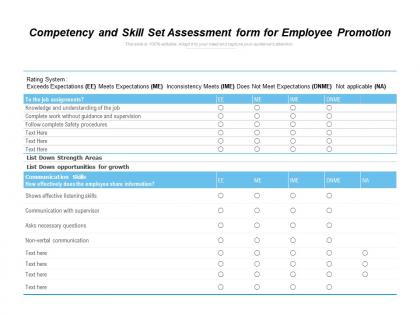
Competency and skill set assessment form for employee promotion




Try Before you Buy Download Free Sample Product
 Impress Your
 Audience
 100%
100% Editable
 Save Hours
 of Time


Our Competency And Skill Set Assessment Form For Employee Promotion are explicit and effective. They combine clarity and concise expression.
People who downloaded this PowerPoint presentation also viewed the following :
Competency and skill set assessment form for employee promotion with all 2 slides:
Give your audience a fulfilling experience. They will find our Competency And Skill Set Assessment Form For Employee Promotion elevating.
FAQs for Competency and skill set assessment form
Look at how they're doing now first - hitting their numbers? Going extra mile? Then check if they've got the leadership stuff down: talking to people, solving problems, handling responsibility without freaking out. Soft skills matter a ton too. Do people actually like working with them? Can they roll with changes? Experience is nice but honestly, sometimes someone newer brings better ideas than the person who's been doing it the same way forever. Most important thing though - make sure they actually want it! I've seen too many people get promoted into jobs they hate. Have that chat before you dive deep into evaluating them.
Honestly, you've got to nail down your criteria first and actually stick to them. I've watched too many managers wing it with promotions - total disaster. Make a solid rubric with measurable stuff that applies to everyone. Get multiple people to weigh in if you can, and document literally everything. Performance reviews, peer feedback, concrete wins they've had. Oh, and try removing names during the first review round if possible. The biggest thing though? Be transparent about your process. People should know exactly what it takes to move up. No surprises, and you'll have your back covered when someone inevitably complains.
Honestly, your performance data is what makes or breaks promotion decisions. Managers need those concrete numbers - your review scores, how you hit goals, project results from the last year or so. Can't just promote people on vibes, you know? They want proof you're crushing it at your current level before bumping you up. Document everything though - seriously, keep track of your wins and metrics because that's literally what they'll pull up when they're deciding. Oh, and consistent performance trends matter way more than one good quarter.
Dude, peer feedback is huge for promotions now. Most companies do those 360 reviews where everyone - coworkers, people under you - gets to spill about your leadership and how you actually treat people. Your boss's opinion isn't everything anymore. HR wants the real story of who you are when nobody's looking over your shoulder. Honestly, this stuff exposes blind spots you never knew existed. Start building real relationships at every level if you want that promotion. Ask for feedback way before review season hits - don't just wait around.
Honestly, just watch who everyone goes to when they need help - that's your future leader right there. I look for people who fix problems I didn't even know we had yet. Super telling. Give them weird projects outside their usual stuff and see what happens. The good ones will ask smart questions instead of just nodding along. How they bounce back from screwups matters way more than being perfect, tbh. You want someone who makes their whole team better, not just themselves. Oh, and write this stuff down as you notice it! You'll thank yourself later when promotion time rolls around.
Dude, cultural fit is SUCH a big deal for promotions. Like, you might be killing it performance-wise, but if you don't vibe with the team or company values? Leadership gets sketchy about promoting you. The higher up you go, the more you're basically the face of their culture to everyone else. So they want someone who actually gets it, you know? I've watched this happen to so many people. Here's what I'd do - watch how the people who actually got promoted act and talk. That's basically your cheat sheet for what they really care about culturally.
Honestly, peer feedback is everything - people know who they'd actually want as a boss. I'd start with 360-degree reviews from their team and colleagues. Look at whether they've mentored anyone or led cross-functional projects successfully. Communication during presentations matters too, plus how they handle conflict and feedback. There are some decent leadership assessment tools out there, though I'm not sure how reliable they really are. Change initiatives are another good test - did they actually get people on board? Pick maybe 3-4 things that fit your company's vibe and the specific role. Don't overthink it.
Honestly, I'd go 70% performance and 30% tenure - though way too many companies still flip that around which is insane to me. Performance stuff needs to be measurable, not just "Sarah seems nice" from managers. Short sentences work. For the tenure piece, focus on actual institutional knowledge and mentoring instead of just counting years. Oh and definitely be upfront about how you're weighting everything so people aren't guessing what matters. Document it all because you'll need to show you're being consistent when someone inevitably complains.
Start with a solid development plan that hits their biggest skill gaps. Give them stretch assignments that actually look like the role they want - don't just throw random busy work at them. Pair them up with someone who's been there before as a mentor. Here's what I learned the hard way: have regular check-ins instead of waiting for annual reviews. I've watched people get completely blindsided thinking they were promotion-ready when they weren't even close. Cross-functional projects help too since they'll get exposure to different parts of the business. Document their wins as you go - you'll need concrete examples later when it's time to make the case upstairs.
Dude, just put everything out in the open - post promotion criteria on your intranet, stick them in handbooks, bring them up during reviews. All-hands meetings work too. Be super specific about skills and experience needed, not some BS like "shows leadership potential." I swear, companies love being vague then act shocked when people quit. Train your managers so they're all saying the same thing. Oh and performance metrics - actual numbers, not fluffy stuff. If your employees are playing guessing games about promotions, you've already lost them.
Look, having diverse people on promotion panels actually makes the whole thing way more solid. Different backgrounds catch things others miss - I've seen this work really well at my last job. You avoid that groupthink trap where everyone just nods along. Short version: better discussions about candidates happen when perspectives vary. Just make sure everyone's using the same criteria upfront, otherwise it gets messy. The diversity thing isn't about being "fair" - it genuinely leads to better decisions because you're not all looking through the same lens.
Look, development programs are basically about bridging that gap between where your team is now and where they need to be for promotions. You want leadership training, mentorship stuff, cross-functional projects - things that actually prep them instead of just throwing them into the deep end. Honestly, I've seen too many companies skip this step and wonder why nobody's ready when positions open up. These programs also help you spot your high-performers early, which is clutch. Start by figuring out what skills each role actually needs, then build around those gaps. Way better than the scramble later.
Honestly, the biggest mistake is getting caught up in recency bias - someone nails one project and suddenly they're your golden child, even if they've been pretty meh for months. I've seen this happen so many times. Don't just promote based on tenure either, or because they keep bugging you about it. Get feedback from different people too, not just their immediate team. You might discover they're actually terrible to work with cross-functionally. Oh, and having some kind of consistent framework helps - otherwise you're just winging it every time.
Oh man, get performance management software if you can. It's such a lifesaver when promotion season hits. All your employee data lives in one spot - goals, feedback, development stuff - instead of digging through random emails and messy spreadsheets like we used to do. Makes comparing candidates way more fair since you're using the same criteria for everyone. Employees love it too because they can see exactly what they need to work on. Pro tip though: set up those reminder notifications or you'll still end up scrambling last minute (learned that the hard way).
So succession planning is basically mapping out who fills key roles before people leave. Smart companies use it to make promotions strategic instead of just winging it when someone quits. It's actually pretty cool because managers have to think about everyone's career path, not just their favorites. You get way better visibility into what's coming up and which skills to focus on. My old boss was terrible at this stuff, but when done right, it totally changes the game. Definitely bring it up with your manager - you'll figure out your promotion timeline and can prep accordingly.
No Reviews