


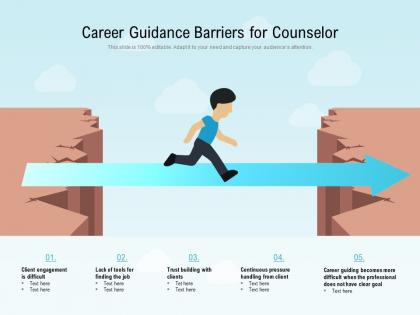
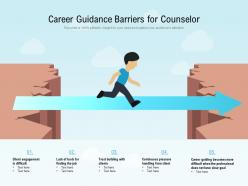
Career guidance barriers for counselor




Try Before you Buy Download Free Sample Product
 Impress Your
 Audience
 100%
100% Editable
 Save Hours
 of Time


Eyes get fixed by the brilliance of our Career Guidance Barriers For Counselor. You will grab eyeball after eyeball.
People who downloaded this PowerPoint presentation also viewed the following :
Career guidance barriers for counselor with all 5 slides:
Customers feel enchanted by our Career Guidance Barriers For Counselor. Gazes get fixed by their brilliance.



FAQs for Career guidance
Common misconceptions include believing career counseling only involves matching interests to jobs, that it's a one-time decision process, that counselors provide direct answers rather than facilitate self-discovery, and that it's only for students or job seekers. These misconceptions limit counselors' effectiveness by creating unrealistic client expectations, reducing engagement in comprehensive exploration, and underutilizing counseling's strategic value in helping professionals navigate complex career transitions, ultimately hindering the development of sustainable career strategies.
Socio-economic factors significantly impact career counseling by creating barriers like limited access to resources, networking opportunities, and educational pathways, while also influencing client aspirations and self-perception. Counselors must adapt approaches by addressing financial constraints, cultural expectations, and systemic inequalities, with many professionals finding that integrating community resources and flexible service models ultimately enhances accessibility and delivers more equitable career outcomes.
Cultural differences can create barriers through language limitations, varying career expectations across cultures, unfamiliarity with diverse educational systems, and differing communication styles between counselors and clients. These challenges often result in misaligned guidance strategies, reduced client engagement, and missed opportunities for meaningful career development, with many counseling organizations finding that culturally responsive training and diverse counselor teams significantly enhance client outcomes and satisfaction.
Counselors overcome limited client self-awareness through structured assessments like personality inventories and skills evaluations, reflective questioning techniques, and experiential activities including job shadowing and informational interviews. These approaches enable clients to discover hidden strengths and interests while building deeper self-understanding, with many career services finding that combining multiple assessment methods ultimately delivers more accurate career matches and confident decision-making.
Technology presents both opportunities and challenges in career counseling, streamlining assessments, expanding access through virtual sessions, and enabling data-driven insights, while potentially creating digital divides and reducing personal connection. Many counseling organizations find that strategic integration of platforms like AI-powered career matching and online resources ultimately enhances service delivery and client outcomes.
Counselors can better address non-traditional students and career changers by conducting comprehensive skills assessments, offering flexible scheduling options, providing targeted financial guidance, and creating specialized support groups for similar demographics. Through personalized career mapping and industry-specific mentoring programs, many educational institutions and career centers find that these tailored approaches significantly enhance engagement, reduce dropout rates, and ultimately deliver faster career transitions with improved job placement outcomes.
**INPUT**: What strategies can be implemented to improve communication between counselors and clients from diverse backgrounds? **OUTPUT**: Effective cross-cultural communication strategies include cultural competency training, multilingual resources, active listening techniques, non-verbal communication awareness, and collaborative goal-setting approaches. These methods enhance counselor effectiveness by building trust, reducing misunderstandings, and creating inclusive environments, with many educational institutions and corporate counseling programs finding that culturally responsive practices ultimately deliver stronger client relationships and more successful outcomes. [Word count: 58 words]
Institutional policies significantly shape career guidance availability and quality by determining resource allocation, counselor training requirements, caseload limits, and service delivery standards. These policies directly impact counselor effectiveness through funding constraints, professional development opportunities, and administrative support structures, with many educational institutions and organizations finding that well-designed policies enhance counselor capacity while poorly structured ones create barriers to comprehensive career services.
Ethical considerations include maintaining cultural competency, avoiding demographic bias, ensuring equitable resource access, respecting individual values, and recognizing socioeconomic limitations. These principles require counselors to balance personal beliefs with client needs, adapt guidance approaches across diverse populations, and acknowledge systemic barriers, while ultimately delivering inclusive support that respects each individual's unique circumstances and cultural background.
Counselors can evaluate client preparedness through comprehensive assessments examining career awareness, decision-making readiness, motivation levels, skill inventories, and personal barriers or constraints. By utilizing tiered intervention strategies, counselors adapt their approaches from foundational career exploration for unprepared clients to advanced planning for ready individuals, ultimately delivering personalized guidance that meets each client where they are in their career development journey.
Mental health significantly influences career guidance effectiveness by affecting decision-making clarity, motivation levels, self-confidence, and goal-setting capabilities, often creating barriers to processing and implementing professional advice. Through supportive counseling approaches, many career professionals find that addressing anxiety, depression, or stress alongside career planning enhances client engagement, improves outcome success rates, and ultimately delivers more sustainable career transitions and workplace satisfaction.
Systemic barriers like inadequate funding, high counselor-to-student ratios, limited technology access, and inflexible curricula significantly compromise career guidance effectiveness by restricting personalized attention and current industry insights. These institutional constraints prevent counselors from delivering comprehensive services, with many schools finding that strategic resource allocation and administrative support ultimately enhance program outcomes and student career readiness.
Professional development enhances counselors' capabilities through specialized training in emerging career fields, cultural competency workshops, technology integration skills, and evidence-based intervention techniques. These strategic combinations enable counselors to better address diverse student needs, navigate evolving job markets, and deliver more personalized guidance services, with many educational institutions finding that ongoing professional development ultimately streamlines counseling effectiveness and improves student career outcomes.
Counselors can leverage community resources by establishing partnerships with local nonprofits, educational institutions, healthcare providers, employment agencies, and social services organizations to address clients' multifaceted needs. These strategic collaborations enable counselors to provide comprehensive support through referral networks, shared programming, and resource pooling, ultimately delivering more effective career guidance while maximizing their impact in an increasingly complex service landscape.
Analyzing client feedback reveals crucial insights about counseling effectiveness, communication gaps, resource adequacy, session structure preferences, and outcome satisfaction levels. Through systematic feedback analysis, counselors can identify specific areas for improvement, adapt their methodologies to diverse client needs, and enhance service delivery, with many practitioners finding that regular feedback integration significantly improves client engagement and career transition success rates.
No Reviews