


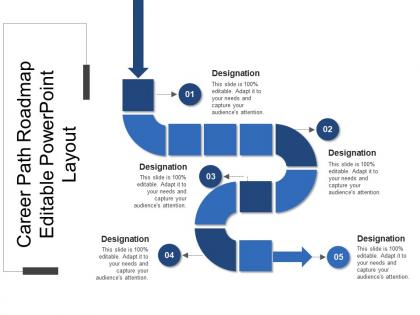
Career path roadmap editable powerpoint layout




Try Before you Buy Download Free Sample Product
 Impress Your
 Audience
 100%
100% Editable
 Save Hours
 of Time


Break free from convention with our Career Path Roadmap Editable Powerpoint Layout. Get access to advanced approaches.
People who downloaded this PowerPoint presentation also viewed the following :
Career path roadmap editable powerpoint layout with all 5 slides:
Generate convergence with our Career Path Roadmap Editable Powerpoint Layout. Folks agree to function together.

FAQs for Career path roadmap
Career path roadmaps should include clear progression levels, required skills and competencies, timeline expectations, performance milestones, and development opportunities for each stage. These elements work together by providing structured guidance, setting realistic expectations, and identifying specific training needs, with many organizations finding that comprehensive roadmaps enhance employee retention while streamlining succession planning efforts.
Visualization techniques enhance career understanding by transforming abstract progression concepts into clear, actionable roadmaps through flowcharts, timeline graphics, and milestone mapping. These visual tools enable professionals to identify skill gaps, track advancement opportunities, and communicate career objectives more effectively, with many organizations finding that visual career frameworks increase employee engagement and strategic workforce planning.
Common career paths in emerging industries include data science and AI engineering, renewable energy development, cybersecurity analysis, digital health technology, and sustainable business consulting. These roles span sectors like fintech, biotech, and clean technology, with many professionals finding that cross-functional skills in technology, sustainability, and digital transformation deliver significant competitive advantage in today's evolving marketplace.
Personal values and passions significantly influence career path decisions by guiding industry selection, role preferences, work environment choices, and long-term professional goals. These internal drivers help professionals evaluate opportunities against their core beliefs and interests, with many finding that alignment between values, passions, and career choices ultimately delivers greater job satisfaction, enhanced performance, and sustained motivation throughout their professional journey.
Mentorship provides strategic guidance, industry insights, networking opportunities, skill development feedback, and career navigation support when developing your roadmap. Through experienced mentors, professionals gain access to insider knowledge, avoid common pitfalls, and accelerate their progression, with many finding that mentor relationships unlock opportunities and perspectives they wouldn't discover independently, ultimately delivering faster career advancement.
Professionals can leverage networking to enhance career trajectories by building strategic relationships, accessing hidden job opportunities, gaining industry insights, seeking mentorship, and expanding their professional visibility. Through authentic connections at conferences, LinkedIn engagement, and industry events, professionals unlock referrals, collaborative opportunities, and insider knowledge, ultimately accelerating career advancement and opening doors to leadership positions.
Career progress metrics include performance ratings, skill acquisition benchmarks, compensation growth, leadership responsibilities, network expansion, and goal achievement rates. These indicators help professionals track advancement through measurable outcomes like project completions, certifications earned, and team management scope, while organizations increasingly use comprehensive assessment frameworks that combine quantitative results with qualitative leadership development, ultimately delivering clearer promotion pathways and strategic career advancement.
Career roadmap tools include career assessment platforms, professional development software, mentorship programs, industry networking groups, and online learning resources. These resources enable professionals to identify skill gaps, set strategic goals, and track progress systematically, with many organizations finding that structured career planning tools enhance employee engagement, reduce turnover, and accelerate talent development across teams.
Effective career pivoting requires strategic skill assessment, targeted upskilling, network building, and gradual transition planning through lateral moves or additional certifications. Professionals in finance successfully transition to tech through coding bootcamps, while marketing specialists move into data analytics by leveraging transferable communication skills, ultimately delivering enhanced career flexibility and competitive positioning in evolving markets.
Self-assessment through skills inventories, informational interviews, and career mapping exercises help identify transferable abilities like communication, problem-solving, project management, and analytical thinking across industries. Many professionals find that core competencies from finance translate effectively to consulting, healthcare administration, or technology sectors, ultimately enabling strategic career pivots while leveraging existing expertise for competitive advantage.
Cultural differences significantly impact career path decisions through varying values around work-life balance, family expectations, risk tolerance, hierarchical respect, and collective versus individual achievement priorities. While Western cultures often emphasize personal fulfillment and career mobility, many Asian and Latin American cultures prioritize family obligations and organizational loyalty, with professionals increasingly navigating these diverse expectations in global workplaces, ultimately creating more nuanced and culturally-aware career strategies.
Setting both short-term and long-term career goals provides direction, motivation, and measurable progress markers while ensuring strategic alignment with broader professional aspirations. This balanced approach enables professionals to maintain momentum through achievable milestones, adapt to industry changes, and build relevant skills systematically, with many finding that combining immediate wins with visionary planning ultimately delivers sustained career growth and competitive advantage.
Feedback from peers and supervisors provides critical insights into performance gaps, skill development needs, and advancement opportunities within an organization. By incorporating this input into career planning, professionals can align their growth strategies with organizational expectations and market demands, ultimately enhancing their promotion prospects and long-term career trajectory.
Successful unconventional career paths include Howard Schultz transitioning from salesperson to Starbucks CEO, Oprah Winfrey moving from news anchor to media mogul, and Sara Blakely pivoting from door-to-door sales to founding Spanx. These individuals leveraged transferable skills, embraced calculated risks, and maintained persistent vision, ultimately delivering breakthrough innovations and market leadership that traditional career trajectories often cannot achieve.
Technology and online platforms streamline career planning through AI-powered assessments, skills gap analysis, job market insights, networking tools, and personalized learning recommendations. These digital solutions enable professionals to explore opportunities across industries like healthcare, finance, and technology while accessing real-time salary data and industry trends, ultimately delivering strategic career decisions and competitive positioning in an increasingly dynamic job market.
-
Informative presentations that are easily editable.
-
The Designed Graphic are very professional and classic.
-
good template