


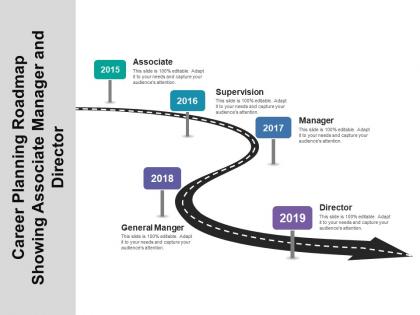
Career planning roadmap showing associate manager and director




Try Before you Buy Download Free Sample Product
 Impress Your
 Audience
 100%
100% Editable
 Save Hours
 of Time


Make your clientele happy with our Career Planning Roadmap Showing Associate Manager And Director. Your goods will appear extremely attractive.
People who downloaded this PowerPoint presentation also viewed the following :
Career planning roadmap showing associate manager and director with all 5 slides:
Bring the core concept into clear focus with our Career Planning Roadmap Showing Associate Manager And Director. Identify important elements of the doctrine.

FAQs for Career planning roadmap showing associate
Key milestones in a career progression roadmap include skill development benchmarks, leadership responsibilities, performance achievements, cross-functional experience, and strategic project completions. These milestones enable organizations to streamline talent development, enhance employee retention, and deliver clear advancement pathways, with many companies finding that structured roadmaps ultimately accelerate professional growth while improving succession planning.
Professionals can identify advancement skills through industry research, networking with senior colleagues, analyzing job descriptions for target roles, and consulting professional associations or mentors. Many find that combining technical competencies with leadership capabilities, strategic thinking, and cross-functional knowledge delivers the strongest competitive advantage, with industries like healthcare, finance, and technology increasingly valuing adaptability and continuous learning skills.
Networking accelerates career progression by providing access to hidden job opportunities, industry insights, mentorship, and strategic partnerships that enhance professional visibility and credibility. Building an effective network involves actively engaging at industry conferences, joining professional associations, maintaining meaningful relationships through regular communication, and offering value to others through knowledge sharing, with many professionals finding that consistent networking efforts ultimately deliver faster promotions and expanded career opportunities.
Individuals leverage mentorship for career development by gaining industry insights, receiving personalized guidance, expanding professional networks, developing strategic skills, and accessing advancement opportunities. Through regular mentorship relationships, professionals enhance their decision-making capabilities, navigate organizational dynamics more effectively, and accelerate their growth trajectories, with many finding that mentors provide invaluable perspectives that ultimately deliver faster promotions and increased career satisfaction.
Career progression tools include skills matrices, competency frameworks, individual development plans, career mapping software, and performance dashboards. These frameworks enhance workforce planning by tracking skill gaps, measuring development outcomes, and aligning talent pipelines with organizational goals, with many companies finding that structured visualization ultimately delivers improved retention and strategic succession planning.
Balancing skill development with current responsibilities requires strategic time management, setting learning priorities aligned with career goals, and integrating skill-building into daily work tasks. Many professionals find success by dedicating early morning hours to learning, pursuing skills that directly enhance current role performance, and seeking projects that combine immediate job needs with future competencies, ultimately delivering both present value and career advancement.
Emerging trends include artificial intelligence integration, sustainability practices, remote work technologies, data analytics capabilities, and cybersecurity measures across sectors. These developments reshape industries by automating processes, enhancing decision-making, and creating new roles, with professionals in healthcare, finance, and manufacturing finding that upskilling in these areas delivers competitive advantage and accelerated career growth.
Personal branding significantly influences career progression by establishing professional credibility, differentiating you from competitors, and creating opportunities for advancement through enhanced visibility and reputation. Strategic approaches include consistently sharing industry insights on LinkedIn, developing expertise in specialized areas, networking authentically across sectors, and aligning your personal values with your professional image, ultimately delivering increased recognition, better job prospects, and accelerated career growth in an increasingly competitive marketplace.
Common pitfalls include neglecting skill development, focusing solely on vertical moves, ignoring networking opportunities, lacking clear goal setting, and underestimating lateral experience value. While many professionals rush advancement timelines, successful career strategies require strategic patience, continuous learning, and relationship building, with organizations increasingly recognizing that diverse experience paths ultimately deliver stronger leadership capabilities.
Organizational structures influence career pathways by determining promotion hierarchies, reporting relationships, role specialization, and advancement opportunities within companies. Flat structures often enable broader skill development and faster lateral movement, while hierarchical organizations provide clearer vertical progression routes, with many professionals finding that matrix structures offer diverse project exposure and cross-functional leadership development.
Continuous education significantly accelerates career progression by enhancing skill relevance, expanding professional networks, increasing marketability, and opening advancement opportunities across industries. Professionals should pursue certifications, online courses, industry conferences, mentorship programs, and cross-functional training, with many organizations finding that employees who engage in lifelong learning demonstrate higher performance, adaptability, and leadership potential, ultimately delivering faster promotions and salary growth.
Feedback should be integrated through regular performance reviews, peer assessments, 360-degree evaluations, and continuous manager check-ins to identify strengths, development areas, and skill gaps. These insights enable employees to adjust their career trajectories, prioritize targeted learning opportunities, and align their professional growth with organizational needs, ultimately delivering more strategic career advancement and enhanced job satisfaction.
Professionals can prepare for lateral moves by developing transferable skills, building cross-functional relationships, understanding adjacent departments' operations, and gaining exposure to diverse projects. These strategic transitions enable skill diversification, expanded networks, and broader organizational knowledge, with many finding that lateral experiences create multiple promotion pathways and ultimately deliver enhanced leadership capabilities and competitive market positioning.
Emotional intelligence significantly enhances career advancement by improving leadership capabilities, team collaboration, and client relationships, while enabling better conflict resolution and strategic decision-making. Through enhanced self-awareness and empathy, professionals build stronger networks, navigate organizational politics more effectively, and deliver superior customer experiences, with many finding that emotional intelligence becomes increasingly critical for executive-level positions.
Setting effective career goals involves defining specific, measurable objectives with clear timelines, conducting regular skills assessments, and aligning personal aspirations with industry trends and market demands. These strategies enable professionals to create actionable development plans through networking, continuous learning, and performance tracking, with many organizations finding that employees who regularly revise their goals achieve faster promotions and greater job satisfaction.
-
Good research work and creative work done on every template.
-
The Designed Graphic are very professional and classic.