


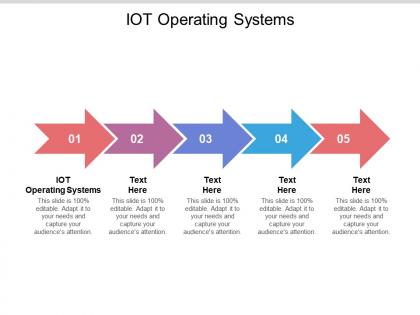
Iot operating systems ppt powerpoint presentation file demonstration cpb




Try Before you Buy Download Free Sample Product
 Impress Your
 Audience
 100%
100% Editable
 Save Hours
 of Time


Our IOT Operating Systems Ppt Powerpoint Presentation File Demonstration Cpb are explicit and effective. They combine clarity and concise expression.
People who downloaded this PowerPoint presentation also viewed the following :
Iot operating systems ppt powerpoint presentation file demonstration cpb with all 2 slides:
Give your audience a fulfilling experience. They will find our IOT Operating Systems Ppt Powerpoint Presentation File Demonstration Cpb elevating.
FAQs for Iot operating systems ppt powerpoint presentation
**INPUT**: What are the key differences between real-time operating systems (RTOS) and traditional operating systems in the context of IoT? **OUTPUT**: RTOS prioritize deterministic response times, minimal resource consumption, and predictable task scheduling, while traditional operating systems focus on throughput, multitasking flexibility, and user interface optimization. In IoT deployments, manufacturing sensors, medical devices, and automotive systems leverage RTOS capabilities to deliver microsecond-level precision and reliable performance, ultimately enabling mission-critical applications where timing delays could compromise safety or operational efficiency. [Word count: 58 words]
Security concerns fundamentally drive IoT operating system design through built-in encryption protocols, secure boot mechanisms, regular update capabilities, and minimal attack surface architectures. These security-first approaches enable manufacturers in sectors like healthcare devices, smart manufacturing, and connected vehicles to deliver robust protection against cyber threats, while ensuring compliance requirements are met, ultimately providing competitive advantage in an increasingly connected marketplace.
Lightweight coding minimizes memory usage, reduces processing overhead, and accelerates system responsiveness in IoT operating systems, enabling devices to operate efficiently within strict hardware constraints. This streamlined approach allows smart sensors, industrial monitors, and connected appliances to deliver faster data processing and extended battery life, ultimately enhancing operational efficiency across IoT deployments.
IoT operating systems manage device interoperability through standardized communication protocols like MQTT, CoAP, and Zigbee, along with middleware layers that translate between different device languages and data formats. These systems enable seamless integration across diverse hardware platforms, with smart home ecosystems and industrial automation networks finding that unified protocol management streamlines operations and enhances scalability.
Common IoT operating systems include FreeRTOS, Contiki, TinyOS, Ubuntu Core, and Windows IoT Core, each designed for specific deployment scenarios. These platforms enhance device functionality by delivering real-time processing, energy efficiency, and seamless connectivity, with many manufacturers finding that strategic OS selection streamlines development cycles, reduces operational costs, and ultimately accelerates time-to-market for connected solutions.
Power management features in IoT operating systems significantly extend device longevity and optimize performance by implementing dynamic frequency scaling, sleep mode scheduling, and adaptive resource allocation based on workload demands. These capabilities enable devices to reduce energy consumption by up to 70%, minimize heat generation that degrades components, and maintain consistent performance levels, with many manufacturers in smart agriculture and industrial monitoring finding that strategic power optimization ultimately delivers years of additional operational life and reduced maintenance costs.
Open-source IoT operating systems offer cost savings, customization flexibility, and community-driven innovation, while proprietary systems provide dedicated support, guaranteed security updates, and streamlined integration. Organizations in manufacturing and healthcare increasingly find that open-source solutions enable rapid prototyping and scalability, though proprietary options deliver predictable maintenance and compliance assurance for mission-critical applications.
IoT operating systems facilitate edge computing by enabling real-time data processing, reducing latency through local computation, and minimizing bandwidth usage by filtering data before transmission. These systems streamline operations by managing distributed computing resources, automating decision-making at device level, and seamlessly integrating with cloud infrastructure, ultimately delivering faster response times and enhanced operational efficiency for connected enterprises.
**INPUT**: What strategies can be employed to update and maintain IoT operating systems securely? **OUTPUT**: Secure IoT operating system maintenance strategies include over-the-air updates, code signing verification, rollback capabilities, staged deployment protocols, and encrypted communication channels. These approaches streamline security management by automating patch distribution, minimizing downtime, and ensuring system integrity, with many manufacturing and healthcare organizations finding that proactive update frameworks ultimately deliver enhanced operational resilience and reduced vulnerability exposure.
IoT operating systems support scalability through modular architectures, lightweight resource management, distributed processing capabilities, and automated device orchestration. These systems enable organizations to seamlessly deploy thousands of connected devices across manufacturing plants, smart cities, and retail networks, while minimizing operational overhead and ensuring consistent performance, ultimately delivering cost-effective expansion and centralized management.
Hardware architecture and resource constraints significantly influence IoT operating system selection through memory footprint requirements, processor compatibility, power consumption optimization, and real-time processing capabilities. Organizations deploying sensor networks in manufacturing or smart city applications find that systems with limited RAM and battery life require lightweight, specialized operating systems that streamline resource allocation, ultimately delivering enhanced operational efficiency and extended device lifecycles.
IoT operating systems enable advanced analytics and machine learning by providing real-time data processing frameworks, edge computing capabilities, distributed algorithm support, and seamless cloud integration APIs. These systems streamline complex computations directly on devices, with manufacturing plants and smart cities finding that localized processing reduces latency, minimizes bandwidth costs, and delivers faster predictive insights for operational efficiency.
Best practices for testing IoT applications include unit testing, integration testing, hardware-in-the-loop simulation, real-world environment testing, and continuous monitoring frameworks. These approaches streamline development by identifying performance bottlenecks, ensuring device compatibility, and validating connectivity across diverse networks, with many manufacturers finding that comprehensive testing reduces deployment costs and enhances system reliability.
Development frameworks associated with IoT operating systems enhance application development by providing pre-built libraries, standardized APIs, and device abstraction layers that streamline coding processes. These frameworks enable developers to create scalable applications faster through cross-platform compatibility, automated device management, and integrated security protocols, ultimately reducing development time and costs while ensuring reliable deployment across diverse IoT ecosystems.
Emerging IoT operating system trends include edge-native architectures, AI-integrated platforms, ultra-lightweight kernels, enhanced security frameworks, and cross-platform standardization protocols. These innovations streamline device management, accelerate real-time processing, and minimize resource consumption, with manufacturing, healthcare, and smart city sectors finding that next-generation IoT systems ultimately deliver faster deployment cycles and significantly improved operational efficiency.
No Reviews