


Challenges and limitations of machine learning ppt powerpoint presentation slides




Try Before you Buy Download Free Sample Product
 Impress Your
 Audience
 100%
100% Editable
 Save Hours
 of Time


Our Challenges And Limitations Of Machine Learning Ppt Powerpoint Presentation Slides are explicit and effective. They combine clarity and concise expression.
People who downloaded this PowerPoint presentation also viewed the following :
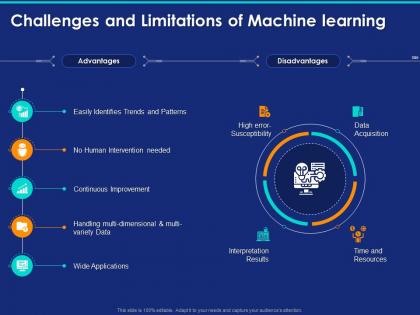
Challenges and limitations of machine learning ppt powerpoint presentation slides with all 2 slides:
Give your audience a fulfilling experience. They will find our Challenges And Limitations Of Machine Learning Ppt Powerpoint Presentation Slides elevating.

FAQs for Challenges and limitations of machine learning ppt
Oh man, data leakage is probably the worst one - you accidentally let future info sneak into your training set and then wonder why your model sucks in production. Missing values trip people up constantly too. Don't just drop rows automatically; sometimes you should fill them in instead. Scaling is another big one I see all the time. Split your data FIRST, then do all your preprocessing separately on each chunk. Otherwise you're basically cheating. And honestly? Document everything as you go because you'll definitely forget what transforms you did later when you're trying to reproduce results.
So basically you've got this tradeoff between bias and variance that'll make or break your model. High bias = too simple, misses the good stuff. High variance = overfits like crazy and just memorizes everything. The guitar string analogy is actually perfect - loose or tight both suck. What works for me is plotting those learning curves first to figure out what you're dealing with. Then tweak your model complexity from there. Honestly the "sweet spot" everyone talks about? Way harder to find than it sounds, but that's the goal.
Got a few ways to tackle this. SMOTE works great for oversampling your minority class, or you could undersample the majority one instead. Class weights are clutch too - basically makes your model care more about getting the rare cases right. Random Forest handles this stuff pretty well without much tweaking, which is nice. Oh and ditch accuracy as your main metric, it's basically useless here. Precision, recall, F1-score - those'll actually tell you what's going on. I used to just hunt for more data but that gets expensive fast.
Oh man, overfitting is super annoying but easy to spot - your model kills it on training data then totally bombs on new stuff. The performance gap between training and validation sets basically screams "overfitting!" Cross-validation catches this early which is nice. For fixes, I'd start with regularization (L1 or L2), maybe simplify your model, or just get more data if you can swing it. Dropout works great for neural networks too. Early stopping is honestly my go-to move though - stops the model from just memorizing everything. Just keep watching that train-validation gap!
So feature selection is basically cleaning up your data so your model doesn't get confused by junk. Remove the useless stuff and suddenly your model can actually see the patterns that matter. Accuracy goes up, training gets faster, and you avoid overfitting too. The hard part? Figuring out what to toss. I'd start with checking correlations between features - sometimes you'll find variables that are basically saying the same thing. Recursive feature elimination works well too since it tests different combos automatically. Honestly, I've seen models perform way better with like half the original features.
So each algorithm looks at your data totally differently, right? Linear models only see straight lines, so they miss weird patterns but you'll get super clear feature rankings. Tree models catch all the funky non-linear stuff - though good luck explaining random forests to your boss lol. SVMs handle messy boundaries like champs. Then clustering finds hidden groups you never knew existed. Honestly, the whole trick is just picking whatever matches the insights you're actually hunting for. Some algorithms are black boxes, others show their work clearly.
Bias is huge - your training data probably has historical discrimination baked right in, which is honestly such a common mistake. Privacy matters too, especially if you're dealing with sensitive stuff like healthcare or hiring decisions. Can you actually explain how your model works? Because transparency is key for anything high-stakes. Document where your data comes from and audit regularly to check if it's fair across different groups. The job displacement thing is real too, so think about broader societal impact. Oh, and always keep humans involved for the big decisions - don't just let the algorithm run wild.
Dude, SHAP and LIME are lifesavers for this stuff - they'll show you exactly which features are driving predictions with these cool color-coded charts that even executives actually understand. What really works is creating simple what-if scenarios people can relate to. Most folks just want to know if they can trust your model, right? So build dashboards with confidence scores and write explanations in normal English, not tech speak. Oh, and those before/after comparisons are gold. I usually start with whatever visualization addresses their biggest worry first - gets buy-in way faster.
So accuracy alone won't cut it - you'll want precision, recall, F1-score, and AUC-ROC too. Cross-validation is clutch here, or at least do a proper train/validation/test split. ROC curves are honestly where it's at for binary stuff because you can actually see the tradeoffs. Check your confusion matrix first though - shows you exactly what's getting mixed up. Compare your training vs validation scores to catch overfitting (happens more than you'd think). Oh, and make sure your test data actually looks like what you'll see in the real world or you're basically screwed.
So hyperparameter tuning is basically finding that sweet spot where your model doesn't suck but also doesn't memorize everything. Grid search will test every combo but takes forever - I usually skip it unless I'm feeling masochistic. Random search is way faster and honestly gets you pretty close to optimal results. Bayesian optimization though? That's the good stuff. It actually learns from what didn't work before and gets smarter about what to try next. I'd start with random search to get a decent baseline, then maybe switch to Bayesian if you're chasing those final accuracy gains.
Honestly, the big pain points are gonna be latency, limited resources, and model drift. You need responses in milliseconds - so those massive transformer models are out. Memory and compute are tight too, especially if you're running on edge devices. What really sucks is watching your model's accuracy slowly tank as real-world data changes from what you trained on. I'd set up monitoring for prediction quality ASAP and figure out your retraining strategy early. Oh, and definitely benchmark those latency requirements first - learned that one the hard way.
So basically you start with models that are already trained on similar stuff - like if you're doing medical images, grab an ImageNet model. For legal docs, use a general language model. Honestly works way better than starting from scratch when your dataset isn't huge. Freeze those early layers since they pick up generic features anyway. Only train the final layers on your specific data. Oh and use tiny learning rates when fine-tuning or you'll mess up what the model already learned. Always test on domain-specific data though - that part's crucial.
Ugh, GDPR and CCPA are such a pain but you really can't ignore them anymore. You need explicit consent before grabbing any data, and users can demand you delete their info - which is honestly a nightmare when it's already trained into your model. Transparency is huge too, so you gotta explain what data you're using and why. Only collect what you actually need (data minimization is the fancy term). Here's the thing though - don't bolt privacy stuff on at the end like most people do. Build it right into your ML pipeline from the start. Maybe check out federated learning or differential privacy if you're feeling fancy.
So basically ensemble methods work by mixing predictions from different models together. You're not stuck depending on just one model screwing up. Random forests and gradient boosting are solid options - the individual mistakes kind of balance out when you combine everything. It's like asking multiple friends for advice instead of trusting just one person's opinion (though honestly, sometimes that backfires too). The models need to mess up in different ways for this to actually work. Try bagging or boosting next time. You'll probably notice your results don't swing around as much.
Honestly, model drift is gonna be your worst enemy - your models slowly get worse as real data changes from what you trained on. Scaling gets messy quick too, especially with real-time stuff. Like suddenly everyone's hitting your API and everything breaks (though I guess that's a good problem?). Debugging is brutal since you're not dealing with normal deterministic code anymore. Monitor everything from the start and set up automated retraining. Trust me on the logging thing - you'll thank yourself later when things inevitably go sideways.
No Reviews