


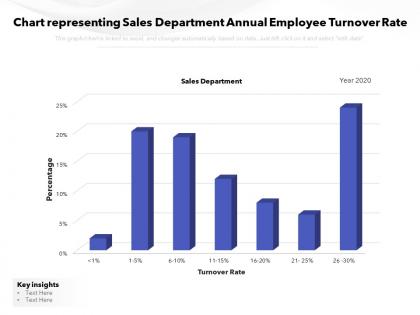
Chart representing sales department annual employee turnover rate




Try Before you Buy Download Free Sample Product
 Impress Your
 Audience
 100%
100% Editable
 Save Hours
 of Time


Our Chart Representing Sales Department Annual Employee Turnover Rate are topically designed to provide an attractive backdrop to any subject. Use them to look like a presentation pro.
People who downloaded this PowerPoint presentation also viewed the following :
Chart representing sales department annual employee turnover rate with all 2 slides:
Use our Chart Representing Sales Department Annual Employee Turnover Rate to effectively help you save your valuable time. They are readymade to fit into any presentation structure.
FAQs for Chart representing sales department annual
Primary factors contributing to high employee turnover include inadequate compensation, limited career advancement opportunities, poor management relationships, work-life balance issues, and insufficient recognition programs. These challenges particularly impact organizations in competitive sectors like technology, healthcare, and retail, where companies increasingly find that addressing compensation gaps, enhancing management training, and implementing flexible work arrangements significantly reduces turnover while improving employee satisfaction and operational efficiency.
Employee turnover rate is calculated by dividing the number of employees who left during a specific period by the average number of employees, then multiplying by 100 for a percentage. This metric enables organizations to assess workforce stability, identify retention challenges, and benchmark against industry standards, ultimately helping businesses reduce recruitment costs, maintain productivity levels, and enhance operational efficiency in an increasingly competitive talent landscape.
Voluntary turnover occurs when employees choose to leave for personal reasons, career advancement, or dissatisfaction, while involuntary turnover involves employer-initiated separations due to performance issues, layoffs, or restructuring. Both significantly impact organizational costs, productivity, and morale, with voluntary turnover often indicating systemic workplace issues requiring strategic retention interventions, while involuntary turnover, though sometimes necessary, can affect team stability and employer branding in competitive talent markets.
Employee turnover disrupts team dynamics by fragmenting established workflows, reducing institutional knowledge, and creating communication gaps that strain remaining members. High turnover forces teams into constant rebuilding mode, with productivity declining as new hires require training and integration time, while experienced employees face increased workloads, ultimately compromising project continuity and team cohesion.
Organizations can implement competitive compensation packages, flexible work arrangements, comprehensive professional development programs, robust recognition systems, and improved manager training to reduce voluntary turnover. These strategies work by addressing key retention drivers like career growth, work-life balance, and employee engagement, with many companies finding that investing in these areas significantly lowers recruitment costs while enhancing overall organizational performance.
Employee engagement plays a critical role in reducing turnover rates by fostering emotional connection, job satisfaction, recognition programs, and career development opportunities within organizations. Engaged employees demonstrate higher loyalty and productivity, with companies like Google and Salesforce finding that strong engagement initiatives can reduce turnover by up to 40%, ultimately delivering lower recruitment costs and enhanced operational continuity.
Exit interviews reveal turnover causes through structured conversations about compensation, management quality, career development opportunities, work-life balance, and organizational culture challenges. These insights enable targeted retention strategies, with many companies finding that addressing specific feedback patterns like inadequate growth opportunities or poor supervisor relationships significantly reduces future departures while enhancing overall employee satisfaction.
Leadership style significantly impacts employee retention through trust-building, communication effectiveness, recognition practices, and career development support. Transformational leaders who provide clear direction and mentorship often see retention rates improve by 20-40%, while micromanagement approaches frequently drive turnover, with many organizations finding that collaborative leadership styles ultimately deliver stronger team loyalty and reduced recruitment costs.
Company culture significantly influences employee turnover by shaping job satisfaction, engagement levels, and workplace relationships through clear communication, recognition programs, and growth opportunities. Organizations with strong, inclusive cultures experience reduced turnover costs and improved retention, with many companies finding that positive cultural initiatives enhance employee loyalty, streamline recruitment processes, and ultimately deliver competitive advantages in talent acquisition.
Organizations can use industry-specific benchmarks from HR analytics firms, Bureau of Labor Statistics data, professional association surveys, and peer networking groups to assess turnover rates. These benchmarks vary significantly by sector, with technology companies typically seeing 15-20% annual turnover while healthcare and retail often experience 25-35%, enabling organizations to identify competitive positioning and strategic retention opportunities.
Technology and HR analytics help organizations manage turnover through predictive modeling, employee sentiment analysis, automated exit interviews, performance tracking systems, and real-time engagement monitoring. These tools enable companies to identify at-risk employees, streamline retention strategies, and optimize recruitment processes, with many organizations finding that data-driven approaches reduce turnover costs while enhancing workplace satisfaction.
Effective onboarding improvements include structured orientation programs, mentorship assignments, clear role expectations, regular feedback sessions, and cultural integration activities. These enhancements streamline new employee experiences by providing comprehensive support, fostering meaningful connections, and establishing clear success pathways, with many organizations finding that strategic onboarding reduces turnover by up to 50% while accelerating productivity.
High employee turnover creates significant financial burdens through recruitment costs, training expenses, lost productivity, and reduced operational efficiency. Organizations typically spend 50-200% of an employee's salary to replace them, with sectors like healthcare and financial services finding that turnover disrupts client relationships, delays project timelines, and ultimately erodes competitive advantage through constant knowledge loss.
Turnover rates vary significantly across demographics, with younger employees typically experiencing higher turnover than seasoned professionals, while roles in customer service, retail, and entry-level positions show elevated rates compared to specialized functions. These patterns reflect career progression expectations, compensation structures, and job satisfaction factors, with organizations increasingly leveraging demographic insights to develop targeted retention strategies and enhance workforce stability.
Warning signs of impending turnover include decreased engagement in meetings, reduced collaboration with colleagues, declining work quality, increased absenteeism, and withdrawal from team activities. These behavioral indicators often manifest through employees avoiding additional responsibilities, expressing frustration with processes, or demonstrating less investment in long-term projects, ultimately enabling managers to address retention concerns proactively.
-
Designs have enough space to add content.
-
Excellent design and quick turnaround.
-
Awesomely designed templates, Easy to understand.
-
Good research work and creative work done on every template.