


CIOs Strategies To Boost IT Spending Optimization Powerpoint Presentation Slides




Try Before you Buy Download Free Sample Product
 Impress Your
 Audience
 100%
100% Editable
 Save Hours
 of Time


Strategic IT cost optimization focuses on accomplishing adequate cost savings among infrastructure, process, and technology. Check out our professionally designed CIOs Strategies to Boost IT Spending Optimization template that present challenges the IT department faces, IT cost breakdown and overspend assessment, comparative assessment of IT service management, etc. It caters to slides related to the relevance of strategic IT cost optimization in terms of key statistics related to strategic IT cost optimization, addressing short terms cost reduction vs. strategic IT cost optimization. It covers slides about CIOs progress towards strategic IT cost optimization in the CIOs roadmap, IT cost optimization prioritization model, and three step approach. It covers slides about CIOs IT cost optimization process, including budgeting measures, IT cost optimization initiatives, and cost optimization strategies. The template covers various CIOs initiatives such as automating IT infrastructure, application rationalization, virtualization and containerization, artificial intelligence deployment in IT operations, etc. It caters to slides regarding critical people involved in strategic IT cost optimization, cross functional team, and training plans. IT covers slides about cost assessment for IT cost optimization solutions and impact assessment for effective CIOs strategic IT cost optimization initiatives. Download it now.
People who downloaded this PowerPoint presentation also viewed the following :
Content of this Powerpoint Presentation
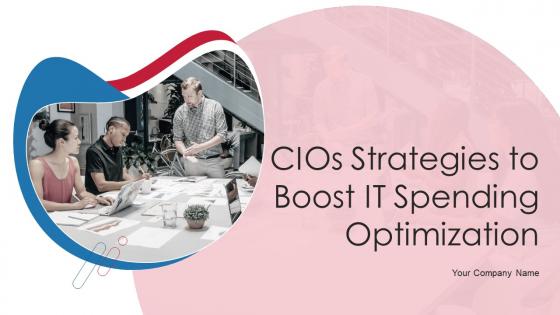
Slide 1: This slide introduces CIOs Strategies to Boost IT Spending Optimization. State Your Company Name and begin.
Slide 2: This slide states Agenda of the presentation.
Slide 3: This slide presents Table of Content for the presentation.
Slide 4: This is another slide continuing Table of Content for the presentation.
Slide 5: This slide shows title for topics that are to be covered next in the template.
Slide 6: This slide displays Addressing Present Challenges Faced by IT Department.
Slide 7: This slide represents Determine Overall IT Cost Breakdown and Overspend Assessment.
Slide 8: This slide showcases Comparative Assessment of IT Service Management at Present.
Slide 9: This slide provides information regarding IT staff performance measurement in terms of cost.
Slide 10: This slide shows title for topics that are to be covered next in the template.
Slide 11: This slide presents Key Statistics Related to Strategic IT Cost Optimization Initiatives.
Slide 12: This slide displays Determine Short Term Cost Reduction vs. Strategic IT Cost Optimization.
Slide 13: This slide represents Addressing Cost Cutting Initiative vs. Strategic IT Cost Optimization.
Slide 14: This slide shows title for topics that are to be covered next in the template.
Slide 15: This slide provides information regarding strategic IT cost optimization framework.
Slide 16: This slide showcases Different Stages Involved in Strategic IT Cost Optimization Framework.
Slide 17: This is another slide continuing Different Stages Associated to Strategic IT Cost Optimization Framework.
Slide 18: This slide presents Key Levers Associated to IT Cost Optimization Framework.
Slide 19: This slide displays Essential Principles Associated to IT Cost Optimization.
Slide 20: This slide shows title for topics that are to be covered next in the template.
Slide 21: This slide presents Addressing CIOs Roadmap for Strategic IT Cost Optimization.
Slide 22: This slide provides information regarding IT cost optimization prioritization model in order to assess score on various parameters.
Slide 23: This slide displays Three Step Approach for Strategic IT Cost Optimization.
Slide 24: This slide shows title for topics that are to be covered next in the template.
Slide 25: This slide provides information regarding critical IT budgeting measures checklist.
Slide 26: This slide represents key IT cost optimization initiatives such as application portfolio, infrastructure rationalization, etc.
Slide 27: This is another slide continuing Addressing Key IT Cost Optimization Initiatives.
Slide 28: This slide provides information regarding effective IT cost optimization strategies for CIOs.
Slide 29: This is another slide continuing Effective IT Cost Optimization Strategies for CIOs.
Slide 30: This slide shows title for topics that are to be covered next in the template.
Slide 31: This slide presents Addressing Dimensions for Digitally Advanced Infrastructure.
Slide 32: This is another slide continuing Addressing Dimensions for Digitally Advanced Infrastructure.
Slide 33: This slide displays Addressing Infrastructure Provisioning for IT Systems Automation.
Slide 34: This is another slide continuing Addressing Infrastructure Provisioning in IT Systems Automation.
Slide 35: This slide represents Addressing Hyperconverged Infrastructure for Data Centre Management.
Slide 36: This slide shows title for topics that are to be covered next in the template.
Slide 37: This slide provides information regarding CIOs initiative to rationalize application in order to reduce overall IT costs.
Slide 38: This slide showcases CIOs Initiative 2 – Cloud Management to Optimize Spend and Costs.
Slide 39: This is another slide continuing CIOs Initiative 2 – Cloud Management to Optimize Spend and Costs.
Slide 40: This slide presents CIOs Initiative 3 – Deploying Virtualization and Containerization Technologies.
Slide 41: This slide provides information regarding cost benefits associated to containerization technology.
Slide 42: This slide displays CIOs Initiative 4 – Deploying Artificial Intelligence in IT Operations to Reduce Cost.
Slide 43: This slide represents CIOs Initiative 5 – Enabling Project Portfolio Management.
Slide 44: This slide provides information regarding customer centric transformation initiative.
Slide 45: This slide showcases assessment of technology vendors in order to select potential vendor by assessing them.
Slide 46: This slide shows CIOs Initiative 8 – Outsourcing Managed Service Providers to Reduce Overall Costs.
Slide 47: This slide provides information regarding implementation of IT risk management framework.
Slide 48: This slide shows title for topics that are to be covered next in the template.
Slide 49: This slide displays Key People Involved in Strategic IT Cost Optimization Cross Functional Team.
Slide 50: This slide represents Role of Management in Effective Information Security Governance.
Slide 51: This slide provides information regarding cross functional IT team training as employees.
Slide 52: This slide shows title for topics that are to be covered next in the template.
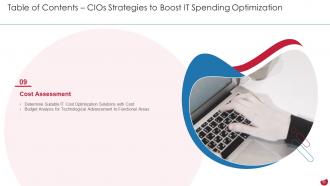
Slide 53: This slide presents Determine Suitable IT Cost Optimization Solutions with Cost.
Slide 54: This slide displays Budget Analysis for Technological Advancement to Functional Areas.
Slide 55: This slide shows title for topics that are to be covered next in the template.
Slide 56: This slide represents Impact of Effective CIOs Strategic IT Cost Optimization Initiatives Implementation.
Slide 57: This slide shows title for topics that are to be covered next in the template.
Slide 58: This slide provides information regarding IT spending management dashboard for tracking parameters.
Slide 59: This slide displays Determine IT Department Cost Management Dashboard.
Slide 60: This slide represents Determine IT Project Portfolio Management Tracking Dashboard.
Slide 61: This slide displays Icons for CIOs Strategies to Boost IT Spending Optimization.
Slide 62: This slide is titled as Additional Slides for moving forward.
Slide 63: This is Our Mission slide with related imagery and text.
Slide 64: This is Our Team slide with names and designation.
Slide 65: This is About Us slide to show company specifications etc.
Slide 66: This is a Timeline slide. Show data related to time intervals here.
Slide 67: This slide contains Puzzle with related icons and text.
Slide 68: This slide provides 30 60 90 Days Plan with text boxes.
Slide 69: This slide shows Post It Notes. Post your important notes here.
Slide 70: This slide presents Roadmap with additional textboxes.
Slide 71: This slide presents Bar chart with two products comparison.
Slide 72: This is a Thank You slide with address, contact numbers and email address.
CIOs Strategies To Boost IT Spending Optimization Powerpoint Presentation Slides with all 77 slides:
Use our CIOs Strategies To Boost IT Spending Optimization Powerpoint Presentation Slides to effectively help you save your valuable time. They are readymade to fit into any presentation structure.









FAQs for CIOs Strategies To Boost IT Spending Optimization
CIOs should evaluate IT spending effectiveness through key metrics including ROI on technology investments, cost per user or transaction, system uptime and performance benchmarks, business process efficiency gains, and alignment with strategic objectives. These metrics enable organizations to identify underperforming investments, optimize resource allocation, and demonstrate technology's direct contribution to operational efficiency, with many finding that balanced scorecards combining financial and operational measures deliver the clearest insights into IT value creation.
CIOs can align IT spending with business goals through strategic budget allocation, cross-departmental collaboration, performance metrics tracking, and regular stakeholder engagement sessions. These approaches streamline resource allocation by connecting technology investments directly to revenue objectives, operational efficiency targets, and customer experience improvements, with many organizations finding that this alignment delivers measurable ROI and sustainable competitive advantage.
Cloud computing optimizes IT expenditures by eliminating upfront infrastructure costs, reducing maintenance expenses, and enabling scalable resource allocation based on actual usage. Through cloud migration, organizations achieve 20-30% cost reductions while enhancing operational flexibility, with many financial services and healthcare institutions finding that pay-per-use models significantly streamline budget forecasting and resource management.
CIOs can leverage data analytics to identify cost reduction opportunities by analyzing usage patterns, performance metrics, license utilization, infrastructure efficiency, and vendor spending trends across their technology portfolio. Through predictive analytics and real-time monitoring, organizations streamline resource allocation, eliminate redundant systems, and optimize cloud spending, with many enterprises finding that data-driven insights deliver 15-30% cost savings while enhancing operational efficiency.
Best practices for negotiating vendor contracts include establishing clear performance metrics, securing volume discounts, implementing flexible scaling terms, negotiating favorable payment schedules, and building in regular review periods. Through strategic contract structuring, organizations streamline costs while maintaining service quality, with many CIOs finding that multi-year agreements with performance guarantees deliver significant savings and operational predictability.
Organizations can balance technology investments by implementing phased modernization strategies, establishing clear ROI thresholds for new initiatives, and strategically integrating legacy systems with modern platforms through APIs and middleware solutions. Many financial institutions and healthcare organizations find that allocating 60-70% of IT budgets to maintenance while dedicating remaining resources to innovation delivers optimal operational stability and competitive advancement.
CIOs should implement centralized cost allocation systems, standardized reporting dashboards, cross-departmental budget reviews, automated expense tracking tools, and regular ROI assessments to ensure comprehensive IT spend transparency. These strategies streamline financial visibility by enabling real-time cost monitoring, departmental accountability, and data-driven decision making, with many organizations finding that transparent spending processes ultimately reduce costs while enhancing strategic technology investments.
CIOs can assess technology investment ROI through comprehensive metrics analysis, including productivity gains, cost reduction measurements, revenue impact tracking, operational efficiency improvements, and customer satisfaction scores. Through balanced scorecards and performance dashboards, organizations streamline budget allocation decisions, enhance strategic planning accuracy, and minimize investment risks, with many enterprises finding that systematic ROI evaluation ultimately delivers better resource prioritization and competitive advantage.
CIOs can reduce operational costs through cloud migration, automation of routine processes, strategic vendor consolidation, implementation of zero-based budgeting, and adoption of as-a-service models. These approaches streamline resource allocation while enhancing service delivery, with many organizations finding that combining intelligent automation with cloud-native solutions ultimately delivers 20-30% cost reductions and improved operational efficiency.
CIOs should adopt a risk-based budgeting approach that allocates resources across threat detection, prevention, response capabilities, and staff training, while maintaining flexibility for emerging threats. This strategic combination enables organizations to balance proactive security investments with adaptive funding reserves, with many enterprises finding that integrating cybersecurity costs into overall digital transformation budgets delivers better protection and operational efficiency.
CIOs should evaluate energy-efficient infrastructure, cloud migration strategies, sustainable vendor partnerships, circular economy practices for hardware lifecycle management, and carbon footprint reduction initiatives when planning environmentally conscious IT spending. These considerations enable organizations to achieve operational cost savings, meet corporate sustainability goals, and enhance brand reputation, while many companies in manufacturing, retail, and financial services find that green IT investments ultimately deliver both environmental benefits and competitive advantages.
Cross-departmental collaboration enhances IT spending effectiveness by aligning technology investments with actual business needs, eliminating duplicate solutions, and creating shared accountability for outcomes. Through regular communication between IT, finance, operations, and business units, organizations streamline resource allocation, reduce redundant purchases, and ensure technology solutions deliver measurable value across multiple departments simultaneously.
CIOs can leverage strategic outsourcing to optimize IT resources through selective vendor partnerships, cloud migration services, managed infrastructure solutions, and specialized expertise acquisition. This approach enables organizations to reduce operational costs, access cutting-edge technologies, and reallocate internal resources toward core business initiatives, while maintaining service quality and scalability in an increasingly competitive landscape.
CIOs should monitor cloud computing evolution, artificial intelligence and machine learning adoption, cybersecurity advancements, edge computing expansion, and automation technologies to predict budget shifts. These trends significantly impact infrastructure investments, operational costs, and resource allocation, with many organizations finding that early adoption of emerging technologies like AI-driven analytics and zero-trust security frameworks delivers competitive advantages while optimizing long-term spending efficiency.
CIOs can foster cost-consciousness by implementing transparent budget sharing, establishing cost-benefit analysis requirements for new projects, creating cross-functional teams that include finance perspectives, and instituting regular spending reviews with clear accountability metrics. These approaches enable IT teams to understand financial impacts while making informed decisions, with many organizations finding that empowering teams with budget visibility and decision-making authority ultimately delivers both operational efficiency and strategic cost optimization.
-
They saved me a lot of time because they had exactly what I was looking for. Couldn’t be happier!
-
I can say with full confidence that all your business, academic, or professional work requirements will be sufficed with SlideTeam. Their gallery is as rich as 2Million+!!