


Clinical Trials Phases With Discovery Science Clinical Research Trial Stages




Try Before you Buy Download Free Sample Product
 Impress Your
 Audience
 100%
100% Editable
 Save Hours
 of Time


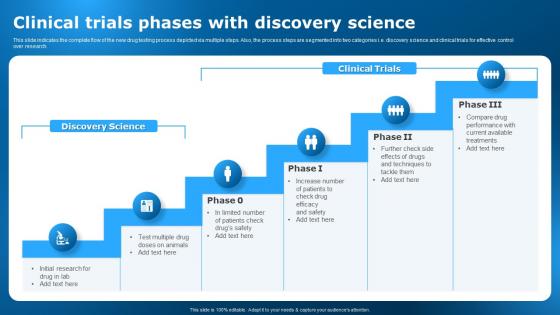
This slide indicates the complete flow of the new drug testing process depicted via multiple steps. Also, the process steps are segmented into two categories i.e. discovery science and clinical trials for effective control over research.
People who downloaded this PowerPoint presentation also viewed the following :
Clinical Trials Phases With Discovery Science Clinical Research Trial Stages with all 6 slides:
Use our Clinical Trials Phases With Discovery Science Clinical Research Trial Stages to effectively help you save your valuable time. They are readymade to fit into any presentation structure.





FAQs for Clinical Trials Phases With Discovery Science Clinical
Phase I focuses on safety, dosage determination, and side effect identification in small patient groups, while Phase II evaluates effectiveness and further safety in larger populations. Phase III compares new treatments against standard care through large-scale studies, and Phase IV monitors long-term effects post-market approval, with pharmaceutical companies and research institutions finding that this systematic progression ultimately delivers safer therapies and regulatory compliance.
Eligibility criteria become progressively broader as trials advance through phases, with Phase I focusing on healthy volunteers or patients with specific conditions, Phase II targeting patients with the target disease, and Phase III including diverse patient populations. These expanding criteria enable researchers to evaluate safety profiles, dosage effectiveness, and real-world applicability across different demographics, ultimately delivering more comprehensive data for regulatory approval.
The Institutional Review Board evaluates and monitors clinical trial protocols across all phases, ensuring participant safety, informed consent adequacy, and ethical compliance throughout the research process. IRBs conduct initial protocol reviews before trial initiation, ongoing safety monitoring during Phase I-III studies, and adverse event assessments, with many research institutions finding that robust IRB oversight streamlines regulatory approvals while maintaining participant protection standards.
Patient safety is ensured through rigorous protocols, independent ethics committees, informed consent processes, continuous monitoring, and predefined stopping rules across all phases. These safeguards work by establishing clear eligibility criteria, regular safety assessments, and real-time data review, with many pharmaceutical companies and research institutions finding that this multi-layered approach ultimately delivers both participant protection and reliable clinical outcomes.
Phase I trials primarily use descriptive statistics and dose-escalation methods like the 3+3 design to assess safety profiles. Phase II employs response rate analysis, survival curves, and Simon's two-stage design to evaluate preliminary efficacy, while Phase III utilizes sophisticated statistical approaches including randomized controlled comparisons, intention-to-treat analysis, and survival analysis, ultimately delivering the robust evidence regulatory agencies require for drug approvals.
Researchers determine sample sizes through statistical power calculations, safety requirements, and regulatory guidelines, with Phase I typically enrolling 20-100 participants for safety assessment, Phase II requiring 100-300 for efficacy signals, and Phase III needing 300-3,000 for definitive results. These calculations balance patient safety, statistical validity, and resource efficiency, with pharmaceutical companies increasingly using adaptive trial designs and biostatistical modeling to optimize enrollment while ensuring regulatory compliance and meaningful outcomes.
**INPUT**: What challenges do sponsors face when transitioning from one phase of clinical trials to the next? **OUTPUT**: Sponsors encounter regulatory compliance shifts, evolving data requirements, scaling operational complexity, patient recruitment difficulties, and increased financial commitments when transitioning between phases. These challenges streamline through strategic planning and adaptive protocols, with pharmaceutical companies finding that early preparation for regulatory submissions, enhanced data management systems, and robust patient engagement strategies ultimately deliver smoother transitions and competitive advantage. [Word count: 59 words]
Regulatory requirements intensify progressively through clinical trial phases, with Phase I requiring basic safety protocols and informed consent, Phase II demanding efficacy endpoints and expanded safety monitoring, and Phase III necessitating comprehensive regulatory submissions, international compliance standards, and rigorous data management systems. These escalating requirements ensure patient safety while building the robust evidence base needed for market approval, with many pharmaceutical companies finding that early regulatory engagement streamlines later-phase approvals.
Placebo-controlled trials in Phase III studies provide the gold standard for demonstrating true drug efficacy by eliminating bias and psychological effects that could skew results. These rigorous comparisons enable pharmaceutical companies to generate definitive evidence for regulatory approval, with many finding that blinded placebo controls significantly strengthen their submissions to agencies like FDA and EMA, ultimately accelerating market access.
Endorsements from previous phases significantly influence subsequent trial design by informing dosage protocols, patient selection criteria, safety monitoring requirements, and endpoint measurements based on demonstrated efficacy and adverse events. These insights enable researchers to refine study parameters, optimize resource allocation, and enhance protocol feasibility, with many pharmaceutical companies finding that leveraging phase-specific data ultimately accelerates development timelines while minimizing regulatory risks.
Common reasons for clinical trial termination include insufficient patient enrollment, safety concerns, lack of efficacy, regulatory issues, and funding constraints. These challenges particularly impact Phase II and III studies, where larger patient populations and extended timelines increase operational complexity, with many pharmaceutical companies finding that early endpoint evaluation and adaptive trial designs help minimize costly late-stage failures.
Patient recruitment differs significantly across phases, with Phase I focusing on small groups of healthy volunteers or specific patient populations, Phase II targeting larger cohorts with the studied condition, and Phase III requiring thousands of diverse participants across multiple sites. Each phase presents unique challenges, with early phases emphasizing safety monitoring and later phases prioritizing statistical power, ultimately requiring increasingly sophisticated recruitment strategies and broader geographical reach.
Phase II trials measure success through response rates, progression-free survival, overall survival, safety profiles, and biomarker changes. These metrics enable pharmaceutical companies to evaluate treatment efficacy across oncology, cardiology, and neurology studies, while assessing patient tolerability and optimal dosing, ultimately determining whether promising therapies advance to Phase III trials.
Adverse events are reported through standardized protocols involving immediate documentation, regulatory notifications, and continuous safety monitoring by Data Safety Monitoring Boards. Throughout all phases, researchers use electronic data capture systems, real-time safety databases, and risk-benefit assessments, with pharmaceutical companies and hospitals finding that proactive adverse event management ultimately streamlines regulatory approvals while enhancing patient safety and trial integrity.
**INPUT**: What innovations are currently shaping the landscape of clinical trials in the early phases? **OUTPUT**: Early-phase clinical trial innovations include adaptive trial designs, AI-powered patient matching, digital biomarkers, virtual trial platforms, and precision medicine approaches. These technologies streamline participant recruitment, enhance data collection through wearable devices, and enable real-time protocol modifications, with pharmaceutical companies finding that virtual elements reduce costs by up to 30% while accelerating drug development timelines significantly. **Word count: 58 words**
-
Easy to use and customize templates. Helped me give a last minute presentation.
-
I took a chance with SlideTeam. I never looked back. Great products and great service.