

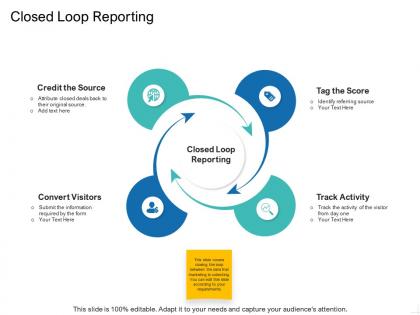
Closed loop reporting ppt powerpoint presentation file styles




Try Before you Buy Download Free Sample Product
 Impress Your
 Audience
 100%
100% Editable
 Save Hours
 of Time


Our Closed Loop Reporting Ppt Powerpoint Presentation File Styles are topically designed to provide an attractive backdrop to any subject. Use them to look like a presentation pro.
People who downloaded this PowerPoint presentation also viewed the following :
Closed loop reporting ppt powerpoint presentation file styles with all 2 slides:
Use our Closed Loop Reporting Ppt Powerpoint Presentation File Styles to effectively help you save your valuable time. They are readymade to fit into any presentation structure.
FAQs for Closed loop reporting ppt powerpoint
Honestly, the game-changer is finally seeing if your decisions actually work instead of just hoping for the best. No more throwing reports out there and wondering what happened to them. When something's not working, you'll catch it right away rather than finding out months later like "oh great, that was a waste." Everyone stays on the same page too - marketing and sales can actually see the same data instead of living in completely separate worlds. I'd say pick one metric that really matters to you first, then expand from there. Trust me, your decisions will feel way less like guesswork once you can see the results in real time.
Oh this is actually really useful stuff! So closed loop reporting connects your marketing straight to actual sales numbers. You'll see which campaigns bring in real money instead of just random clicks. It follows people from their first visit all the way to buying something - honestly wish more companies did this properly. The whole point is getting actual ROI data instead of guessing what works. You can spot trends too, like which lead sources convert better or how long sales actually take. Just make sure your CRM talks to your marketing tools or the data gets messy between teams.
So closed loop reporting is basically tracking what happens after someone sees your marketing - like did they actually buy or just bounce? Your CRM gets way more useful when you know which campaigns turned into real customers, not just website visits. Sales teams love this because they can see what messaging actually worked. You can segment people based on what converts (not just demographics or whatever) and personalize your follow-ups better. Honestly, most companies waste so much time on stuff that looks good on paper but doesn't close deals. Try tracking just one campaign from start to finish - you'll be surprised what you learn.
CRM's the obvious big one, plus your marketing automation and web analytics. Sales activity data too - calls, meetings, how deals move through the pipeline. That sales data is honestly such a pain to keep clean but it'll make or break everything. Oh and email engagement metrics, lead scoring, all that stuff. The real trick is getting these systems to actually talk to each other properly. I'd start by checking what integrations you've already got running - might be surprised what's already connected.
Honestly, data accuracy is such a pain but here's what actually works. Get everyone using the same collection methods - no freelancing allowed. Monthly audits will save your sanity, trust me on this one. Your CRM and marketing tools need to talk to each other properly or you'll hate your life. Set up alerts for weird data spikes because catching problems early beats fixing disasters later. Someone has to own this mess though - make one person responsible for quality checks. Oh, and train people on entering stuff correctly from day one.
Honestly, you can't do closed loop reporting at scale without good tech - it's just impossible. Automated data collection grabs feedback from everywhere, then analytics platforms crunch the numbers fast. Integration tools are clutch for connecting your systems so everything flows without you babysitting it. Manual spreadsheets? Hard pass on that chaos. Real-time dashboards and automated alerts are where things get interesting - you'll spot trends as they happen instead of weeks later. Oh, and definitely map out what data sources you have first. Then figure out which connections you can automate.
Good news - it connects through APIs to whatever analytics you're already using. Google Analytics, Adobe, Tableau, they all work fine. I was surprised how smooth the setup was tbh. Just don't try to do everything at once or you'll get messy data. Pick one channel first and test it out. The trickier part is making sure your attribution doesn't double-count conversions when you add all these new touchpoints. But honestly? Once you see that full customer journey mapped out, it's pretty cool. Way better than guessing which campaigns actually work.
Yeah, it works in tons of places! Healthcare tracks patients from symptoms all the way to recovery. Manufacturing does it too - they trace defective products back to whatever went wrong in production, which honestly makes so much sense. Schools use it to figure out if their teaching methods are actually working. HR departments track whether their hiring strategies lead to people sticking around longer. You just need solid data at the start and end of whatever process you're measuring. Maybe pick one thing your team does and work backwards from the final outcome? That's usually the easiest way to start.
Ugh, data silos are the worst - your marketing and sales tools never play nice together, so good luck tracking anything from lead to actual money. Sales reps are terrible at updating stuff too. Marketing forgets to loop back with feedback. It's honestly chaos most of the time! Multi-channel attribution will make you want to pull your hair out. Oh, and don't try to track everything at once - that's a recipe for disaster. Pick one simple metric first, nail that down, then slowly add more. Trust me on this one.
So basically, closed loop reporting stops tasks from just vanishing into thin air. People have to actually report back on what they're doing and how it turned out. Nobody wants to be that guy constantly showing up with red status updates, you know? The visibility thing really works - suddenly everyone's way more careful about following through. I'd honestly start small though. Pick one area where stuff always gets dropped and add some mandatory check-ins. It's like having a built-in nagging system that actually tracks everything from start to finish. Works better than you'd think!
First thing - figure out what you're actually measuring before you do anything else. You can't fix what you don't track. Automate the data collection wherever you can because manual stuff always gets forgotten (learned this the hard way lol). Make sure feedback goes to people who can actually DO something about it, not some VP who'll just nod and forget. Monthly or quarterly reviews work best - depends on your company's pace. Oh, and definitely test everything with a small group first. You'll catch weird gaps that way before rolling it out to everyone and looking like an idiot.
So basically closed loop reporting creates this perfect audit trail that regulators absolutely love. It tracks everything from your initial data collection all the way to final outcomes and what you actually did about it. You can show that problems got flagged, escalated the right way, and genuinely fixed - not just ignored (happens more than you'd think, honestly). The cool part? It automatically documents who decided what and when. So when auditors show up, you're not frantically digging through random emails trying to figure out what the hell happened six months ago. Just make sure you set it up to hit those key compliance checkpoints from the start.
Pick metrics that actually connect marketing and sales - lead quality scores, conversion rates by source, time-to-close by channel. Revenue attribution matters, but pipeline velocity usually shows what's really working. Cost per qualified lead and customer lifetime value by source are huge since they directly hit your budget calls. Honestly, I'd rather track fewer things well than spread too thin. Both teams need to be able to act on the data, not just look at pretty dashboards. Start with maybe 3-5 core ones and build from there.
So basically you get real-time data on how your resources are actually doing instead of waiting around for quarterly reports. Pretty huge difference honestly. You can see which projects are crushing it and which ones are just burning through budget and people. Then you shift things around fast when you spot opportunities. First thing - figure out what metrics actually matter to you, then set up some dashboards that update automatically. It's kinda like having GPS for resource decisions instead of just winging it and hoping for the best. Game changer for ROI tracking too.
Honestly, attribution platforms with AI are crushing it right now - they track your whole customer journey and feed everything back to your channels automatically. Predictive analytics are wild too, they'll tell you which leads will close before your sales team even calls them. The CDP market is nuts, new companies popping up everywhere (though I still think the ones that play nice with your existing CRM are the real winners). Oh, and here's something most people miss - audit what data you're already collecting first. You might already have everything you need just sitting there unused.
-
Excellent design and quick turnaround.