


Cloud governance policies monitoring audit cost benefit analysis




Try Before you Buy Download Free Sample Product
 Impress Your
 Audience
 100%
100% Editable
 Save Hours
 of Time


Bolster your company's image. Cloud Governance Policies Monitoring Audit Cost Benefit Analysis are a fast affordable way to lend high design to your business presentations.
People who downloaded this PowerPoint presentation also viewed the following :
Content of this Powerpoint Presentation
Description:
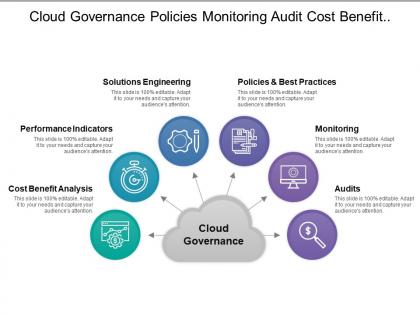
The image is of a PowerPoint slide titled "Cloud Governance Policies Monitoring Audit Cost Benefit," which likely outlines the key components of managing cloud services in an organization. The slide is divided into five interconnected areas, suggesting a comprehensive approach to cloud governance:
1. Solutions Engineering:
This area may focus on designing solutions that align with cloud governance policies and best practices.
2. Policies & Best Practices:
This likely refers to the establishment of rules and guidelines for cloud usage within the organization.
3. Monitoring:
This involves the ongoing oversight of cloud services to ensure compliance with established policies and the effective performance of cloud solutions.
4. Audits:
This step is about conducting regular reviews and inspections to verify compliance with cloud governance policies and to identify any issues or opportunities for improvement.
5. Cost Benefit Analysis:
This is an assessment to evaluate the financial impacts of cloud services, ensuring that the benefits outweigh the costs.
Each area is accompanied by an icon, visually representing the concept, and a note that the slide is "100% editable."
Use Cases:
This type of slide can be used across various industries for different purposes:
1. Financial Services:
Use: Managing cloud-based financial applications and data.
Presenter: IT Compliance Officer
Audience: Financial analysts, risk management teams
2. Healthcare:
Use: Overseeing patient data storage and applications in the cloud.
Presenter: Health Informatics Director
Audience: Healthcare administrators, IT security staff
3. Education:
Use: Governing cloud services for online learning platforms.
Presenter: Chief Information Officer
Audience: Educational technologists, academic staff
4. Retail:
Use: Monitoring cloud-based inventory and sales systems.
Presenter: E-commerce Manager
Audience: Retail operations teams, data analysts
5. Manufacturing:
Use: Ensuring cloud platforms for supply chain and production are efficient and secure.
Presenter: Operations Director
Audience: Supply chain managers, IT specialists
6. Government:
Use: Auditing cloud services for public sector data and service delivery.
Presenter: Digital Transformation Lead
Audience: Government officials, public service managers
7. Telecommunications:
Use: Administering cloud infrastructure and services for telecom.
Presenter: Network Operations Manager
Audience: Network engineers, service delivery teams
Cloud governance policies monitoring audit cost benefit analysis with all 5 slides:
Introduce folks in a friendly environment with our Cloud Governance Policies Monitoring Audit Cost Benefit Analysis. It becomes a joy to bond.



FAQs for Cloud governance policies monitoring audit
Key components of an effective cloud governance framework include security policies, cost management controls, compliance protocols, resource allocation guidelines, and performance monitoring systems. These elements work together by establishing clear oversight structures, automating policy enforcement, and enabling real-time visibility across cloud environments, with many organizations finding that comprehensive frameworks reduce operational risks while accelerating digital transformation initiatives.
Organizations ensure cloud compliance through comprehensive governance frameworks, continuous monitoring systems, automated compliance tools, data classification protocols, and regular auditing processes. These strategies enable businesses to maintain regulatory adherence across industries like healthcare and finance, while cloud providers increasingly offer built-in compliance features, ultimately delivering operational efficiency and reduced compliance risks.
Risk management serves as the foundation of cloud governance strategies by identifying security vulnerabilities, ensuring regulatory compliance, monitoring data protection protocols, and establishing incident response frameworks. Through comprehensive risk assessments and automated monitoring tools, organizations can proactively address threats while maintaining operational efficiency, with many financial services and healthcare institutions finding that structured risk management ultimately delivers enhanced security posture and regulatory confidence.
Organizations should approach cloud resource management through automated policy enforcement, role-based access controls, continuous monitoring, resource tagging strategies, and cost optimization frameworks. These governance mechanisms streamline compliance by establishing clear ownership boundaries, tracking resource utilization patterns, and implementing automated alerts, with many enterprises finding that structured governance ultimately delivers reduced operational costs, enhanced security posture, and improved regulatory compliance across multi-cloud environments.
Cloud governance identity and access management best practices include implementing zero-trust architecture, enforcing multi-factor authentication, establishing role-based access controls, conducting regular access audits, and maintaining centralized identity directories. These security frameworks streamline user verification while minimizing unauthorized access risks, with financial services and healthcare organizations finding that comprehensive IAM policies ultimately deliver enhanced compliance and operational efficiency.
Automation enhances cloud governance processes by streamlining compliance monitoring, enforcing security policies automatically, and reducing manual oversight requirements across distributed environments. Through automated tools, organizations can maintain consistent resource allocation, detect policy violations in real-time, and ensure regulatory adherence, while significantly reducing operational costs and human error rates.
Organizations should track cost optimization metrics, security compliance scores, resource utilization rates, policy adherence percentages, and incident response times to measure cloud governance effectiveness. These metrics enable businesses to identify cost savings opportunities, maintain regulatory compliance, and optimize resource allocation, with many enterprises finding that comprehensive tracking delivers improved operational efficiency and reduced cloud spending across departments.
Multi-cloud environments complicate governance by creating fragmented security policies, inconsistent compliance frameworks, varied cost structures, and complex data management across different platforms. Organizations can mitigate these challenges through centralized governance dashboards, standardized security protocols, automated compliance monitoring, and unified identity management systems, with many financial services and healthcare institutions finding that strategic orchestration tools ultimately deliver enhanced operational efficiency and reduced regulatory risks.
Enterprise cloud governance tools include cloud management platforms like AWS Control Tower and Azure Policy, security solutions such as Cloud Security Posture Management (CSPM), identity access management systems, cost optimization tools, and compliance automation platforms. These technologies streamline governance by automating policy enforcement, monitoring resource usage, and ensuring regulatory compliance, with many organizations finding that integrated governance suites deliver enhanced visibility and control across multi-cloud environments.
Aligning cloud governance policies with organizational goals requires establishing clear frameworks that connect cloud initiatives to business outcomes, regulatory requirements, and strategic priorities. Organizations achieve this alignment by conducting regular stakeholder assessments, implementing automated compliance monitoring, and creating cross-functional governance committees, ultimately ensuring cloud investments deliver measurable value while maintaining operational efficiency and risk management standards.
Common pitfalls include inadequate access controls, inconsistent policy enforcement, poor cost monitoring, lack of compliance frameworks, and insufficient data governance protocols. These oversights can lead to security vulnerabilities, budget overruns, and regulatory violations, with many organizations finding that proactive governance strategies ultimately deliver enhanced operational efficiency and reduced risk exposure.
Organizations effectively train staff on cloud governance through comprehensive onboarding programs, hands-on workshops, role-specific certifications, regular policy updates, and practical simulations of real-world scenarios. These training approaches enhance compliance understanding, streamline policy implementation, and minimize security risks, with many enterprises finding that structured governance education ultimately delivers improved operational efficiency and stronger regulatory adherence across departments.
Data classification is fundamental to cloud governance frameworks, establishing security protocols, compliance requirements, access controls, and risk management strategies based on data sensitivity and business criticality. Through systematic classification, organizations streamline regulatory adherence, enhance data protection measures, and optimize resource allocation, with many financial services and healthcare institutions finding that structured classification ultimately delivers improved operational efficiency and reduced compliance costs.
Organizations should handle data residency and sovereignty by implementing geographically distributed cloud architectures, establishing clear data classification frameworks, and maintaining compliance with regional regulations like GDPR and local privacy laws. Through strategic multi-cloud deployments, financial services, healthcare institutions, and government agencies can ensure data remains within required jurisdictions while leveraging automated compliance monitoring, ultimately delivering regulatory adherence and operational flexibility.
Stakeholder engagement ensures cloud governance strategies address diverse organizational needs, from IT security requirements to business operational goals, compliance mandates, and user experience expectations. Through collaborative input from executives, IT teams, compliance officers, and end-users, organizations develop comprehensive frameworks that balance innovation with risk management, ultimately delivering sustainable cloud adoption and strategic alignment.
-
Good research work and creative work done on every template.
-
Very unique and reliable designs.