


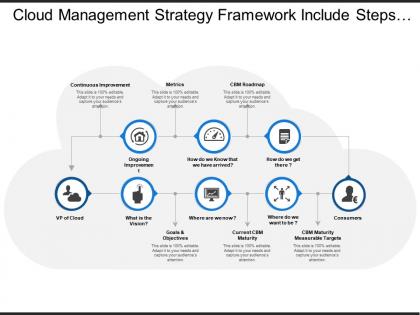
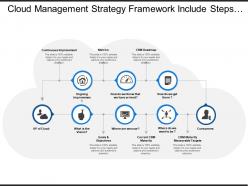
Cloud management strategy framework include steps for continuous improvement




Try Before you Buy Download Free Sample Product
 Impress Your
 Audience
 100%
100% Editable
 Save Hours
 of Time


Halt any downfall before it effects. Our Cloud Management Strategy Framework Include Steps For Continuous Improvement help nip it in the bud.
People who downloaded this PowerPoint presentation also viewed the following :
Cloud management strategy framework include steps for continuous improvement with all 5 slides:
Identify the cause of deterioration with our Cloud Management Strategy Framework Include Steps For Continuous Improvement. Initiate action to end the decline.



FAQs for Cloud management strategy framework include steps
So you'll need four main things: governance, cost management, security, and automation. Governance sets your policies and compliance stuff. Cost management tracks what you're spending and optimizes resources. Security is identity management, access controls, monitoring - honestly this is where most people screw up at first. Automation handles your deployments and scaling. Oh, and you'll want centralized monitoring to track performance everywhere. I'd tackle governance and security first since they're your foundation. The cost and automation parts can come later as you grow your setup.
So basically, these cloud management tools watch all your stuff automatically and tell you when you're wasting money. They'll scale things up when you need more power, then back down when you don't. Plus they catch those random resources you forgot about that are just sitting there costing you cash. The smart ones even learn your patterns and suggest fixes before problems hit. You can set spending limits, resize instances that are too big, and schedule non-critical stuff for cheaper times. Honestly, most people see like 20-30% savings pretty quick just from cutting the fat.
Honestly, start small with just one workload and nail down your governance structure first. Cloud bills will absolutely destroy your budget if you don't set up cost controls early - learned that one the hard way. Automate your security compliance from the beginning because retrofitting it later is such a pain. Create solid tagging strategies so you can actually find your stuff later. Once you've got that framework working smoothly, then roll it out to other teams. The deployment process standardization part sounds boring but it'll save you tons of headaches down the road.
Look, security can't just be an add-on - it has to be built into every piece of your cloud setup from day one. Map out where your current gaps are first (saves you tons of headaches later). Then weave security controls through identity management, data policies, network access, the whole thing. Automate what you can and set up continuous monitoring. Most teams think one firewall at the front door is enough, but you really need checkpoints everywhere. It's like... having multiple locks instead of just trusting that front gate, you know?
So basically, these frameworks give you one dashboard to control all your cloud stuff - AWS, Azure, whatever you're using. Monitoring and cost tracking all happens in one place, which is honestly a lifesaver when you're juggling multiple platforms. The orchestration part is pretty sweet too - deploy apps wherever without rebuilding your whole process each time. Oh, and governance policies stay consistent across everything. My advice? Map out what clouds you're actually running first (not just what you think you're using), then find a framework that plays nice with those specific ones. Way less headache than the alternative.
So you gotta measure both the techy stuff and business impact to see if your framework's actually doing anything. Cost savings are obvious - is your cloud bill going down? Then look at ops stuff like faster deployments and fewer fires to put out. Don't forget governance compliance rates and security metrics (policy violations, access control, all that). Honestly every company defines "success" differently which makes this fun, right? Grab your baseline numbers first, then check in quarterly. My advice? Pick like 3-5 metrics max instead of trying to track everything - you'll just overwhelm yourself. Focus on whatever your stakeholders actually care about.
So automation basically runs everything in cloud management now. It handles provisioning, scaling, monitoring, backups - all that tedious stuff you'd hate doing by hand. Tools like Terraform and Ansible let you set policies and everything just runs automatically. Honestly, managing cloud resources manually is pretty painful once you've experienced automation. My advice? Pick whatever manual task annoys you most and automate that first. You'll probably wonder why you waited so long. The time savings are actually insane.
So these Cloud Management Frameworks are pretty clutch for compliance stuff. They'll watch your cloud resources 24/7 and catch violations before auditors even show up - which honestly saves you from those awkward conversations. You get automatic reports for SOC 2, HIPAA, whatever regulations you're dealing with. Plus they keep all your audit trails organized (thank god). The cool part? You can set it to auto-fix common issues too. Just make sure you configure it right from the start with your industry's specific requirements. Map out your regulations first, then use their policy templates to speed things up.
Honestly, the biggest pain point is usually people just not wanting to change. Your team will dig in their heels if they're used to how things work now. Tech integration gets really messy too - trying to connect old systems with new stuff is a nightmare. Costs are impossible to predict during the switch, which finance will hate. Oh, and governance is where most companies totally crash and burn. Getting everyone on the same page about who does what and compliance stuff? Takes forever. Definitely try a small pilot first instead of going all-in right away.
Think of it as getting everyone on the same page finally. Both IT and business teams look at identical dashboards and metrics instead of arguing past each other. You'll have one clear view of costs, performance, and what resources you're actually using. The whole "tech people speak gibberish, business people only care about dollars" thing gets way better (okay, it still happens sometimes). Requesting resources becomes standardized. So does tracking spending and measuring results. Decisions happen faster since there's less confusion about what's going on in your cloud setup. Honestly, just pick some KPIs both teams actually care about and start there.
Track your cost trends and resource usage first - that's where you'll save the most money. Performance stuff like response times and uptime are obvious must-haves. Security scores matter too, but honestly those dashboards can be pretty overwhelming at first. Focus on CPU and memory usage across instances. Don't go crazy with alerts though - I learned that the hard way when my phone wouldn't stop buzzing about minor CPU spikes at 2am. Set up automated alerts for the big stuff: cost spikes and performance issues. You can always add more metrics later once you figure out what your team actually looks at.
Dude, cloud management frameworks are clutch for disaster recovery. They handle automated backups, replicate your data across regions, and orchestrate failover if everything hits the fan. The monitoring catches problems early - which honestly saves your ass more than you'd think. When your primary site tanks, workflows automatically fire up resources elsewhere. You'll get consistent DR policies across environments too. Oh, and definitely test this stuff regularly through the framework. I've seen too many people assume it works perfectly until they actually need it.
Honestly, most places I've seen use Terraform or CloudFormation for infrastructure stuff, then Kubernetes for containers. Monitoring's usually Prometheus or Datadog - though Datadog gets pricey fast. CI/CD wise, Jenkins and GitLab are everywhere. Configuration management? Ansible or Chef, depending on what your team already knows. Cloud platforms like AWS Control Tower or Azure Arc can help too, but don't go crazy with tools that don't play nice together. That integration headache isn't worth it. I'd map out what you have now first and tackle your biggest problems.
Dude, get a Cloud Management Framework - it's a game changer for tracking where all your money goes across different cloud services. The automated monitoring catches unused resources that are just sitting there draining your budget (honestly, you'll be shocked at how much waste there is). Budget alerts will save your ass before things get crazy expensive. Plus you can set up rules so teams can't randomly spin up massive instances without getting approval first. Oh, and the spending reports? They're actually useful for once. Just run regular cost reviews and let the automation handle the optimization - your wallet will thank you.
Hey! So the big stuff to watch right now is AI automation getting baked into everything - it's wild how these systems can predict what resources you'll need. Multi-cloud management is huge too since everyone's using AWS, Azure, and GCP together now. FinOps tools are finally getting good at showing where your money actually goes (spoiler: it's probably more than you think). Oh, and edge computing support since everything's moving closer to users. Honestly? Start with the cost visibility stuff first - that's where most teams are just hemorrhaging cash without realizing it.
-
Visually stunning presentation, love the content.
-
Appreciate the research and its presentable format.