


Commercial real estate appraisal methods powerpoint presentation slides




Try Before you Buy Download Free Sample Product
 Impress Your
 Audience
 100%
100% Editable
 Save Hours
 of Time


Introducing our commercial real estate appraisal methods PowerPoint presentation slides. Analyze and value properties with the help of our commercial estate evaluation PowerPoint deck. Talk about the chief purpose for the property valuation using this business property PPT layout. Make this estate trade evaluation PowerPoint design part of your presentation as it lets you discuss the role of inspection and the importance of property examination. This particular property assessment PPT theme lets you dive into the current market trends. This estate rating PowerPoint creative set helps you forecast the factors that influence the market value. Deploy this property trade estimation PPT bundle to provide property specifications and details. Selection of this plot evaluation PowerPoint template lets you discuss the cost approach method with details of evaluation. This commercial trade PPT deck lets you make required variations to icons and colors. Choose this estate appraisal PowerPoint design to showcase organization and assurance. Download this PPT slide to explore true perfection.
People who downloaded this PowerPoint presentation also viewed the following :
Content of this Powerpoint Presentation
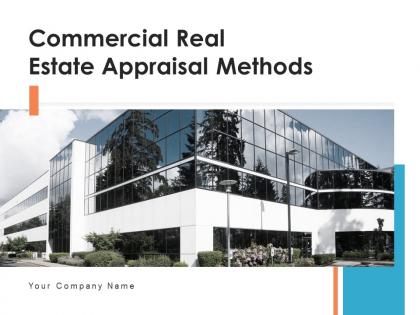
Slide 1: This slide illustrates the topic Commercial Real Estate Appraisal Methods.
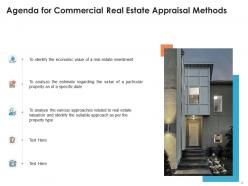
Slide 2: This slide illustrates the Agenda for Commercial Real Estate Appraisal Methods.
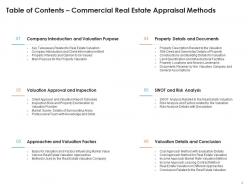
Slide 3: This is a Table of Contents slide representing the Commercial Real Estate Appraisal Methods, Key Takeaways Related to Real Estate Valuation, Client Approval/Valuation Report Schedule, and more.
Slide 4: This is a Table of Contents slide illustrating Company Introduction and Client Information.
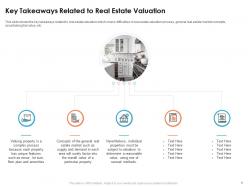
Slide 5: This slide shows the key takeaways related to real estate valuation which covers difficulties in the real estate valuation process, general real estate market concepts, ascertaining fair value, etc.
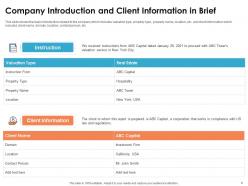
Slide 6: This slide shows the basic introduction related to the company which includes valuation type, property type, property name, location, and client information including client name, domain, location, contact person, etc.
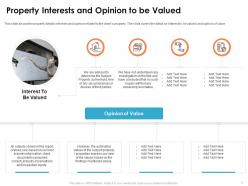
Slide 7: This slide shows the property details, interests, and opinions related to the client’s property.
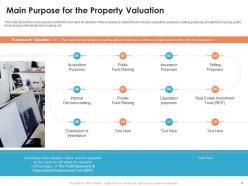
Slide 8: This slide shows the main reasons behind the demand of valuation of the property by a client including acquisition purposes, selling purposes, private fundraising, public fundraising, internal decision making, etc.
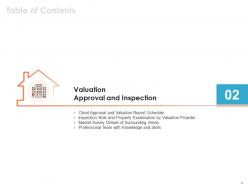
Slide 9: This is a Table of Contents slide representing Valuation Approval and Inspection.
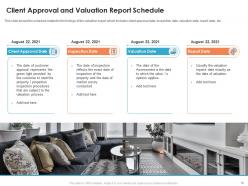
Slide 10: This slide shows the schedule related to the timings of the valuation report which includes client approval date, inspection date, valuation date, report date, etc.
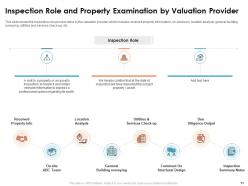
Slide 11: This slide shows the inspection role process done by the valuation provider which includes received property information, on-site team, location analysis, general building surveying, utilities, and services check-up.
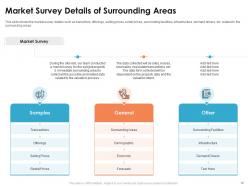
Slide 12: This slide shows the market survey details, such as transitions, offerings, selling prices, rental prices, surrounding facilities, infrastructure, and demand drivers related to the surrounding areas.
Slide 13: This slide shows the professional team details of the real estate valuation provider company with their knowledge and skill specifications such as group CEO, head of the valuation department, etc.
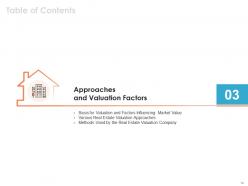
Slide 14: This is a Table of Contents slide illustrating Approaches and Valuation Factors.
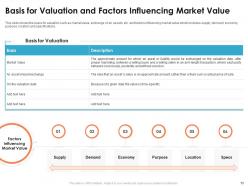
Slide 15: This slide shows the basis for valuation, such as market value, exchange of assets, and factors influencing market value.
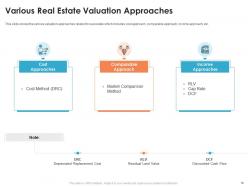
Slide 16: This slide shows the various valuation approaches related to real estate which include a cost approach, comparable approach, income approach, etc.
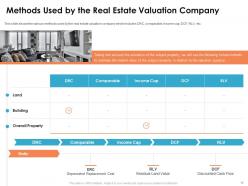
Slide 17: This slide shows the various methods used by the real estate valuation company which include DRC, comparable, income cap, DCF, RLV, etc.
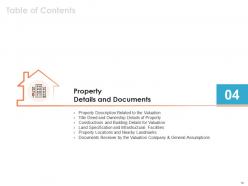
Slide 18: This is a Table of Contents slide illustrating Property Details and Documents.
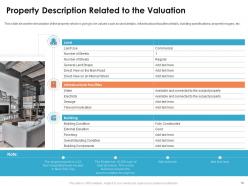
Slide 19: This slide shows the description of the property which is going to be valued, such as land details, infrastructural faculties details, building specifications, property images, etc.
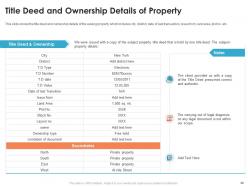
Slide 20: This slide shows the title deed and ownership details of the valuing property which includes city, district, date of the last transaction, issue from, land area, plot number, etc.
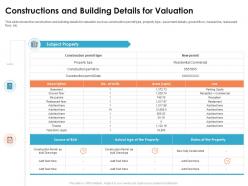
Slide 21: This slide shows the construction and building details for valuation, such as construction permit type, property type, basement details, ground floor, mezzanine, restaurant floor, etc.
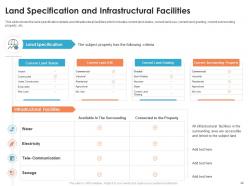
Slide 22: This slide shows the land specification details and infrastructural facilities which include current land status, current land use, current land grading, current surrounding property, etc.
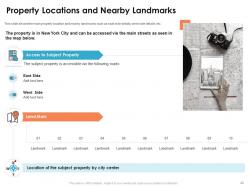
Slide 23: This slide shows the main property location and nearby landmarks such as east side details, west side details, etc.
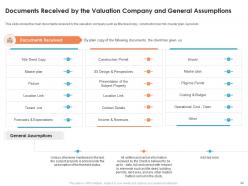
Slide 24: This slide shows the main documents received by the valuation company, such as title deed copy, construction permit, master plan, layout, etc.
Slide 25: This is a Table of Contents slide representing SWOT and Risk Analysis.
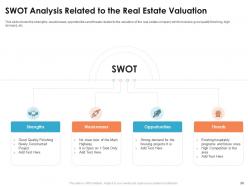
Slide 26: This slide shows the strengths, weaknesses, opportunities, and threats related to the valuation of the real estate company, which includes good quality finishing, high demand, etc.
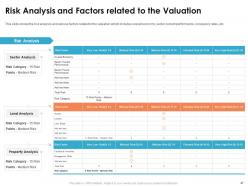
Slide 27: This slide shows the risk analysis and various factors related to the valuation which includes overall economy, sector current performance, occupancy rates, etc.
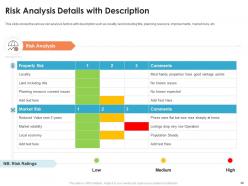
Slide 28: This slide shows the various risk analysis factors with descriptions such as locality, land including title, planning resource, improvements, market risks, etc.
Slide 29: This is a Table of Contents slide representing Valuation Details and Conclusion.
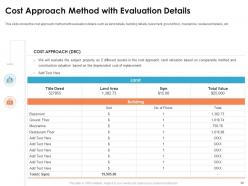
Slide 30: This slide shows the cost approach method with evaluation details such as land details, building details, basement, ground floor, mezzanine, restaurant details, etc.
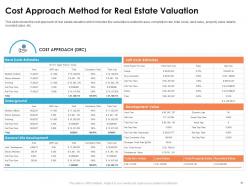
Slide 31: This slide shows the cost approach of real estate valuation which includes the calculations related to the area, completion rate, total costs, land value, property value details, rounded value, etc.
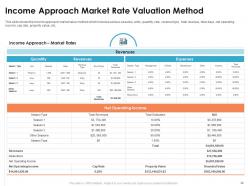
Slide 32: This slide shows the income approach market value method which includes various seasons, units, quantity, rate, revenue type, total revenue, total days, net operating income, cap rate, property value, etc.
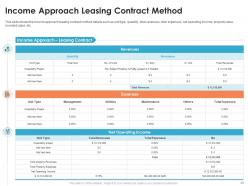
Slide 33: This slide shows the income approach leasing contract method details such as unit type, quantity, total revenues, total expenses, net operating income, property value, rounded value, etc.
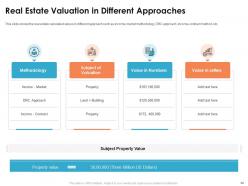
Slide 34: This slide shows the real estate calculated values in different approaches, such as income-market methodology, DRC approach, income-contract method, etc.
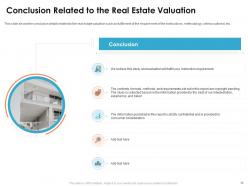
Slide 35: This slide shows the conclusion details related to the real estate valuation, such as the fulfillment of the requirement of the instructions, methodology, criteria outlined, etc.
Slide 36: This is a template that represents Additional Slides.
Slide 37: This is an icon slide that represents Commercial Real Estate Appraisal Methods.
Slide 38: This is an About Us slide that can be used to illustrate the Target Audiences, Valued Clients, and more.
Slide 39: This slide is a Timeline template to showcase the progress of the steps of a project with time.
Slide 40: This slide provides a Venn diagram that can be used to show interconnectedness and overlap between various departments, projects, etc.
Slide 41: This slide contains Post-It Notes that can be used to express any brief thoughts or ideas.
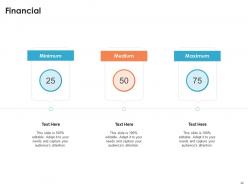
Slide 42: This is a financial slide representing minimum, medium, and maximum data.
Slide 43: This slide is a Roadmap template to showcase the stages of a project, for example.
Slide 44: This is a thank you that can be used to illustrate the company address, email, contact details, and more.
Commercial real estate appraisal methods powerpoint presentation slides with all 44 slides:
Use our Commercial Real Estate Appraisal Methods Powerpoint Presentation Slides to effectively help you save your valuable time. They are readymade to fit into any presentation structure.




FAQs for Commercial real estate appraisal methods
The income approach values properties based on their revenue-generating potential through cap rates and cash flow analysis, while the sales comparison approach relies on recent comparable property transactions and market data. The income approach proves particularly valuable for investment properties like office buildings and retail centers, whereas sales comparison works best when sufficient comparable sales exist, with many appraisers combining both methods for comprehensive valuations.
Appraisers determine capitalization rates by analyzing comparable property sales, reviewing market investor surveys, and extracting rates from recent transactions of similar commercial properties. Through examination of local market conditions, risk assessments, and investor return expectations, appraisers establish rates that reflect current market sentiment, ultimately delivering accurate valuations that support investment decisions and financing requirements.
Market trends significantly influence commercial real estate appraisal by affecting property values, rental rates, capitalization rates, and overall market demand across various sectors. Appraisers analyze current market conditions, recent comparable sales, and economic indicators to determine accurate valuations, with many commercial properties in retail, office, and industrial sectors experiencing value fluctuations based on shifting market dynamics, ultimately ensuring appraisals reflect true market conditions.
Appraisers assess location impact through comparative market analysis, neighborhood demographics evaluation, accessibility studies, proximity to amenities mapping, and economic trend analysis. These methods enable precise valuation by examining transportation links, local market conditions, zoning regulations, and future development plans, with many commercial appraisers finding that location typically represents 60-80% of total property value.
The cost approach offers advantages like accurate valuations for new properties, specialized buildings, and insurance purposes, providing clear depreciation assessment and replacement cost calculations. However, it presents limitations including difficulty estimating land values in prime locations, challenges quantifying functional obsolescence, and potential inaccuracy for income-producing properties, with many appraisers finding it less reliable than comparable sales approaches.
External factors like zoning changes significantly influence property valuations by altering permitted uses, development potential, and market demand for specific locations. These regulatory shifts can increase values when allowing higher-density development or mixed-use projects, while restrictive changes may decrease valuations, with many commercial investors and appraisers incorporating zoning trend analysis into their strategic property assessments.
Commercial real estate appraisers rely on multiple listing services (MLS), local assessor records, CoStar databases, transaction records, and market surveys for comprehensive property valuations. These data sources enhance accuracy by providing comparable sales data, rental rates, and market trends, with many appraisal firms finding that combining public records with proprietary databases delivers superior market insights and competitive advantage.
Income-producing properties rely heavily on the income capitalization approach, analyzing rental income, operating expenses, and cap rates to determine value based on cash flow potential. Owner-occupied properties emphasize the sales comparison approach, focusing on recent comparable sales and replacement costs, with appraisers considering factors like location, condition, and market demand rather than revenue generation capabilities.
Comparable sales serve as the foundation for determining accurate property values by providing real market evidence of what buyers actually pay for similar properties. These sales establish credible pricing benchmarks through location, size, condition, and timing comparisons, with commercial appraisers finding that recent, verified transactions ultimately deliver the most reliable valuations for investment decisions.
Environmental considerations significantly impact commercial property appraisals through contamination assessments, energy efficiency ratings, flood zone designations, and sustainability certifications like LEED or ENERGY STAR. These factors influence property values by affecting insurance costs, regulatory compliance expenses, and tenant desirability, with many investors finding that environmentally superior properties command premium valuations and attract quality tenants.
Common pitfalls include inadequate market research, relying on outdated comparable sales, overlooking property-specific factors like deferred maintenance, and failing to account for local market conditions or zoning restrictions. These oversights can significantly impact valuation accuracy, with many appraisers finding that thorough due diligence, regular market analysis, and comprehensive property inspections ultimately deliver more reliable assessments and better investment decisions.
Appraisers typically account for future value appreciation through market trend analysis, comparable sales projections, and income capitalization models that factor in anticipated rental growth and property improvements. While most appraisals focus on current market value, forward-looking assessments consider neighborhood development plans, infrastructure projects, and economic indicators, with many commercial real estate professionals finding that conservative appreciation estimates enhance investment decision-making and strategic planning.
Property condition and maintenance history significantly impact commercial real estate valuations by affecting income potential, operating expenses, and future capital requirements. Well-maintained properties with documented upkeep histories command premium valuations, while deferred maintenance reduces asset value through higher vacancy rates, increased repair costs, and shortened building lifespans, ultimately influencing investor returns and market competitiveness.
Market cycles significantly influence commercial real estate appraisal methods by requiring adjustments to comparable sales data, cap rates, and market assumptions during different economic phases. During expansion periods, appraisers emphasize income approaches with optimistic projections, while recession cycles demand more conservative cost approaches and extensive market analysis, ultimately delivering more accurate valuations that reflect current economic realities.
Appraisers must maintain independence from clients, avoid conflicts of interest, ensure data accuracy, provide unbiased valuations, and adhere to professional standards like USPAP guidelines. These ethical frameworks protect market integrity by preventing inflated valuations, ensuring transparency in commercial transactions, and maintaining public trust, with many financial institutions and investors increasingly relying on certified, ethically-compliant appraisals for strategic decisions.
-
Unique design & color.
-
Unique research projects to present in meeting.
-
Much better than the original! Thanks for the quick turnaround.
-
Awesome presentation, really professional and easy to edit.
-
Topic best represented with attractive design.