


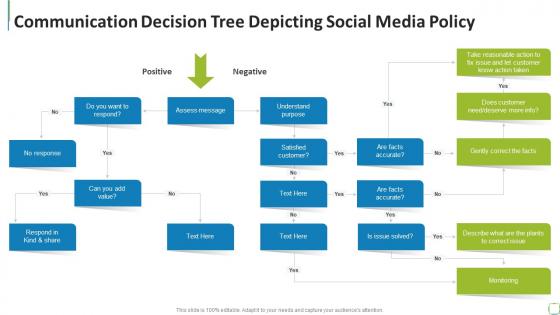
Communication Decision Tree Depicting Social Media Policy




Try Before you Buy Download Free Sample Product
 Impress Your
 Audience
 100%
100% Editable
 Save Hours
 of Time


The following slide depicts some digital marketing strategies to resolve queries and have quality customers. It includes location based marketing, content marketing, SEO, social media marketing etc.
People who downloaded this PowerPoint presentation also viewed the following :
Communication Decision Tree Depicting Social Media Policy with all 6 slides:
Use our Communication Decision Tree Depicting Social Media Policy to effectively help you save your valuable time. They are readymade to fit into any presentation structure.





FAQs for Communication Decision Tree Depicting
An effective social media policy should include guidelines for professional conduct, brand voice consistency, content approval processes, privacy protection measures, and crisis response protocols. These components work together by establishing clear boundaries for employee engagement, protecting organizational reputation, and ensuring regulatory compliance, with many companies finding that comprehensive policies ultimately enhance their digital presence while minimizing potential risks and legal exposure.
Organizations ensure social media policy alignment by establishing clear brand voice guidelines, defining messaging frameworks, and creating consistent visual standards across all platforms. This strategic approach enables marketing teams, customer service representatives, and executives to maintain unified communications, ultimately strengthening brand recognition and delivering cohesive customer experiences that reinforce organizational values.
Employee education about social media policy adherence involves comprehensive training sessions, clear guideline documentation, regular workshops, real-world scenario discussions, and ongoing communication reinforcement. Through interactive training modules and case study examples, organizations streamline policy understanding while minimizing compliance risks, with many companies finding that consistent education ultimately delivers stronger brand protection and employee confidence in digital communications.
Companies should handle negative comments through prompt, professional responses that acknowledge concerns, offer solutions publicly when possible, and move detailed discussions to private channels. Their social media policy should establish clear escalation procedures, response timeframes, and approved language, with many organizations finding that transparent, empathetic engagement transforms negative situations into opportunities for demonstrating excellent customer service.
A social media policy protects organizations from legal liabilities by establishing clear content guidelines, defining employee responsibilities, addressing confidentiality requirements, and implementing compliance protocols for regulatory standards. Through structured frameworks, companies minimize risks related to defamation, harassment, intellectual property violations, and regulatory breaches, while ensuring consistent brand messaging, ultimately delivering legal protection and enhanced reputation management across all digital platforms.
Social media policies should be reviewed quarterly and updated annually at minimum, with immediate revisions following major platform changes, regulatory updates, or significant incidents. With social platforms continuously evolving features and algorithms, organizations increasingly find that regular policy maintenance ensures compliance, protects brand reputation, and enables teams to leverage emerging opportunities effectively.
Training serves as the cornerstone of successful social media policy implementation, ensuring employees understand guidelines, recognize potential risks, and develop appropriate response protocols. Through comprehensive education programs, organizations equip their teams with practical skills for professional online engagement, crisis management, and brand representation, ultimately reducing compliance violations while enhancing digital communication effectiveness.
Businesses can balance social media engagement with employee privacy by establishing clear social media policies, providing comprehensive training on professional boundaries, and creating separate guidelines for personal versus company-affiliated accounts. Many organizations implement role-based social media permissions, offer privacy awareness workshops, and develop content approval processes, ultimately enabling strategic brand engagement while respecting individual privacy rights and maintaining employee trust.
Organizations can enforce social media policies through clear guidelines with creative boundaries, regular training sessions, approval workflows for sensitive content, and designated social media champions within teams. This balanced approach enables employees to maintain authentic brand voices while ensuring compliance, with many companies finding that structured creativity frameworks actually enhance content quality and strategic alignment.
A social media policy can address personal device usage by establishing clear guidelines for platform access, data security protocols, content approval processes, and professional conduct standards. Through device management solutions and communication frameworks, organizations streamline employee interactions while maintaining brand consistency and regulatory compliance, ultimately delivering enhanced security and professional accountability across all digital touchpoints.
Best practices for social media customer inquiries include establishing response time standards, maintaining consistent brand voice, escalating complex issues to appropriate departments, and documenting interactions for quality assurance. These approaches streamline customer service by ensuring timely acknowledgment, personalized responses, and seamless integration with existing support systems, ultimately delivering enhanced customer satisfaction and stronger brand loyalty across digital channels.
Organizations can encourage positive social media use by establishing clear guidelines, providing comprehensive training on brand representation, and creating incentive programs for employee advocacy. These strategic approaches enhance professional development while protecting corporate reputation, with many companies finding that transparent policies, regular education sessions, and recognition programs ultimately deliver increased brand visibility and employee engagement while minimizing compliance risks.
Platform-specific considerations include audience demographics, content format requirements, privacy settings, engagement protocols, and regulatory compliance standards. Different platforms like LinkedIn, Instagram, Twitter, and Facebook each present unique professional risks and opportunities, with many organizations finding that tailored guidelines for visual content, response times, and crisis management ultimately deliver consistent brand messaging and reduced liability across channels.
Social media policies can incorporate authenticity and transparency guidelines by establishing clear disclosure requirements for partnerships, mandating honest communication about products and services, and requiring employees to identify their organizational affiliations when posting. These frameworks enable organizations to build genuine customer relationships, maintain regulatory compliance, and protect brand credibility, with many companies finding that transparent practices ultimately enhance audience trust and engagement.
A strong social media policy enhances employee morale by providing clear guidelines that reduce anxiety about online behavior, while fostering transparency and trust between management and staff. This clarity enables organizations to build more cohesive company cultures, with many businesses finding that well-defined social media boundaries ultimately encourage authentic employee advocacy and stronger team alignment.
-
Thanks for all your great templates they have saved me lots of time and accelerate my presentations. Great product, keep them up!
-
A library of engaging, customizable and content-ready templates.