


Company Reorganization Planning Process For Retail Industry




Try Before you Buy Download Free Sample Product
 Impress Your
 Audience
 100%
100% Editable
 Save Hours
 of Time


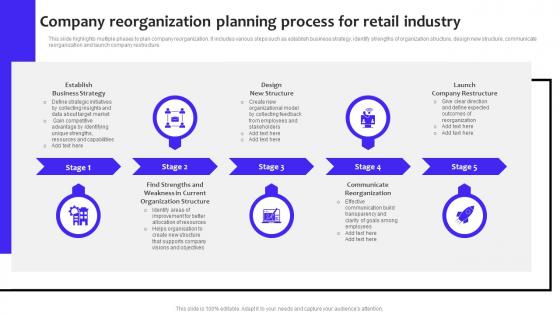
This slide highlights multiple phases to plan company reorganization. It includes various steps such as establish business strategy, identify strengths of organization structure, design new structure, communicate reorganization and launch company restructure.
People who downloaded this PowerPoint presentation also viewed the following :
Company Reorganization Planning Process For Retail Industry with all 9 slides:
Use our Company Reorganization Planning Process For Retail Industry to effectively help you save your valuable time. They are readymade to fit into any presentation structure.
-
Company Reorganization Planning Process For Retail Industry
-

Company Reorganization Planning Process For Retail Industry
-

Company Reorganization Planning Process For Retail Industry
-

Company Reorganization Planning Process For Retail Industry
-

Company Reorganization Planning Process For Retail Industry
-

Company Reorganization Planning Process For Retail Industry
-

Company Reorganization Planning Process For Retail Industry
-

Company Reorganization Planning Process For Retail Industry
-

Company Reorganization Planning Process For Retail Industry
FAQs for Company Reorganization Planning Process
Key objectives of company reorganization include improving operational efficiency, reducing costs, enhancing competitive positioning, streamlining decision-making processes, and optimizing resource allocation across departments. These strategic initiatives enable organizations to adapt to market changes, eliminate redundancies, and accelerate growth, with many companies finding that well-executed reorganizations ultimately deliver stronger financial performance and improved organizational agility.
Companies can effectively assess their current structure through comprehensive organizational audits, performance analytics, employee feedback surveys, workflow mapping, and financial impact analysis. These assessment methods enable leaders to identify inefficiencies, communication gaps, and resource allocation issues across departments, with many organizations finding that systematic evaluation reveals hidden bottlenecks and ultimately delivers strategic insights for more effective restructuring decisions.
Employee feedback serves as a critical input for reorganization planning, providing insights into operational inefficiencies, workflow bottlenecks, cultural dynamics, and potential resistance points that leadership might overlook. This strategic information enables organizations to design more effective structural changes, anticipate implementation challenges, and build employee buy-in, ultimately delivering smoother transitions and improved organizational performance.
Leadership can minimize reorganization resistance through transparent communication, early stakeholder engagement, clear rationale explanation, regular updates, and two-way feedback channels. By addressing concerns proactively, sharing specific timelines and expected outcomes, and involving employees in transition planning, organizations create buy-in and reduce uncertainty, ultimately enabling smoother transformations with greater employee acceptance and faster adaptation to new structures.
**INPUT**: What factors should be considered when determining the timeline for a reorganization? **OUTPUT**: Reorganization timelines should consider regulatory compliance requirements, employee transition periods, system integration complexity, stakeholder communication needs, and operational continuity demands. These factors work together to balance speed with stability, with many organizations finding that phased approaches enable smoother transitions while maintaining customer service levels and minimizing business disruption throughout the transformation process. [Word count: 54 words]
Data analytics aids reorganization by identifying operational inefficiencies, performance gaps, redundant processes, and resource allocation patterns through comprehensive data mining and trend analysis. Through predictive modeling and workforce analytics, organizations can pinpoint underperforming departments, streamline communication flows, and optimize team structures, ultimately delivering strategic insights that guide decision-making and minimize disruption during organizational transitions.
Common pitfalls during corporate restructuring include inadequate communication, rushed timelines, insufficient stakeholder engagement, overlooking cultural integration, and underestimating resource requirements. These challenges can derail restructuring efforts by creating employee uncertainty, operational disruptions, and resistance to change, with many organizations finding that proactive planning, transparent communication, and phased implementation ultimately deliver smoother transitions and sustained competitive advantage.
Companies ensure goal alignment with new organizational structures by establishing clear communication channels, redefining roles and responsibilities, implementing cascading objectives, and creating accountability frameworks that connect individual performance to strategic outcomes. Through regular cross-functional meetings and updated KPIs, organizations streamline decision-making processes, enhance collaboration between departments, and ultimately deliver improved operational efficiency, with many finding that structured alignment initiatives significantly accelerate their transformation success.
Company culture significantly influences reorganization success by affecting employee acceptance, change adaptation speed, and communication effectiveness throughout the transformation process. Organizations with collaborative, transparent cultures typically experience smoother transitions, while rigid cultures may require additional change management strategies, ultimately determining whether reorganization efforts enhance operational efficiency and competitive positioning.
Technology facilitates smoother reorganization transitions by automating workflow redistribution, enabling real-time communication across restructured teams, and providing data analytics for informed decision-making. Through cloud-based collaboration platforms and project management systems, organizations streamline role transitions, minimize operational disruptions, and maintain productivity levels, with many companies finding that integrated digital tools reduce reorganization timelines by thirty percent while enhancing employee adaptation.
Best practices for maintaining morale during reorganization include transparent communication, frequent updates, acknowledging employee concerns, providing clear timelines, and offering support resources like counseling or training programs. Organizations implementing these approaches find that employees respond positively when leadership demonstrates empathy, involves staff in appropriate decisions, and clearly articulates the vision for improved operations and career opportunities post-restructuring.
Performance metrics can be adjusted post-reorganization by realigning key performance indicators with new role responsibilities, establishing cross-functional collaboration measures, and implementing outcome-based targets that reflect revised organizational structure. Through strategic metric redesign, companies streamline performance evaluation processes, enhance accountability across restructured teams, and deliver clearer career progression pathways, with many organizations finding that updated metrics improve employee engagement and operational efficiency.
**INPUT**: What strategies can help integrate newly acquired departments or teams during reorganization? **OUTPUT**: Integration strategies include cultural alignment workshops, cross-functional team formations, unified communication systems, standardized processes, and leadership shadowing programs. These approaches streamline integration by minimizing operational disruptions, enhancing collaboration, and establishing clear reporting structures, with many organizations finding that strategic combination of teams ultimately delivers improved efficiency and competitive advantage.
External stakeholders can be factored into reorganization planning through comprehensive mapping, impact assessments, communication strategies, and feedback integration processes. Companies should identify key stakeholders like customers, suppliers, investors, and regulatory bodies, then develop tailored engagement plans that address their concerns while maintaining transparency, ultimately ensuring smoother transitions and preserving critical business relationships during organizational change.
A comprehensive reorganization plan should include clear organizational structure changes, detailed timeline with milestones, communication strategy for stakeholders, resource allocation guidelines, and risk mitigation measures. These elements work together by establishing accountability frameworks, minimizing operational disruption, and maintaining employee engagement, with many organizations finding that transparent communication and phased implementation ultimately deliver smoother transitions and improved operational efficiency.
-
I really liked their customized design services. I got my desired template made by their expert team. Thank You!
-
I am extremely pleased with these PPT slides that we used for our event. They were easy to modify and came out great in all aspects!