


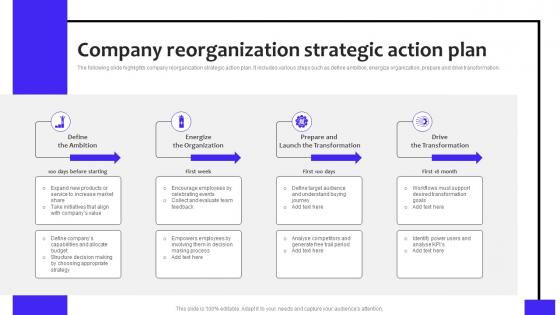
Company Reorganization Strategic Action Plan




Try Before you Buy Download Free Sample Product
 Impress Your
 Audience
 100%
100% Editable
 Save Hours
 of Time


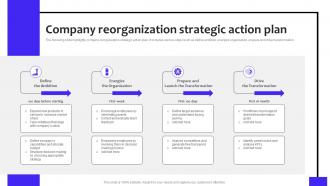
The following slide highlights company reorganization strategic action plan. It includes various steps such as define ambition, energize organization, prepare and drive transformation.
People who downloaded this PowerPoint presentation also viewed the following :
Company Reorganization Strategic Action Plan with all 9 slides:
Use our Company Reorganization Strategic Action Plan to effectively help you save your valuable time. They are readymade to fit into any presentation structure.








FAQs for Company Reorganization
Key indicators include declining financial performance, operational inefficiencies, poor employee morale, outdated organizational structures, and inability to adapt to market changes. These warning signs often manifest through reduced profitability, increased customer complaints, high turnover rates, and missed strategic opportunities, with many organizations finding that early recognition enables smoother transitions and competitive repositioning.
Reorganization improves operational efficiency by streamlining workflows, eliminating redundant processes, and optimizing resource allocation across departments. Through strategic restructuring, companies can reduce decision-making bottlenecks, enhance cross-functional collaboration, and automate routine tasks, with many organizations finding that reorganization delivers faster service delivery, lower operational costs, and improved competitive positioning.
Restructuring risks include employee resistance and decreased morale, operational disruptions during transition periods, potential talent loss, communication breakdowns, and short-term productivity declines. While these challenges are significant, organizations that plan strategically often find that transparent communication, phased implementation, and clear role definitions minimize disruptions, ultimately delivering stronger operational efficiency and competitive positioning.
Leaders can effectively communicate reorganization needs by being transparent about business challenges, clearly articulating the strategic vision, and emphasizing how changes will benefit both the organization and employees. Through regular town halls, department meetings, and one-on-one sessions, leaders enable teams to understand the rationale, address concerns proactively, and maintain engagement, ultimately delivering smoother transitions and stronger organizational alignment.
Employee feedback serves as a critical foundation for reorganization success, providing insights into operational inefficiencies, workflow bottlenecks, team dynamics, and cultural challenges that leadership might otherwise overlook. This input enables organizations to design more effective structures, minimize resistance to change, and identify potential implementation obstacles early, with many companies finding that incorporating employee perspectives throughout the process ultimately delivers smoother transitions and higher adoption rates.
Common mistakes include poor communication creating uncertainty, rushing implementation without adequate planning, neglecting employee concerns and cultural shifts, failing to clearly define new roles and responsibilities, and underestimating resource requirements. These oversights often result in decreased productivity, talent loss, and operational disruptions, with many organizations finding that successful reorganization requires transparent leadership, phased implementation, and continuous stakeholder engagement throughout the transformation process.
Technology streamlines reorganization through automated workforce analytics, digital communication platforms, cloud-based collaboration tools, and AI-driven organizational modeling systems. These solutions enable companies to analyze current structures, facilitate seamless transitions, and maintain productivity during changes, with many organizations finding that integrated digital approaches reduce reorganization timelines while enhancing employee engagement and operational continuity.
Reorganization significantly impacts company culture and employee morale through structural changes, communication shifts, role redefinitions, and altered team dynamics. While initial uncertainty can create anxiety, well-managed reorganizations ultimately enhance collaboration, streamline decision-making, and boost engagement, with many organizations finding that transparent communication and employee involvement during transitions foster stronger cultural alignment and improved performance.
Companies should assess their current structure by evaluating organizational hierarchy, communication flows, decision-making processes, resource allocation efficiency, and performance bottlenecks across departments. Through comprehensive audits, leadership teams can identify redundancies, skill gaps, and operational inefficiencies, while analyzing employee feedback and market alignment, ultimately enabling strategic restructuring that enhances productivity and competitive positioning.
Successful reorganization best practices include clear communication planning, stakeholder engagement strategies, phased implementation timelines, comprehensive change management protocols, and continuous feedback mechanisms. These approaches streamline transitions by minimizing resistance, maintaining operational continuity, and preserving employee morale, with many organizations finding that transparent leadership and structured support systems ultimately deliver faster adaptation and sustained competitive advantage.
Businesses can measure reorganization success through key performance indicators like employee productivity, operational efficiency, customer satisfaction scores, financial metrics, and time-to-market improvements. These measurements enable organizations to track progress across departments, identify areas needing adjustment, and demonstrate tangible outcomes, with many companies finding that regular assessment ensures sustained competitive advantage.
Legal considerations during organizational restructuring include employment law compliance, contract renegotiation, regulatory approvals, intellectual property transfers, and stakeholder notification requirements. These legal frameworks ensure seamless transitions by protecting employee rights, maintaining contractual obligations, and securing regulatory compliance, with many organizations finding that proactive legal planning minimizes disruption while accelerating restructuring timelines.
Collaboration tools support teams through reorganization by maintaining communication continuity, preserving institutional knowledge, and facilitating seamless workflow transitions across new structures. These platforms enable real-time updates, centralized document sharing, and cross-functional coordination, with many organizations finding that integrated collaboration systems reduce reorganization friction while accelerating team adaptation and productivity recovery.
Talent retention strategies during reorganization include transparent communication about changes, providing clear career development paths, offering competitive retention packages, involving key employees in planning processes, and maintaining regular feedback sessions. These approaches streamline uncertainty while enhancing employee engagement, with many organizations finding that proactive communication and strategic involvement ultimately delivers higher retention rates and smoother transitions.
Matrix structures enable faster cross-functional coordination and resource sharing during reorganization but can create role confusion, while flat structures streamline decision-making and reduce bureaucratic delays yet may limit specialized expertise access. Through strategic restructuring, organizations in sectors like technology and consulting find that matrix models enhance project flexibility and innovation, whereas flat structures deliver operational efficiency and clearer accountability, ultimately requiring alignment with specific business objectives and market demands.
-
The PPT layout is great and it has an effective design that helps in presenting corporate presentations. It's easy to edit and the stunning visuals make it an absolute steal!
-
Very well designed and informative templates.