


Comparison Between Quantitative And Qualitative Research




Try Before you Buy Download Free Sample Product
 Impress Your
 Audience
 100%
100% Editable
 Save Hours
 of Time


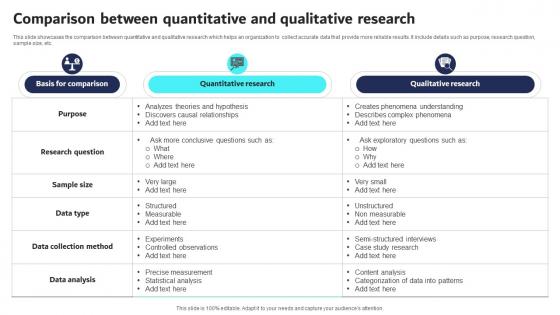
This slide showcases the comparison between quantitative and qualitative research which helps an organization to collect accurate data that provide more reliable results. It include details such as purpose, research question, sample size, etc.
People who downloaded this PowerPoint presentation also viewed the following :
Comparison Between Quantitative And Qualitative Research with all 9 slides:
Use our Comparison Between Quantitative And Qualitative Research to effectively help you save your valuable time. They are readymade to fit into any presentation structure.








FAQs for Comparison Between Quantitative
Effective comparison research in academic studies includes systematic variable control, representative sample selection, standardized measurement criteria, rigorous analytical frameworks, and comprehensive documentation protocols. These methodologies enhance research validity by minimizing bias, ensuring reproducibility, and establishing clear causal relationships, with many institutions finding that structured comparative approaches ultimately deliver more credible findings and stronger scholarly impact.
Comparison research enhances business decision-making by systematically evaluating multiple options against key criteria, identifying strengths and weaknesses of alternatives, and providing data-driven insights that minimize risk. Organizations across sectors like retail, finance, and healthcare leverage comparative analysis to streamline vendor selection, product development, and strategic planning, ultimately delivering more informed choices and competitive advantage.
Common comparison research methodologies include controlled experiments, case studies, cross-sectional surveys, longitudinal studies, and meta-analyses. These approaches differ in their scope, timeframe, and data collection methods, with controlled experiments offering precise variable isolation while case studies provide deeper contextual insights, ultimately enabling organizations across healthcare, finance, and retail sectors to make data-driven strategic decisions.
Comparison research contributes to public policy development by identifying best practices across different jurisdictions, evaluating policy effectiveness through cross-national studies, and providing evidence-based recommendations for implementation. Through comparative analysis, policymakers can assess successful healthcare reforms, education initiatives, and economic policies from various countries, ultimately enabling more informed decision-making and strategic policy adaptation.
Qualitative analysis in comparison research explores contextual factors, stakeholder perspectives, and underlying motivations, while quantitative analysis measures statistical differences, performance metrics, and numerical trends across variables. These complementary approaches enable organizations to understand both the "what" and "why" behind comparative findings, with many research teams finding that combining both methodologies delivers more comprehensive insights and strategic decision-making capabilities.
Researchers ensure cultural objectivity through standardized methodologies, diverse research teams, cultural consultation, systematic bias identification, and cross-cultural validation techniques. These approaches streamline comparative analysis by incorporating local perspectives, minimizing researcher assumptions, and implementing rigorous peer review processes, with many international organizations finding that multicultural research teams ultimately deliver more accurate insights and culturally sensitive conclusions.
Sourcing comparable data for diverse populations presents challenges including inconsistent data collection methods, varying demographic classifications, cultural measurement biases, language barriers, and unequal access to technology across communities. These obstacles can compromise study validity, with many researchers finding that standardizing protocols, implementing multilingual approaches, and partnering with community organizations helps ensure representative samples and ultimately delivers more accurate, actionable insights.
Technology significantly enhances comparison research through advanced data analytics, machine learning algorithms, statistical modeling software, automated data collection systems, and visualization platforms. These tools enable researchers to process vast datasets more accurately, identify complex patterns across multiple variables, and generate actionable insights faster, with organizations in healthcare, finance, and retail finding that technology-driven comparison studies deliver more reliable strategic decisions and competitive advantages.
Ethical considerations include informed consent, data privacy protection, cultural sensitivity, potential harm minimization, and transparent methodology disclosure. When researching sensitive topics like healthcare disparities or social inequities, organizations must balance research value with participant welfare, ensuring anonymity and respectful representation, while many institutions find that robust ethical frameworks ultimately enhance research credibility and stakeholder trust.
Visual representation methods enhance comparison research clarity by transforming complex data into digestible formats like bar charts, scatter plots, heat maps, and comparison tables that highlight patterns and differences instantly. These tools enable researchers to present multi-variable comparisons effectively, with stakeholders in sectors like healthcare, finance, and market research finding that visual data storytelling accelerates decision-making and improves comprehension across diverse audiences.
Common pitfalls include drawing conclusions from insufficient sample sizes, ignoring confounding variables, misinterpreting correlation as causation, cherry-picking favorable data, and overlooking statistical significance. These mistakes can lead organizations to make flawed strategic decisions, with many businesses finding that establishing clear methodological standards, involving cross-functional teams in analysis, and validating findings through multiple lenses ultimately delivers more reliable insights and competitive advantage.
Comparison research informs product development by identifying market gaps, analyzing competitor strengths and weaknesses, understanding customer preferences, and revealing emerging trends across industry landscapes. Through systematic competitive analysis, organizations can prioritize feature development, optimize pricing strategies, and accelerate innovation cycles, with many companies finding that data-driven comparisons ultimately deliver stronger market positioning and enhanced customer experiences.
Longitudinal comparison research enables organizations to track patterns, measure progress, and identify emerging trends by collecting data from the same subjects across multiple time periods. This approach delivers strategic insights for forecasting, performance evaluation, and resource allocation, with healthcare institutions, financial services, and educational organizations finding that sustained data collection ultimately enhances decision-making and competitive advantage.
Case studies enhance comparison research by providing rich, contextual detail that quantitative data alone cannot capture, offering real-world examples that illustrate how variables interact in specific environments. Through detailed narratives, organizations can examine nuanced differences between approaches, strategies, or outcomes across sectors like healthcare implementations or retail transformations, ultimately delivering deeper insights that enable more strategic decision-making and competitive advantage.
Emerging trends include AI-powered analytics, real-time data integration, interactive visualization tools, social sentiment analysis, and cross-platform comparison capabilities. These technologies streamline research processes by automating data collection, enhancing accuracy, and delivering deeper insights, with many organizations finding that strategic combination of these approaches ultimately provides significant competitive advantage in increasingly data-driven markets.
-
Thank you SlideTeam for such an excellent service.
-
I’m not a design person, so I couldn’t make a presentation to save my life. Thankfully, they have all kinds of templates that I regularly use for my work.