


Comparison Of Centralized Vs Decentralized Vs Distributed Systems Training Ppt




Try Before you Buy Download Free Sample Product
 Impress Your
 Audience
 100%
100% Editable
 Save Hours
 of Time


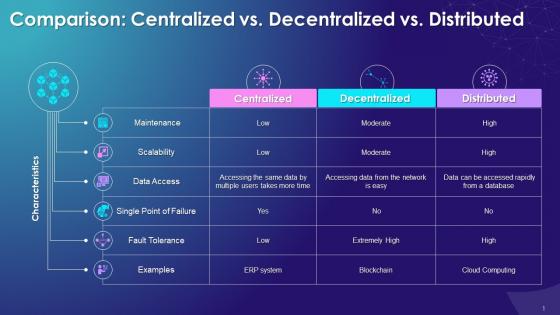
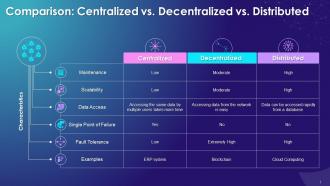
This slide illustrates the comparison between centralized vs. decentralized vs. distributed systems. These are compared on parameters like maintenance, scalability, data access, single point of failure, fault tolerance, etc.
People who downloaded this PowerPoint presentation also viewed the following :
Comparison Of Centralized Vs Decentralized Vs Distributed Systems Training Ppt with all 16 slides:
Use our Comparison Of Centralized Vs Decentralized Vs Distributed Systems Training Ppt to effectively help you save your valuable time. They are readymade to fit into any presentation structure.













FAQs for Comparison Of Centralized Vs Decentralized Vs Distributed
So basically, centralized means everything runs through one main server - like old school databases. Way easier to manage but if it goes down, you're screwed. Decentralized spreads things out across multiple nodes that still talk to each other. Distributed is when you've got data and processing happening on tons of machines doing their own thing. I'll be honest though - the difference between decentralized and distributed gets pretty fuzzy sometimes. Bottom line for building stuff: centralized is simple but becomes a bottleneck. Distributed handles failures better and scales nicely, but man does it get complicated fast.
So centralized stuff runs super fast since you've got those beefy dedicated servers doing all the work. Problem is, it doesn't scale well and if that one server goes down - you're screwed. Decentralized is better for scaling because the load gets spread around, but there's definitely some performance hit from all the nodes talking to each other. Distributed systems? That's where you get crazy scale like Netflix handles. Performance gets weird though since your data's scattered everywhere and network lag becomes a real pain. Honestly depends what you need more - speed or the ability to handle tons of users.
So centralized systems are basically like having one vault for everything - hack that and you're screwed. But honestly, it's way easier to guard one door than ten, you know? Decentralized is the opposite. Your data's scattered everywhere, so losing one piece isn't the end of the world. The downside? Now you've got like 15 different systems to patch and monitor. I'd probably go centralized if you want simple security management. Go decentralized if you're paranoid about everything crashing at once (which... fair enough these days).
Honestly? Go decentralized when you can't risk your whole system crashing because one server dies. Geographic stuff is huge too - if you've got users everywhere, you'll want servers closer to them for speed. Regulatory compliance is another big one since some countries make you store data locally. High availability requirements basically force your hand here. The thing is, you're making your life way more complicated in exchange for bulletproof reliability. Some apps handle distributed load better anyway, but definitely weigh whether all that extra complexity is actually worth the headache for what you're building.
Look, centralized systems are honestly your best bet for data consistency - just one source, no drama. Decentralized gets messy fast because of CAP theorem stuff (consistency vs availability vs partition tolerance). Distributed is where things get really fun though... you're basically accepting that data won't always match up immediately across nodes. Temporary inconsistencies happen while everything syncs. Here's the thing - you gotta pick your poison upfront. Can you live with some data being slightly off sometimes if it means faster performance? Or do you absolutely need everything perfectly consistent even if operations crawl?
So consensus algorithms are how nodes in decentralized networks figure out what's actually true when there's no central authority. Bitcoin uses Proof of Work, while newer systems often go with Proof of Stake - honestly PoS makes way more sense energy-wise. The whole point is getting all these distributed computers to agree on stuff like which transactions are valid. You're basically trading speed for security and removing the need to trust anyone. Blockchain's the obvious example most people know. If you're building something decentralized, nail down your consensus method early or you'll be kicking yourself later.
Okay so fault tolerance is huge when you're working with distributed systems. Multiple nodes means multiple points of failure - and yeah, they'll crash at the absolute worst moments possible. You need automatic routing around dead components or backup systems that can jump in immediately. Otherwise one server going down kills your whole app, which honestly defeats the entire point of going distributed. Oh and design this stuff upfront, not when everything's already on fire. Trust me on that one.
So basically, centralized is like your bank - everything goes through one main server. BitTorrent is decentralized, which spreads things across tons of computers so if one crashes, whatever. Google uses distributed systems where they split the work between thousands of servers but still coordinate it all centrally (honestly pretty wild when you think about the scale). Banks stick with centralized for security reasons. BitTorrent-style works great when you need something bulletproof. Distributed is your go-to for massive performance. Really depends what you're prioritizing - control, reliability, or speed.
So centralized systems are pretty straightforward - everything just goes through one main server, like old-school client-server stuff. Your message hits the central hub and bounces back. Decentralized systems? Way messier but honestly more robust. Nodes talk directly to each other or through multiple hubs, which means you need protocols that can handle routing and consensus when half the network might be down. It's like comparing a simple HTTP request to something gnarly like blockchain protocols. The big thing is centralized systems have that single source of truth to lean on, while decentralized ones have to keep working even when nodes are unreachable.
Ugh, distributed systems are a pain because there's no single source of truth anymore. Each node has its own version of data, and getting them to agree? Good luck with that. Network partitions will mess you up - nodes can't talk to each other and you get split-brain scenarios. It's basically like trying to coordinate a group text when half the people have bad service. The consensus problem is huge too - which version wins when there's a conflict? I'd focus on solid conflict resolution from the start and pick the right consistency model. Learned that one the hard way.
Honestly, centralized is gonna be your fastest option since there's just one hop to get your data. Decentralized gets messy though - way higher latency because requests bounce around between nodes looking for stuff. Distributed sits in the middle, but decent caching can actually make it pretty competitive. If you absolutely need speed and don't mind the single point of failure risk, just go centralized. Otherwise I'd try distributed first with some good caching - that's usually the sweet spot for most projects anyway.
Okay so centralized is definitely cheaper upfront - you're just buying one beefy server instead of dealing with multiple machines. Distributed systems? Total pain initially. More nodes, complex networking, debugging makes you want to cry. But honestly, distributed often pays off long-term through better fault tolerance and scaling. With centralized, one failure can completely wreck you financially. I learned this the hard way at my last job, actually. Calculate what downtime would cost you versus the infrastructure investment. That math will tell you which way to go - way more useful than just looking at sticker prices.
Look, centralized systems are honestly just easier to deal with. You get faster response times since everything's in one place. No network delays or sync nightmares to worry about. Data consistency? Not even an issue - there's just one source of truth. Real-time features and complex transactions work way better this way too. When something breaks, you're not hunting bugs across a dozen different servers (trust me, that's a headache). If your app doesn't need to handle millions of users right away, going centralized first makes total sense. You can always scale out later.
Honestly, go centralized if you're just getting started. Everything's in one spot so updates and monitoring are super simple - way less headache. Distributed systems sound cool but you'll be dealing with network problems, keeping data in sync across nodes, coordinating updates... it gets messy fast. I mean, the performance and fault tolerance are nice perks, but is it worth the complexity? Really depends on your team size and how much chaos you can handle. If you don't have a huge ops team, centralized will save you so much pain until you actually need that distributed scalability.
Honestly, cloud computing is pushing everything toward hybrid setups where you get the best of both worlds. Microservices scattered across AWS regions but centrally managed - it's actually pretty cool how that works. The cloud lets you build distributed systems without the hardware nightmare, plus you still get those nice centralized management tools. Your architecture choices will probably depend more on what you're actually building rather than infrastructure limits. Oh, and focus on designing for your real needs first - then just let the cloud services deal with all the messy complexity underneath.
-
Great quality slides in rapid time.
-
Thrilled to see several customizable templates catering various verticals and industries.