


Difference Between Centralized And Decentralized System Training Ppt




Try Before you Buy Download Free Sample Product
 Impress Your
 Audience
 100%
100% Editable
 Save Hours
 of Time


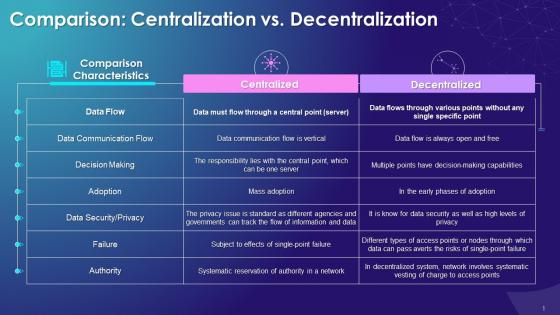
This slide illustrates the comparison between centralized vs. decentralized system. These are compared on characteristics such as data flow, data communication flow, decision making, adoption, data security, authority and failure.
People who downloaded this PowerPoint presentation also viewed the following :
Difference Between Centralized And Decentralized System Training Ppt with all 16 slides:
Use our Difference Between Centralized And Decentralized System Training Ppt to effectively help you save your valuable time. They are readymade to fit into any presentation structure.







FAQs for Difference Between Centralized And Decentralized
So basically it comes down to who's calling the shots. Centralized systems have one main authority (like your bank) making all the decisions. Decentralized ones spread that control across tons of different participants. Centralized is definitely faster and way easier to coordinate. But yeah, you're putting all your trust in one place. Decentralized systems can't really "break" the same way since there's no single weak point, though they're slower and honestly kind of chaotic to manage sometimes. Really depends what you need more - speed and simplicity, or that independence from having some central authority control everything.
So basically there's two ways to run things. Centralized means one person (like a CEO) makes all the big calls - super clear who's in charge but everything moves at a snail's pace when you need approvals. Decentralized is the opposite - you push decisions down to individual teams and departments. Way faster responses since people closer to the action are calling the shots. But honestly? Coordination can get messy real quick. The trick is figuring out what decisions really need someone at the top versus what your teams can just handle themselves.
Look, centralized systems are just way easier to deal with. One person calls the shots, so you don't get that messy situation where different departments are doing completely different things. Security's simpler too - you're watching one entry point instead of like ten scattered ones. Updates? Push once, done everywhere. I mean, unless you enjoy the chaos of managing fifty different access points (some people do, weirdly). If your company's smaller or you've got strict compliance stuff to worry about, centralized is probably gonna save you a lot of headaches.
Look, decentralized systems are perfect when you can't have everything go down because one server dies. Your users scattered everywhere? They'll hit local nodes instead of some server halfway across the world - way faster. Also better for sensitive stuff since there's no central target for hackers. Users keep more control too, which people actually care about these days. They handle outages and censorship really well. Downside is they're a pain to set up and maintain. Worth it though if you need that reliability and don't trust centralized solutions.
So centralized systems? They scare me a bit because hackers hit one server and boom - they've got everything. Though you do get cleaner security policies that way. Decentralized stuff spreads your data around, which is cool since there's no single jackpot for attackers. But managing security across all those different points becomes a total headache. Your privacy usually gets better though since nobody owns all your info. Honestly depends on how much risk you can handle and what resources you're working with.
Look, tech is pretty much what decides if you can go centralized or decentralized. Good networking and encryption? Decentralization works great - like how blockchain made crypto possible or cloud stuff lets people work remotely. But when your infrastructure sucks or you need tight security control, centralized makes way more sense. Honestly, the internet flipped everything on its head. Made decentralized models actually doable when they weren't before. Just pick based on what tech you've got and what you actually need operationally. Don't overthink it too much.
Honestly, centralized systems are pretty great for cutting out all that duplicate work everyone's doing. Decision-making gets way faster when there's one clear chain of command instead of people running around in circles. Your policies stay consistent, resources get allocated better, and tracking performance becomes so much simpler - everything just flows through one spot. The cost savings are real too since you're not maintaining like five different systems that basically do the same thing (been there, it's a nightmare). Just don't let your central team become a bottleneck or you'll kill all those efficiency gains.
Honestly, coordination becomes a nightmare at first - teams get more freedom but way less oversight, so everything feels messy. Communication gets super complicated too since info isn't flowing through one person anymore. The cultural shift is probably the hardest part though, especially for people who are used to being told exactly what to do. You'll need to invest big time in training because your teams have to learn how to make good decisions on their own. Oh, and definitely start with small pilot programs first - don't go all-in right away. Good communication tools are worth every penny during the transition.
So here's the deal - centralized systems are usually faster and more reliable since everything runs through their fancy data centers. You'll get consistent speeds because it's all controlled from one spot. Decentralized is kinda the opposite though. Response times are all over the place depending on which random node handles your request and where it's located geographically. Performance gets wonky since you're dealing with different servers with different specs. But honestly? Decentralized handles traffic spikes way better because the load gets spread around naturally. Pick centralized if you need predictable performance, decentralized if you want something that won't completely die on you.
Bitcoin's the obvious one - thousands of computers running it with zero central control. But honestly, the internet itself is decentralized too, which blows my mind. BitTorrent, Wikipedia's editing, GitHub... they all keep chugging along even when parts break down. That's the beauty of it - one server crashes and everything else just keeps working. If you're building something that can't afford to go down, these systems are worth studying. The whole "no single point of failure" thing is pretty genius when you think about it.
So with centralized systems, you've got one person or small group calling all the shots - like your typical corporation or government thing. Decisions happen fast and you know exactly who to blame when stuff goes wrong, but regular people don't get much say. Decentralized is the opposite - power gets spread around to tons of different people. Takes forever to agree on anything (seriously, it can be brutal), but at least everyone feels heard and invested in whatever comes out of it. Really comes down to whether you want quick decisions or you want everyone on board. Both have their place honestly.
Honestly, it's all about what you're trying to achieve. Centralized gives you speed on big decisions and everyone's moving in the same direction, but then you hit those annoying bottlenecks where everything has to go through one person. Decentralized is the opposite - super agile, teams can just go for it without waiting around. But yeah, sometimes you'll have people working on the same thing twice or going completely different directions. I'd probably start with centralized for the main strategy stuff, then let teams run with execution however they want. Seems to work pretty well from what I've seen.
So with centralized stuff, you're pretty much stuck following whatever rules Facebook or your bank decides - they can freeze your account or delete your posts whenever. Decentralized systems let you control your own data and transactions directly. No asking permission, no single company calling the shots. You hold your own keys and make your own choices. The catch? If you mess up, that's on you - and crypto mistakes can get pricey fast. More freedom, but you gotta handle your own security. It's honestly worth it though if you value independence.
Track decision speed and how well teams communicate - those are your big ones. Employee satisfaction scores matter too. Response time when issues pop up is critical (centralized teams usually fix stuff faster but everything gets stuck waiting for approval). Innovation rates, how often people screw up, and department costs all tell the story. Honestly, customer satisfaction is probably your best reality check - sometimes the org chart looks perfect on paper but customers are getting bounced around like pinballs. Just make sure you measure before changing anything so you can actually prove what worked. Maybe start baseline testing next quarter?
So centralized teams usually end up with pretty uniform cultures - everyone follows the same playbook, clear chain of command, that whole thing. Decentralized teams? Totally different vibe. Each group develops its own mini-culture based on what they're dealing with locally. People in centralized setups get really consistent messaging from the top. But decentralized folks have to be more scrappy and entrepreneurial since they can't just wait for orders. Honestly, some people love that freedom while others need the structure to function. Figure out what your team actually prefers first - forcing the wrong setup will tank productivity so fast it's not even funny.
-
Great quality slides in rapid time.
-
Illustrative design with editable content. Exceptional value for money. Highly pleased with the product.