

Key Advantages Of Blockchain Technology Training Ppt




Try Before you Buy Download Free Sample Product
 Impress Your
 Audience
 100%
100% Editable
 Save Hours
 of Time


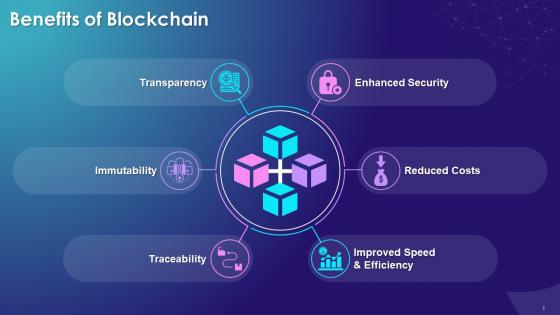
This slide lists the benefits of blockchain network such as enhanced security, cost reductions, immutability etc.
People who downloaded this PowerPoint presentation also viewed the following :
Key Advantages Of Blockchain Technology Training Ppt with all 16 slides:
Use our Key Advantages Of Blockchain Technology Training Ppt to effectively help you save your valuable time. They are readymade to fit into any presentation structure.













FAQs for Key Advantages Of Blockchain
Okay so blockchain basically cuts out the middleman by spreading data across tons of computers instead of one central server. Once something gets recorded in a block, you can't really change it - that's the whole immutable thing. The network uses these consensus algorithms to make sure transactions are legit. Oh and everything's transparent, so anyone can check transaction history (your personal info stays encrypted though). Honestly? This stuff made way more sense to me once I actually tried it. Set up a test wallet and mess around with small transactions - you'll get it pretty quick. Way better than just reading about it.
Honestly, blockchain goes way beyond just crypto stuff. Supply chains are probably where it's making the biggest splash right now - companies can track their products from start to finish without any shady business. Healthcare's using it for patient records, real estate for property deals, even voting systems. Oh and the music industry too for royalty payments, which is pretty cool actually. Look for spots where multiple parties don't really trust each other - that's usually where blockchain shines. If you've got processes involving verification or cutting out middlemen, you're probably onto something. It's basically about creating transparent records nobody can mess with.
So basically, public blockchains like Bitcoin let anyone join - totally open. Private ones? Only certain companies or groups get access. You'll see public ones are super transparent but honestly they're slow as hell and waste tons of energy. Private blockchains run way faster since fewer people are involved, though you kinda lose that whole "no one's in charge" vibe that makes blockchain cool. It's all about whether you want openness or control. For your training thing, just think about what different businesses actually need.
Think of consensus mechanisms as the bouncer for your blockchain - they make sure everyone agrees on what's legit before anything gets added. Otherwise you'd have total chaos with different versions of the ledger everywhere (kinda like Wikipedia with zero moderation, yikes). They stop double-spending and prevent bad actors from messing with transaction history. Different types like Proof of Work vs Proof of Stake each have their own security quirks. Honestly, when you're checking out any blockchain project, look at their consensus model first - it'll tell you way more about how secure they actually are than all their fancy marketing.
Honestly, it's mostly about the programming language each platform uses. Ethereum runs on Solidity - super easy if you already know JavaScript. Binance Smart Chain? Same deal since it copies Ethereum basically. Cardano though... yikes, they use Haskell which is brutal to learn. Solana went with Rust, and Hyperledger lets you use Go or Node.js. Each one's got different costs and speed too, plus their own dev tools. My advice? Don't try learning everything at once. Pick one platform, get really good at it first, then maybe explore others later. Way less overwhelming that way.
Start with Solidity since that's what most Ethereum devs use. You'll also want JavaScript or Python under your belt. Smart contracts are obviously key, but don't forget about crypto fundamentals and how distributed systems actually work. Security auditing is where the real money is right now - so many projects keep getting rekt by basic vulnerabilities. Learn some other blockchains too, not just Ethereum. Web3 frameworks and testing tools are pretty essential. Honestly though? Just build a simple DApp first. You'll figure out what you're missing real quick and have something to show for it.
Okay so for blockchain scalability, you'll want to track three main things: TPS (transactions per second), latency, and how well it handles heavy loads. Bitcoin only does like 7 TPS while Visa crushes thousands - pretty wild difference, right? First benchmark your current setup against what you actually need. Can it handle your expected volume? Then stress test it by adding more nodes and users to see when things start breaking down. Different consensus mechanisms matter too - Proof of Work is way slower than Proof of Stake. Bottom line: always load test with real data before launching, and don't be afraid to look into Layer 2 solutions if you hit walls.
So basically the big issue is blockchain says it's all about transparency, but that can totally backfire on privacy. Once something's on most blockchains, it's stuck there forever for everyone to see - kinda sketchy if it's sensitive stuff. There are workarounds though, like zero-knowledge proofs that let you prove things without showing the actual data. Private blockchains are another option. Honestly, I think the key question is whether your data really needs to be public permanently. Your training should cover these privacy tools so people don't just dump everything on a public ledger without thinking it through first.
Honestly, I'd go with your tech people first - they'll pick it up way faster and can help sell it internally. Mix up the training though: workshops, online stuff, maybe some case studies from companies like yours. Whatever you do, don't throw everything at them at once! That's a recipe for glazed-over eyes. Phase it out instead - basics first, then smart contracts or whatever applies to your business. The trick is connecting it to what they actually do day-to-day, not just theory. Oh, and definitely bring in outside trainers initially. You can build your own expertise later once people get the hang of it.
Grab VS Code and Node.js first - that's your foundation. MetaMask is essential for wallet stuff, and seriously use testnets like Sepolia or Goerli. I learned this the hard way spending actual ETH on dumb mistakes lol. Remix IDE is clutch for smart contracts since it runs right in your browser. No setup needed. Once you get more serious, Hardhat beats Truffle in my opinion. Bookmark Ethereum.org and OpenZeppelin's docs - you'll reference them constantly. Honestly just start with Remix though. You can have your first contract running in like 5 minutes.
Honestly, real-world comparisons work best. I always tell people blockchain is like a shared Google Doc - everyone can see it but nobody can sneak in edits. Don't dive into tech stuff right away! Focus on why it matters first. I've made this mistake so many times and just watched people's eyes glaze over lol. Show them actual blockchain explorers so they can watch transactions happen live. That's when it clicks. Build up from simple stuff like digital signatures, then work toward smart contracts. Oh and connect everything to apps they already use - makes way more sense that way.
Dude, regulations totally control what you can put in blockchain courses. Data protection, financial rules, industry standards - it's all over the map depending where you are. Honestly the whole crypto regulation thing changes like every month so it's kinda exhausting to track. But here's what's cool - you can actually make this into its own training track about compliance stuff. I'd build your modules super flexible so when new rules hit (and they will), you can pivot fast. Oh and always throw in a section on current regulatory landscape. That part's non-negotiable.
So Walmart's got this insane food tracking system - they can trace contaminated produce in literally seconds instead of weeks. Pretty wild considering how complex supply chains are. Maersk handles their shipping logistics with it too, way less paperwork and delays. Oh and Estonia runs their whole digital ID thing on blockchain through e-Residency (which is honestly kind of futuristic). JP Morgan's moving billions with JPM Coin for big institutional stuff. These aren't just experiments anymore - they're actually running full scale. I'd start with the Walmart one since it's easiest to wrap your head around.
Honestly, gamification works so well for blockchain stuff because it makes boring concepts actually fun. People get weirdly competitive about earning badges for smart contracts or hitting the top of leaderboards. I've watched folks who usually hate tech training suddenly obsess over leveling up their "crypto skills" - it's kind of hilarious but it works. Point systems for completing modules are clutch. You can also throw in quests and simulations to make abstract ideas feel real. Start small with some achievement unlocks next time. Trust me, you'll notice way more people actually participating instead of just sitting there zoned out.
Honestly, I'd hit DeFi protocols and NFT stuff first - that space is absolutely nuts right now. Cross-chain interoperability is massive too. Your team should definitely get into smart contract security auditing because holy crap, the number of hacks we're seeing is insane. CBDCs are picking up steam, and supply chain blockchain solutions are solid for enterprise work. Oh, and sustainability training is pretty much mandatory now since everyone's obsessing over energy-efficient consensus. AI-blockchain convergence is getting weird in a good way. Just pick whatever matches your current projects and start there - don't overthink it.
-
“I always have a wonderful experience with SlideTeam. It's my ""go to"" when I need a template.”
-
A big thanks to SlideTeam! An incredible and diverse library of templates helped me with my business project presentation.