

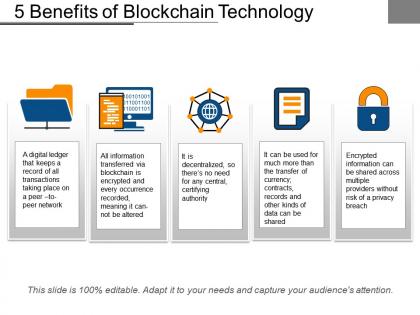
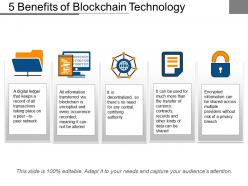
5 benefits of blockchain technology





Try Before you Buy Download Free Sample Product
 Impress Your
 Audience
 100%
100% Editable
 Save Hours
 of Time


Our 5 Benefits Of Blockchain Technology are topically designed to provide an attractive backdrop to any subject. Use them to look like a presentation pro.
People who downloaded this PowerPoint presentation also viewed the following :
5 benefits of blockchain technology with all 5 slides:
Use our 5 Benefits Of Blockchain Technology to effectively help you save your valuable time. They are readymade to fit into any presentation structure.

FAQs for 5 benefits
Dude, blockchain basically lets you track every product from start to finish - crazy useful for catching fraud and quality issues. No more middlemen means cheaper costs and faster processes. Once something's recorded, nobody can mess with the data, which customers and regulators love. Food companies are obsessed with this right now (probably because of all those contamination scares). The tamper-proof thing is honestly the biggest selling point. If you've got messy supply chains or need to prove your stuff is legit, it'll fix those problems fast.
So basically blockchain spreads your data across tons of computers instead of keeping it all in one spot that hackers love to target. Each piece of info gets locked down with cryptography and chained to the previous transaction - honestly, it's pretty genius. Nobody can mess with it without everyone else knowing. Think of it like a receipt book that can't be erased or faked, and everyone has a copy. For your business stuff, you can actually share sensitive data with partners without losing sleep over it. I'd start small though - maybe test it on your most important data first and see how it goes.
So blockchain basically skips all those middleman banks that make international transfers take forever. Your money goes straight from you to whoever you're sending it to - we're talking minutes instead of days. The fees are way cheaper too since you're not feeding like 3 different banks along the way. You can actually track where your payment is in real time, which is honestly such a relief after dealing with those "your transfer is processing" messages that tell you nothing. I'd check out Ripple or some of the stablecoin options if you do this stuff regularly.
So smart contracts are just code that runs automatically when conditions get met. Like a vending machine - you put money in, pick your snack, and it spits out your food without needing anyone there. They're pretty cool because blockchain handles all the verification stuff, so you don't need lawyers or banks getting involved. The whole thing runs 24/7 without people babysitting it, which makes everything faster and cheaper. Honestly, it's wild how much you can automate these days. Next time you're doing any kind of deal, just think - could this be coded instead of handled manually?
So basically blockchain keeps a permanent record of every donation - like, you can literally watch your $50 go from your account all the way to whoever needs it. Each transaction gets locked into this digital ledger that nobody can mess with. Charities can't secretly move money around anymore because everything's visible in real-time. It's honestly pretty genius for solving that whole "where did my donation actually go?" problem. I'd definitely look for organizations already using this tech - way better than just hoping they're legit, you know?
So blockchain basically makes it impossible to mess with transaction records since everything's permanently stored and visible to everyone. Smart contracts can catch weird patterns automatically too. What's cool is there's no central database that hackers can target - it's all spread out. Honestly, the transparency aspect alone stops most fraud attempts because people know they can't hide anything. If your team's dealing with fraud issues, I'd look at whatever processes get hit the most and figure out where having unchangeable records would actually help. Makes sense to start there anyway.
So basically with blockchain, you actually own your digital identity instead of some company controlling it. No more waiting around for third parties to verify who you are - that part's honestly such a pain right now. Your credentials can't really be messed with once they're recorded, which is pretty solid. Plus you can prove who you are without having to hand over a bunch of personal info you don't want to share. There's no central system for hackers to target either. Look into self-sovereign identity stuff if this sounds interesting - that's where the real action is happening.
So blockchain is basically what makes dApps work - it's like having your app run on thousands of computers instead of just one company's server. Smart contracts are pretty cool because they handle all the automated stuff without middlemen taking their cut. Everything's transparent too since transactions are public. I'd honestly just mess around on Ethereum first to see how other people built theirs. Way easier than trying to figure it out from scratch. You don't have to trust some random corporation either, which is nice.
Here's what's worked for companies I've seen - blockchain cuts costs by ditching middlemen and automating stuff with smart contracts. No more crazy bank fees for international payments. Plus you're not paying third parties to verify every transaction, which honestly adds up fast. The automation handles payments and compliance without people babysitting it constantly. Less staff time, fewer mistakes. Oh and audits get way cheaper since everything's already tracked transparently. I'd start by looking at your most expensive manual processes first - that's where you'll see the biggest savings.
Yeah so Bitcoin's the worst offender here - it eats up insane amounts of electricity because of how the mining works. Proof-of-work is just ridiculously energy-hungry by nature. But honestly, things are getting better. Ethereum switched to proof-of-stake last year and now uses like 99% less power, which is pretty wild when you think about it. Most newer blockchains are way more efficient too. I'd definitely check what consensus mechanism they're using before jumping into anything - makes a huge difference for the environmental impact.
Honestly, blockchain's pretty cool for going green. It cuts out all those middlemen who just slow things down and waste energy. Companies can finally prove they're actually sustainable instead of just talking about it - the whole supply chain becomes transparent. You can track carbon credits, see if stuff was ethically sourced, all that good stuff. Yeah, Bitcoin gets dragged for being an energy hog (and fair enough), but the newer blockchain tech is way better. Direct peer-to-peer transactions beat traditional banking every time. Maybe check if there's a way your work could use it? Could streamline a ton of stuff.
So blockchain's making waves in a few key areas right now. Finance is obviously huge - banks are doing cross-border payments way faster. Supply chain stuff is actually pretty interesting too, like Walmart tracking your groceries from the farm all the way to your cart. Healthcare's getting into it for patient records and making sure drugs aren't fake. Oh, and real estate plus digital ID verification are starting to blow up. Honestly, I'd just peek at what the big players in your space are testing out first - saves you some research time.
So basically, blockchain works because everyone gets to see the same record at the same time - can't be changed once it's there. No more of that "wait, my spreadsheet says something totally different" drama we've all dealt with. Since nobody owns the whole thing, people actually trust it more than when one company controls everything. Honestly, the tech sounds way more complicated than it actually is. I'd say test it out small first though - maybe just one process where you and other people need to check the same info. Don't go crazy with it right away.
Honestly, the tech complexity is brutal - blockchain doesn't just plug into your current setup. Most of your devs probably haven't touched it, so there's a learning curve. Scalability still sucks for high-volume stuff, and don't get me started on the regulatory mess... nobody knows what's coming next. Energy costs can be insane depending which type you pick. Also the integration expenses add up fast. I'd say test it small first - like a tiny pilot project or whatever - before you go all in. Way better than finding out it's a nightmare after you've committed everything.
So basically you'd put diplomas and transcripts on blockchain as digital records. Employers could verify them instantly instead of calling around for weeks - which honestly sounds amazing because that process is such a pain. Students get a digital wallet with all their verified stuff, and nobody can fake or lose the credentials since they're tamper-proof. Your graduates would own their records forever too, even if you switch systems later. Really kills the whole degree mill problem. I'd probably start small though - maybe just pilot it with one certificate program first to see how it goes.
-
Perfect template with attractive color combination.
-
Commendable slides with attractive designs. Extremely pleased with the fact that they are easy to modify. Great work!
-
I discovered this website through a google search, the services matched my needs perfectly and the pricing was very reasonable. I was thrilled with the product and the customer service. I will definitely use their slides again for my presentations and recommend them to other colleagues.