


Blockchain technology it powerpoint presentation slides





Try Before you Buy Download Free Sample Product
 Impress Your
 Audience
 100%
100% Editable
 Save Hours
 of Time


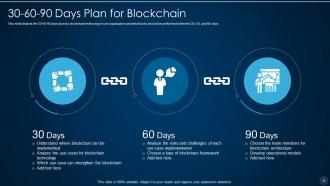
You want to elucidate the importance of blockchain technology with information about its various features in your company. Here is a competently designed template on Blockchain IT that allows you to represent the current situation of your organization by describing the problems that occurred in recent years. Furthermore, the distributed ledger template shows the core components of the blockchain architecture and its features. It also throws light on the components of each block in blockchain technology along with its architecture. Also, this digital ledger presentation depicts how a transaction enters the blockchain and details about different blockchain technologies such as private, public, consortium, hybrid, etc. Also, the crypto ledger template highlights the details of the three pillars of blockchain technology, its pros and cons, bitcoin technology vs. blockchain, blockchain security and the blockchain market. Lastly, the blockchain presentation shows the application of blockchain in different sectors, the impact of blockchain technology, a checklist, a 30-60-90 day plan, and a roadmap for blockchain implementation. Our designers have created 100 percent customizable templates with your convenience in mind. Hit the download button to pack this fabulous deck today.
People who downloaded this PowerPoint presentation also viewed the following :
Content of this Powerpoint Presentation
Slide 1: This slide introduces Blockchain Technology (IT). State Your Company Name and begin.
Slide 2: This slide shows Agenda for Blockchain Technology.
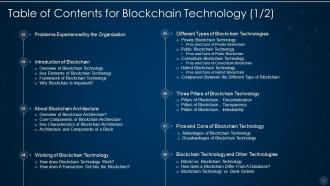
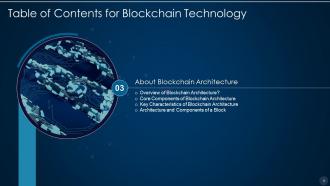
Slide 3: This slide presents Table of Contents for Blockchain Technology.
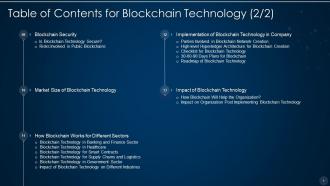
Slide 4: This is another slide continuing Table of Contents for Blockchain Technology.
Slide 5: This slide displays Table of Content highlighting Problems Experienced by the Organization.
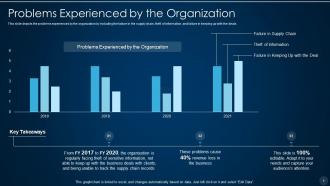
Slide 6: This slide depicts the problems experienced by the organization by including the failure in the supply chain.
Slide 7: This slide shows Table of Contents for Blockchain Technology.
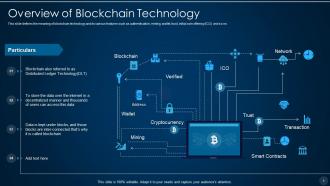
Slide 8: This slide defines the meaning of blockchain technology and its various features such as authentication, mining, wallet, etc.
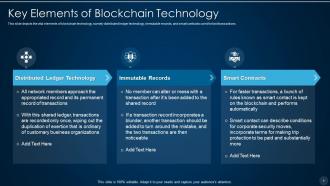
Slide 9: This slide shows vital elements of blockchain technology, namely distributed ledger technology, immutable records, and smart contracts.
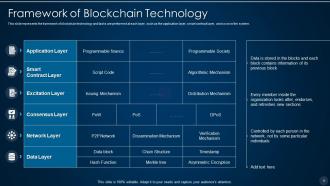
Slide 10: This slide displays framework of blockchain technology and tasks are performed at each layer.
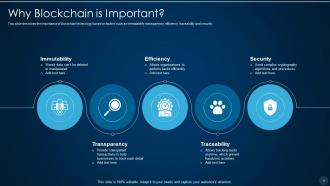
Slide 11: This slide represents importance of blockchain technology based on factors such as immutability, transparency, etc.
Slide 12: This slide shows Table of Contents for Blockchain Technology.
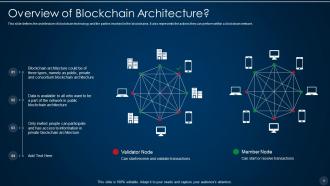
Slide 13: This slide defines the architecture of blockchain technology and the parties involved in the blockchains.
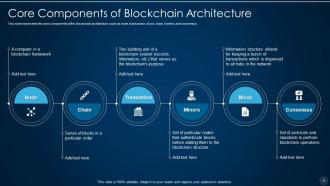
Slide 14: This slide shows core components of the blockchain architecture, such as node, transaction, block, chain, etc.
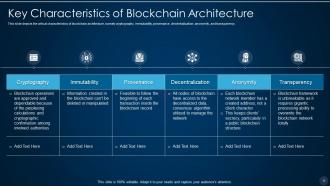
Slide 15: This slide displays Key Characteristics of Blockchain Architecture.
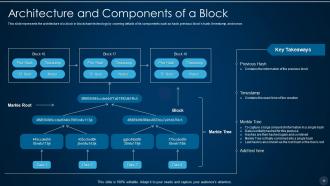
Slide 16: This slide represents architecture of a block in blockchain technology by covering details of its components.
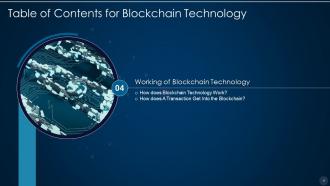
Slide 17: This slide shows Table of Contents for Blockchain Technology.
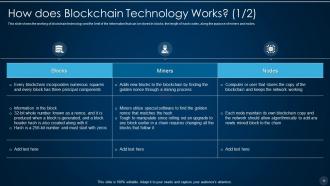
Slide 18: This slide presents the working of blockchain technology and the limit of the information that can be stored in blocks.
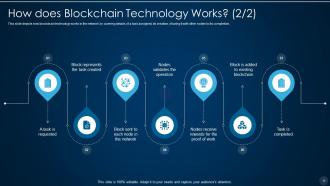
Slide 19: This slide depicts how blockchain technology works in the network by covering details of a task assigned.
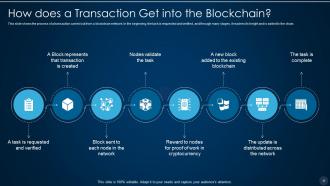
Slide 20: This slide displays process of a transaction carried out from a blockchain network.
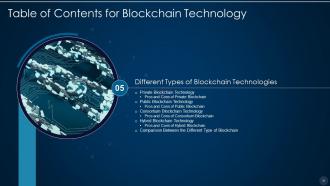
Slide 21: This slide represents Table of Contents for Blockchain Technology.
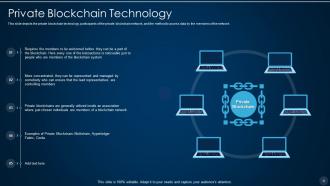
Slide 22: This slide shows private blockchain technology, participants of the private blockchain network, and the method to access data by the members of the network.
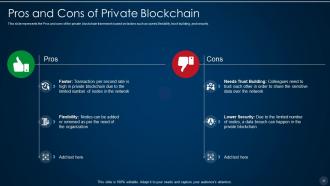
Slide 23: This slide represents the Pros and cons of the private blockchain framework based on factors such as speed, flexibility, trust-building, and security.
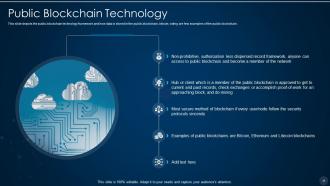
Slide 24: This slide depicts the public blockchain technology framework and how data is stored in the public blockchain.
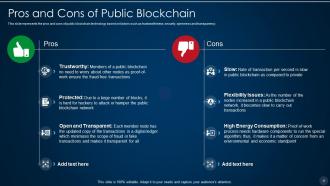
Slide 25: This slide represents the pros and cons of public blockchain technology based on factors such as trustworthiness, security, etc.
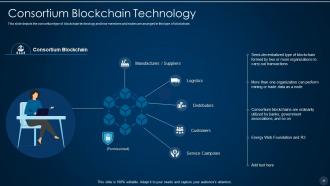
Slide 26: This slide depicts the consortium type of blockchain technology and how members and nodes are arranged in this type of blockchain.
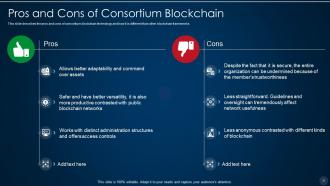
Slide 27: This slide shows Pros and Cons of Consortium Blockchain.
Slide 28: This slide defines the hybrid type of blockchain technology and how it is established by combining two different types of blockchain.
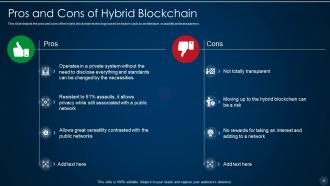
Slide 29: This slide depicts the pros and cons of the hybrid blockchain technology based on factors such as architecture, scalability and transparency.
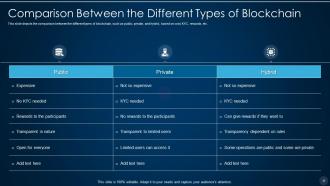
Slide 30: This slide displays the comparison between the different types of blockchain, such as public, private, and hybrid.
Slide 31: This slide shows Table of Contents for Blockchain Technology.
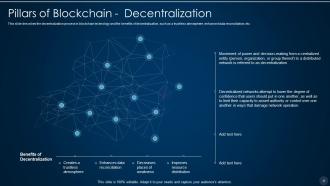
Slide 32: This slide describes the decentralization process in blockchain technology and the benefits of decentralization.
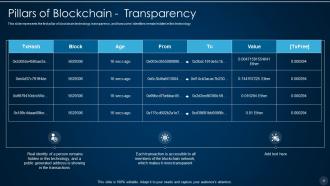
Slide 33: This slide represents the first pillar of blockchain technology, transparency, and how users' identities remain hidden in this technology.
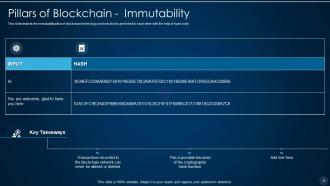
Slide 34: This slide depicts the immutability pillar of blockchain technology and how blocks are linked to each other.
Slide 35: This slide displays Table of Contents for Blockchain Technology.
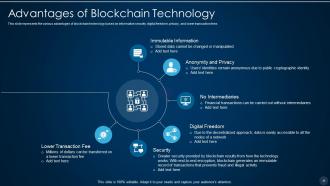
Slide 36: This slide represents advantages of blockchain technology based on information security, digital freedom, privacy, etc.
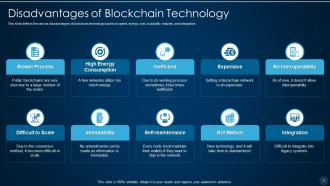
Slide 37: This slide shows disadvantages of blockchain technology based on speed, energy, cost, scalability, etc.
Slide 38: This slide presents Table of Contents for Blockchain Technology.
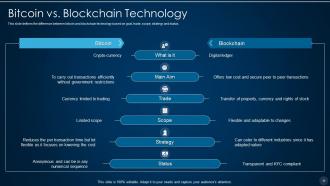
Slide 39: This slide defines the difference between bitcoin and blockchain technology based on goal, trade, scope, strategy and status.
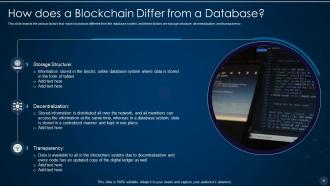
Slide 40: This slide depicts the various factors that make blockchain different from the database system.
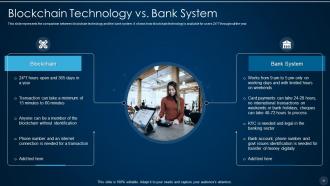
Slide 41: This slide represents the comparison between blockchain technology and the bank system.
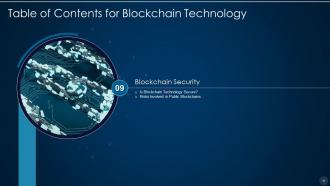
Slide 42: This slide shows Table of Contents for Blockchain Technology.
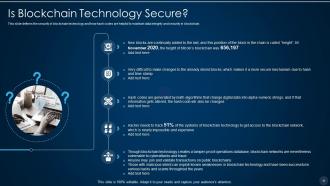
Slide 43: This slide presents the security of blockchain technology and how hash codes are helpful to maintain data integrity.
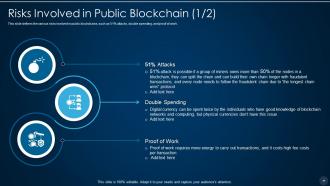
Slide 44: This slide defines the various risks involved in public blockchains, such as 51% attacks, double spending, and proof of work.
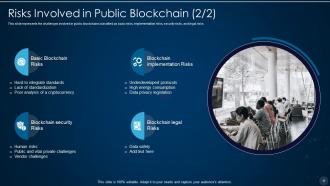
Slide 45: This slide represents the challenges involved in public blockchains classified as basic risks, implementation risks, etc.
Slide 46: This slide shows Table of Contents for Blockchain Technology.
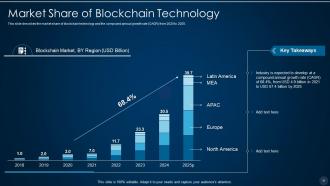
Slide 47: This slide describes the market share of blockchain technology and the compound annual growth rate (CAGR) from 2020 to 2025.
Slide 48: This slide presents Table of Contents for Blockchain Technology.
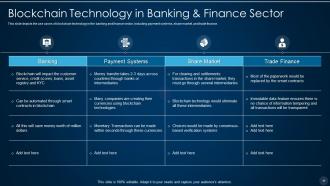
Slide 49: This slide depicts the use cases of blockchain technology in the banking and finance sector.
Slide 50: This slide describes the use case of blockchain in the healthcare sector and how it would be beneficial for medical departments.
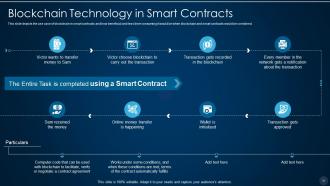
Slide 51: This slide depicts the use case of blockchain in smart contracts and how beneficial and less time-consuming it would be.
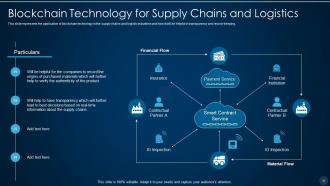
Slide 52: This slide shows Blockchain Technology for Supply Chains and Logistics.
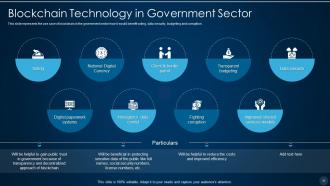
Slide 53: This slide presents use case of blockchain in the government sector how it would benefit voting, data security, budgeting and corruption.
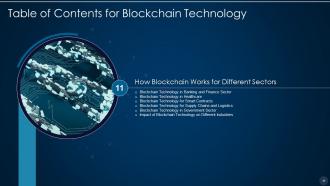
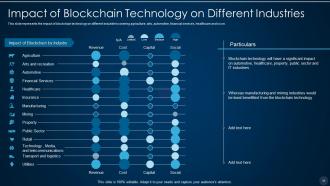
Slide 54: This slide shows Impact of Blockchain Technology on Different Industries.
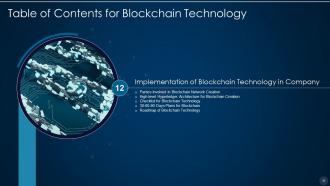
Slide 55: This slide displays Table of Contents for Blockchain Technology.
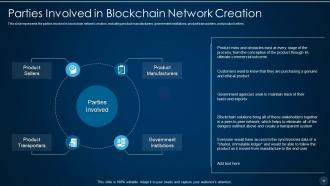
Slide 56: This slide represents Parties Involved in Blockchain Network Creation.
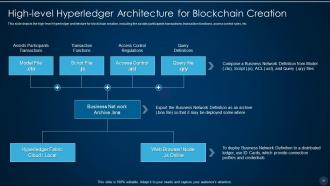
Slide 57: This slide shows High-level Hyperledger Architecture for Blockchain Creation.
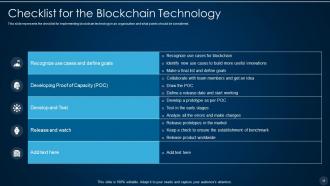
Slide 58: This slide presents Checklist for the Blockchain Technology.
Slide 60: This slide represents the roadmap of blockchain implementation in an organization and the benchmarks to be achieved.
Slide 61: This slide shows Table of Contents for Blockchain Technology.
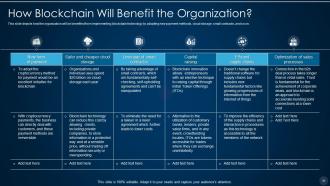
Slide 62: This slide depicts how the organization will be benefited from implementing blockchain technology by adopting new payment methods.
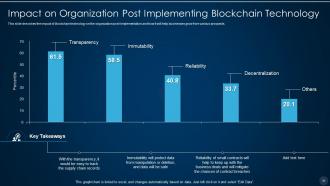
Slide 63: This slide presents Impact on Organization Post Implementing Blockchain Technology.
Slide 64: This slide shows Icons for Blockchain Technology (IT).
Slide 65: This slide is titled as Additional Slides for moving forward.
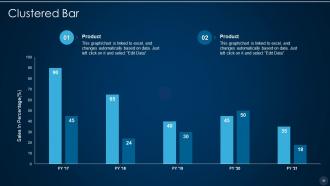
Slide 66: This slide represents Clustered Bar with two products comparison.
Slide 67: This slide shows Line Chart with two products comparison.
Slide 68: This is Our Mission slide with related imagery and text.
Slide 69: This slide shows Venn diagram with text boxes.
Slide 70: This slide displays Post It Notes. Post your important notes here.
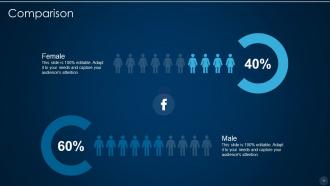
Slide 71: This is a Comparison slide to state comparison between commodities, entities etc.
Slide 72: This is a Thank You slide with address, contact numbers and email address.
Blockchain technology it powerpoint presentation slides with all 72 slides:
Use our Blockchain Technology IT Powerpoint Presentation Slides to effectively help you save your valuable time. They are readymade to fit into any presentation structure.








FAQs for Blockchain technology it
So blockchain has three main things - decentralization, immutability, and transparency. Basically no single company controls it since data gets spread across tons of computers. Once something's added, you can't really change it (which is honestly pretty cool). All transactions are visible to everyone, though people use fake names so it's not like your real identity is out there. Different networks have ways to make sure everyone agrees before adding new stuff. Oh and here's a tip - whenever you're looking at crypto projects, check how they actually use these three principles. That'll tell you pretty quick if it's worth your time or just another scam.
So basically, there's no single weak spot to attack - hackers would need to take down thousands of computers at once, which just isn't happening. Every transaction gets recorded publicly where anyone can check it. Think of it like having a massive crowd watching everything that happens. The whole network has to agree before anything gets approved, so nobody can secretly mess with the records or pull shady stuff. Honestly, I'd probably avoid any blockchain that doesn't have tons of nodes spread out everywhere. That's really your main sign it's actually secure and trustworthy.
Oh totally, blockchain's actually pretty solid for supply chains. Food companies and pharma are already using it - you can trace stuff back to the exact source which is clutch when there's contamination or whatever. My friend works at a startup doing this for organic coffee (random tangent but their beans are amazing). Anyway, it stops counterfeiting since everything's recorded permanently. If something goes wrong, you don't have to shut down your entire operation - just find the problem batch. I'd definitely start with like one product line first though, see how it goes.
Okay so smart contracts are basically "if-then" programs that live on the blockchain. When certain conditions get met, they automatically execute agreements without anyone having to manually do anything. Like in supply chain - once goods are delivered and confirmed, payment gets released instantly. No middlemen needed, which honestly is pretty cool. They cut down on errors too since everything's automated. The biggest win? You set the rules once, then the blockchain handles all the execution for you. Saves a ton of time and money. Way faster than traditional processes.
So basically, each vote becomes this encrypted transaction that gets locked into a distributed ledger - nobody can mess with it after that. Estonia's actually been doing this for years, which is pretty wild when you think about it. Your vote stays private through cryptography but everyone can still verify the results in real-time. The big wins are stopping tampering, cutting costs vs traditional voting, and - honestly the best part - giving people actual confidence their vote matters. There's no single system that hackers can target since it's spread across multiple nodes.
So Bitcoin mining? Yeah, it's terrible for the environment - we're talking entire countries' worth of electricity just to run those computers solving math problems. Honestly the numbers are insane when you look them up. But here's the thing - it totally depends on the energy source. Coal-powered mining is obviously way worse than solar or wind. Oh and newer blockchains like Ethereum actually switched to this "proof-of-stake" thing that uses like 99% less energy, which is pretty cool. Just check what consensus mechanism any project uses before you get into it.
Honestly, blockchain could change everything about money. Instead of banks being middlemen, you'd get instant payments anywhere in the world - no more waiting 3-5 business days for transfers. Smart contracts handle loans and insurance automatically, which is pretty sick when you think about it. All transactions get locked into this permanent record that's basically impossible to hack or fake. Plus it gives banking access to people who can't even get regular accounts right now. I've been messing around with some DeFi apps lately and it's wild seeing this stuff actually work. Way more secure than traditional databases too.
Dude, interoperability is a game changer for crypto. Currently moving stuff between Bitcoin and Ethereum is such a headache - you're stuck dealing with bridges or wrapped tokens or whatever. But when blockchains can actually talk to each other? Way better liquidity and you're not trapped in one ecosystem. It's like texting between iPhone and Android instead of being stuck in one bubble. Polkadot and Cosmos are pretty solid for cross-chain stuff if you're building anything. Honestly wish more projects focused on this instead of just launching another random token.
Honestly? Scalability's your biggest pain point - most blockchain networks are painfully slow compared to regular databases. Cost gets crazy too, especially with proof-of-work systems that burn through energy. Good luck finding devs who actually know smart contracts well. Integration's a total nightmare when you're trying to connect everything to your existing systems. Oh, and don't get me started on regulatory stuff - nobody really knows what's coming next there. I'd just start small, maybe a pilot project or something. Test it out before you dump serious money into it.
So basically blockchain creates these cryptographic records that prove your data is actually yours - no need for Facebook or Google playing middleman. Your info gets encrypted and spread across this decentralized network instead of sitting in some corporate vault. Think of it like a digital safe where you're the only one with keys. Companies can't just grab your data and sell it anymore. You get to pick who sees what, and honestly? You can even make money off it directly. Pretty wild stuff. Look into self-sovereign identity solutions if you're curious - that's where this tech gets really interesting.
Honestly, regulations can totally make or break blockchain projects. Companies need clarity to actually invest money, otherwise they just wait it out. The EU's doing it right with MiCA - gives crypto businesses something to work with. Meanwhile other places? Total mess. Smart rules actually help innovation by setting boundaries everyone understands. But go too restrictive and all the good developers just move somewhere else. I'd definitely watch what's happening in your area though - it'll affect funding and who wants to partner with you.
Blockchain basically gives you control over your own medical records - pretty cool concept. No more hospitals keeping everything locked up in their separate systems. You'd have like a digital medical passport that doctors, pharmacies, whoever actually needs access can use. Can't be hacked or faked either, which is huge. Though honestly the technology is still kind of a mess right now. But imagine never having to deal with faxing records between doctors again - we're literally still doing that in 2024, it's ridiculous. If you're serious about trying this, I'd say start with something simple like tracking prescriptions first.
Honestly, blockchain could be a game-changer for protecting your stuff. It timestamps everything so you can prove exactly when you created something - patents, art, whatever. Think of it like a digital notary that can't lie or lose your paperwork. No single company controls the records either, which makes them way more believable in court. I've been meaning to look into this more myself actually. If you're working on anything original, you should probably get it documented on one of those blockchain platforms sooner rather than later. Better safe than sorry with IP theft these days.
So NFTs are basically digital certificates that prove you own the "original" of something online - like art, music, whatever. Yeah, copies can still exist everywhere, but you've got the blockchain receipt showing it's yours. Pretty weird concept honestly, but it works. Artists love it because they can sell directly and get paid again when their stuff resells later. You can trade them like physical collectibles too. I'd check out OpenSea if you're curious - that's where most people buy and sell them. The whole thing still feels surreal to me sometimes.
Dude, blockchain could be massive for developing countries. People without bank accounts can finally get digital payments and small loans. Plus it fights corruption - imagine transparent government services and land records that can't be faked. Agriculture supply chains get way more efficient too. Sure, internet access is still sketchy in some places, but mobile solutions are already killing it in Kenya and Nigeria. Rwanda and Estonia are doing cool stuff with blockchain for public services if you want to check that out. The potential is honestly pretty wild.
-
Easily Understandable slides.
-
I discovered this website through a google search, the services matched my needs perfectly and the pricing was very reasonable. I was thrilled with the product and the customer service. I will definitely use their slides again for my presentations and recommend them to other colleagues.
-
Out of the box and creative design.
-
Understandable and informative presentation.
-
Unique design & color.
-
Helpful product design for delivering presentation.
-
Much better than the original! Thanks for the quick turnaround.
-
Colors used are bright and distinctive.
-
Innovative and attractive designs.
-
Great quality slides in rapid time.