


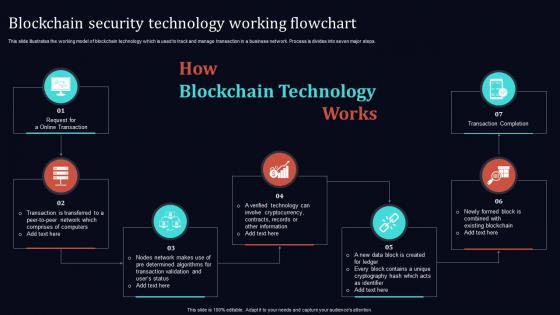
Blockchain Security Technology Working Flowchart




Try Before you Buy Download Free Sample Product
 Impress Your
 Audience
 100%
100% Editable
 Save Hours
 of Time


This slide illustrates the working model of blockchain technology which is used to track and manage transaction in a business network. Process is divides into seven major steps.
People who downloaded this PowerPoint presentation also viewed the following :
Blockchain Security Technology Working Flowchart with all 6 slides:
Use our Blockchain Security Technology Working Flowchart to effectively help you save your valuable time. They are readymade to fit into any presentation structure.





FAQs for Blockchain Security
Look, it's basically three big ideas working together. First, the data gets spread across tons of computers instead of one central server - way harder to hack. Then there's this crazy math thing where each block links to the previous one cryptographically, making it super tough to mess with old records. Oh and the network has to agree before adding new stuff, so you can't just have one person screwing things up. The whole decentralization angle is honestly what makes it so much stronger than regular databases. Start with understanding how those three pieces connect and you'll get why everyone's making such a big deal about blockchain security.
So basically, hashing creates these unique digital fingerprints for each block of data. Change even one tiny bit? The whole hash changes completely - it's like a tamper-proof seal. That's how the network catches anyone trying to mess with transaction records, because suddenly the hash doesn't match what everyone else stored. The hashes link all the blocks together too, so if you screw with one block, you break the entire chain. Honestly, it's pretty clever how they designed it. That's why people say blockchain can't be changed - the hashing system does all the work.
So basically these consensus algorithms make everyone in the network vote on what's legit before adding stuff to the blockchain. Bad actors can't mess with it because they'd need to control most of the network - which costs a fortune. No single authority to trust, which is honestly pretty cool. The whole thing's distributed so there's no weak spot that can break everything. Proof of Work vs Proof of Stake have different pros and cons, but they both let you verify transactions yourself without trusting anyone. Creates this trustless system that just... works.
So smart contracts are like automated bouncers for your transactions - they won't let anything through unless specific conditions get met first. No trusting random people involved. Picture a vending machine that's super strict about exact change, except it's handling your business deals. Once the code goes live, nobody can mess with the rules. The blockchain double-checks everything automatically, which makes scamming pretty much impossible. Honestly, if you're doing any kind of deals or transactions manually right now, you should probably look into this stuff. Saves so much headache.
So blockchain is actually pretty solid against DDoS attacks - no single point they can hammer since it's spread across thousands of nodes globally. Attack some nodes? The rest keep chugging along. The consensus stuff also makes spam attacks crazy expensive to pull off. But here's the thing - apps built on top can still get wrecked if they're designed poorly. I'd honestly just combine blockchain's natural distribution with regular DDoS protection tools at the app level. Works way better than relying on one approach.
So basically a 51% attack is when someone gets control of most of the mining power on a blockchain. Once they have that, they can mess with transactions, spend the same coins twice, even rewrite what happened before. It's honestly pretty terrifying when you think about it. Smaller networks are way more vulnerable since it doesn't cost as much to take them over. Best protection? Networks need tons of miners spread everywhere and good monitoring to catch weird stuff. Bitcoin's probably safe because attacking it would cost billions, but I'd stick with the big established chains for anything important. The math just works better that way.
So blockchain's immutability is pretty sick for security stuff. Once something's written, you literally can't change it without the whole network catching you - like having a million people watching every move. Bad guys can't go back and mess with logs after they've done their damage, which drives them crazy honestly. Security teams are obsessed with this because the audit trail is rock solid. You can track anything from digital certificates to who accessed what and when. My buddy at work uses it for compliance stuff and swears by it. Really though, if you need records that absolutely cannot be tampered with, blockchain's your best bet.
Honestly, public blockchains get hit with way more attacks since literally anyone can join - you've got 51% attacks, Sybil stuff, all that. But they're also more proven because they deal with constant attacks. Private ones flip the script though. Sure, you get better access controls and can actually meet compliance requirements (which is huge for enterprise), but now you're basically trusting a small group of validators. If those guys go bad or get hacked, you're screwed. I guess it comes down to what you need more - true decentralization or having actual control over who's running things.
So basically, you get to own your personal data instead of having it spread all over different platforms. Blockchain stores cryptographic proofs of your credentials - like digital certificates that can't be faked. No central authority means fewer security risks since hackers don't have one big target to go after. Instead of passwords, your identity gets verified through cryptographic signatures. Honestly, it's pretty cool tech - way better than the current mess we deal with. You should check out self-sovereign identity frameworks if you're curious. That's probably the best starting point.
So SHA-256 hashing and digital signatures are your bread and butter here. Proof of Work or Proof of Stake will handle consensus - honestly, PoS is way more energy efficient if you're starting fresh. Merkle trees act like fingerprints for data verification, super handy. Multi-sig schemes work great when you need multiple people signing off on transactions. Zero-knowledge proofs are clutch for keeping sensitive stuff private. I'd definitely audit whatever hash functions you're using first though - that's literally the foundation everything else sits on. Without solid hashing, the rest falls apart pretty quickly.
So basically you're stuck with this trilemma thing - speed vs security vs decentralization. Pick two, you know? Want faster transactions? You'll probably need fewer validators or weaker consensus, which honestly just opens the door for attacks. Layer 2 stuff like Lightning Network helps but creates new problems too (classic crypto move lol). Best approach I've seen is mixing it up - keep the important transactions on main chain for security, then use sidechains for the smaller stuff that doesn't matter as much.
Honestly, I'd start with a solid security audit - check their consensus mechanism, smart contracts, the whole network setup. Has this blockchain been hacked before? How active are the devs? What patches have they rolled out recently? Bug bounty programs are a good sign they actually care about security issues. Your integration points matter too - figure out how you'll handle private keys safely. Oh, and definitely don't just trust their marketing BS. Get your security folks to actually pen test whatever APIs you're planning to use.
So there's some pretty cool stuff happening with blockchain security right now. Zero-knowledge proofs are huge - they let you verify transactions without exposing sensitive data. Quantum-resistant crypto is also being developed since quantum computers could eventually break current encryption (though that's still years away, probably). Machine learning integration is actually really impressive - these systems can spot weird patterns and potential attacks crazy fast. Multi-party computation is another big one - basically lets multiple parties work together securely without revealing their individual data. If you're thinking about implementing anything, I'd definitely check what security features your platform already has built in.
Look, industry groups and regulators need to work together on this - similar to how PCI DSS fixed payment security mess. Different industries have totally different risk levels though, so one standard won't work everywhere. NIST is already drafting blockchain security guidelines that could be a solid starting point. Honestly, I'd follow what ISO and IEEE are putting out while keeping tabs on working groups in your specific field. The tricky part? Start with security practices that most sectors already agree on, then build from there.
So community governance is like having a massive security team watching everything 24/7. When threats pop up, everyone can vote on fixes and upgrades way faster than some corporate board could decide. Pretty smart tbh - no single company gets to make sketchy decisions that could screw everyone over. You want to find networks where people actually participate in voting. High turnout usually means better security oversight. I learned this the hard way after watching too many projects get wrecked because nobody was paying attention to governance proposals. Check those participation rates!
-
I am not the best at presentations but using SlideTeam’s PPT template made it easier for me. Thank you SlideTeam!
-
Good research work and creative work done on every template.