


Compensation plan direct and indirect example




Try Before you Buy Download Free Sample Product
 Impress Your
 Audience
 100%
100% Editable
 Save Hours
 of Time


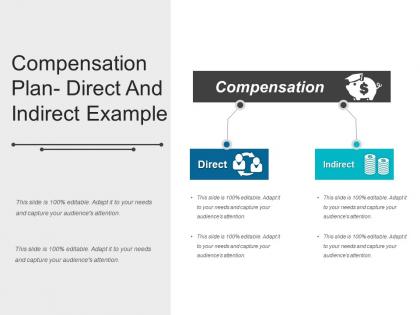
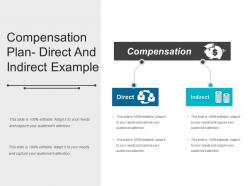
Showcase the complete package that details the wages, salaries, benefits and other terms of payment with the assistance if this amazingly designed Compensation Plan Direct And Indirect Example PPT template. Depict the different types of compensation plan i.e. the direct and the indirect plan in your business organization. Mention the requirements of a good compensation plan and present it in front of your audience with the help of this employee compensation plan PPT slide design. Portray the importance of worker’s compensation plan through this completely customizable compensation strategy PowerPoint slide show. Present the strategy on the basis of which employees’ compensation is calculated. Showcase the basic components of employee compensation and benefits that include the guaranteed pay, variable pay, equity based compensation, and other benefits. Get this compensation plan package PowerPoint template to display the benefits of a good compensation plan in an organization.
People who downloaded this PowerPoint presentation also viewed the following :
Compensation plan direct and indirect example with all 5 slides:
Increase the chances of agreement with our Compensation Plan Direct And Indirect Example.It helps identify grounds for consensus.

FAQs for Compensation plan direct
Key components of an effective compensation plan include base salary, performance incentives, benefits packages, equity compensation, and career development opportunities. These elements work together by attracting top talent, retaining skilled employees, and aligning individual performance with organizational goals, with many companies finding that strategic compensation ultimately drives productivity and competitive advantage.
A compensation plan aligns with business strategy by linking employee rewards to strategic objectives, performance metrics, and company values, ensuring behaviors drive desired outcomes. Through equity-based incentives, performance bonuses tied to revenue targets, and role-specific metrics, organizations streamline talent retention, accelerate goal achievement, and enhance competitive positioning, ultimately delivering strategic execution and sustainable growth.
Performance-based pay motivates employees by directly linking compensation to individual achievements, team outcomes, and organizational goals, creating clear financial incentives for excellence. This approach enhances productivity, accountability, and goal alignment across departments, with many companies finding that sales teams, customer service representatives, and project managers demonstrate significantly improved performance when compensation reflects their measurable contributions.
Organizations ensure pay equity through regular pay audits, standardized salary bands, transparent promotion criteria, consistent performance evaluation processes, and market-based compensation benchmarking. These systematic approaches streamline fairness by eliminating bias, enhancing accountability, and delivering objective compensation decisions, with many companies finding that structured equity measures ultimately reduce turnover while strengthening competitive talent retention.
Designing remote compensation plans requires considering geographic cost-of-living variations, performance measurement methodologies, technology stipends, flexible benefit packages, and equity considerations across locations. Many organizations balance location-based pay scales with role-based benchmarks, while incorporating remote work allowances, enhanced digital benefits, and performance metrics that emphasize outcomes over hours, ultimately delivering competitive packages that attract distributed talent.
Global companies adapt compensation plans by adjusting base salary ratios, benefits packages, performance metrics, and reward structures to align with local cultural values, regulatory requirements, and market expectations. Through localized approaches, organizations in collectivist cultures emphasize team-based incentives while individualistic markets favor merit-based pay, ultimately delivering culturally sensitive compensation strategies that enhance employee satisfaction and retention across diverse markets.
Stock options offer advantages including employee retention through vesting periods, alignment of worker interests with company performance, attraction of top talent without immediate cash outlay, and potential tax benefits for both parties. However, they present disadvantages like dilution of existing shareholder equity, complexity in valuation and administration, market volatility affecting perceived value, and potential employee dissatisfaction if stock prices decline, with many startups finding balanced compensation packages most effective.
Companies effectively communicate compensation plans through transparent documentation, regular town halls, personalized statements, interactive workshops, and dedicated HR consultations. Many organizations find that combining multiple channels—such as detailed plan summaries, one-on-one meetings, and digital portals—enhances employee understanding, builds trust, and ultimately drives better engagement with compensation structures while reducing confusion and misconceptions.
Key metrics include employee retention rates, performance improvement indicators, cost-per-hire reductions, salary competitiveness ratios, and overall productivity measures. These evaluation tools streamline assessment by tracking engagement levels, goal achievement rates, and market positioning, with many organizations finding that regular metric analysis ultimately delivers enhanced talent retention and improved operational efficiency.
Compensation plans should be reviewed annually at minimum, with quarterly assessments for rapidly evolving roles or competitive markets, considering factors like industry benchmarks, performance metrics, regulatory changes, and business objectives. Many organizations find that regular reviews enable them to maintain competitive positioning, address pay equity concerns, and adapt to market shifts, ultimately delivering improved talent retention and organizational performance.
Competitive benchmarking significantly influences compensation planning by ensuring salary ranges align with market standards, identifying pay gaps across roles, and informing strategic positioning decisions. This data-driven approach enables organizations to attract top talent while controlling costs, with many companies finding that regular benchmarking enhances retention rates and maintains competitive advantage in increasingly talent-focused markets.
Technology streamlines compensation plan development through automated data analysis, real-time market benchmarking, predictive modeling, and integrated performance tracking systems. These solutions enhance accuracy by eliminating manual calculations, accelerating approval processes, and providing transparent dashboards, with many organizations finding that automated compensation management reduces administrative costs while improving employee satisfaction and strategic decision-making capabilities.
Best practices for integrating bonuses and incentives include aligning rewards with strategic objectives, establishing clear performance metrics, ensuring transparent communication of criteria, and maintaining competitive market positioning. These approaches enhance employee motivation and retention by creating measurable pathways to additional compensation, while enabling organizations to drive specific behaviors that support business growth, ultimately delivering improved performance outcomes and stronger talent engagement across teams.
Companies balance fixed and variable pay by establishing competitive base salaries for stability while tying 20-40% of total compensation to performance metrics, team goals, and company objectives. Through strategic combinations of salary, bonuses, commissions, and equity components, organizations enhance employee motivation, retain top talent, and align individual performance with business outcomes, ultimately delivering improved productivity and competitive advantage in talent acquisition.
Legal considerations include compliance with wage and hour laws, equal pay regulations, overtime requirements, tax implications, and industry-specific regulations. Organizations must ensure their compensation structures align with federal and state employment laws, anti-discrimination statutes, and benefits regulations, with many companies finding that proactive legal review streamlines implementation while minimizing compliance risks.
-
Professional and unique presentations.
-
Informative presentations that are easily editable.