


Competency Mapping Iceberg Model For Organization




Try Before you Buy Download Free Sample Product
 Impress Your
 Audience
 100%
100% Editable
 Save Hours
 of Time


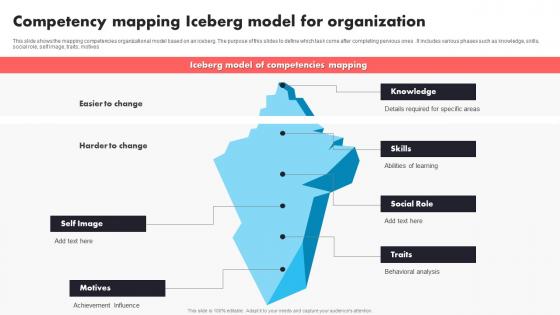
This slide shows the mapping competencies organizational model based on an iceberg. The purpose of this slides to define which task come after completing pervious ones .It includes various phases such as knowledge, skills, social role, self image, traits, motives
People who downloaded this PowerPoint presentation also viewed the following :
Competency Mapping Iceberg Model For Organization with all 6 slides:
Use our Competency Mapping Iceberg Model For Organization to effectively help you save your valuable time. They are readymade to fit into any presentation structure.





FAQs for Competency Mapping Iceberg
Competency mapping is the systematic process of identifying, defining, and evaluating the specific skills, behaviors, and knowledge required for successful job performance across organizational roles. It enables companies to align talent with strategic objectives, optimize recruitment and training programs, and identify skill gaps that impact productivity, with many organizations finding that structured competency frameworks enhance performance management and accelerate leadership development initiatives.
Competency mapping focuses on behavioral attributes, skills, and knowledge required for superior performance, while traditional job analysis emphasizes tasks, duties, and responsibilities within specific roles. This approach enables organizations to identify leadership potential, plan succession strategies, and develop targeted training programs, with many companies finding that competency-based frameworks deliver greater workforce agility and strategic talent alignment.
Key components include competency identification, behavioral indicators definition, proficiency level establishment, assessment methodology design, and gap analysis frameworks. These elements work together by aligning organizational goals with individual capabilities, enabling targeted development programs, and facilitating strategic talent decisions, with many companies finding that systematic competency mapping ultimately enhances workforce planning and competitive advantage.
Organizations identify core competencies through comprehensive workforce assessments, industry benchmarking, strategic business analysis, and stakeholder feedback processes. These methods enable companies to pinpoint critical skills by analyzing competitor requirements, evaluating current employee capabilities, and mapping future business objectives, with many organizations finding that systematic competency frameworks ultimately enhance talent acquisition, development strategies, and competitive positioning.
Competency mapping identifies skill gaps and training needs by comparing current employee abilities against required competencies for specific roles, enabling targeted development programs, personalized learning paths, and strategic resource allocation. Organizations across industries like healthcare, finance, and manufacturing use this approach to enhance workforce capabilities, reduce training costs, and ultimately deliver improved performance while building competitive advantage through strategic talent development.
Competency mapping enhances talent acquisition by defining precise skill requirements, creating targeted job descriptions, and enabling structured candidate assessments that align with organizational needs. This strategic approach streamlines recruitment processes, reduces hiring mismatches, and improves candidate quality, with many HR departments finding that competency-based frameworks significantly accelerate time-to-hire while ensuring better role-candidate fit.
Common competency mapping tools include behavioral assessment platforms, 360-degree feedback systems, competency modeling software, skills gap analysis tools, and performance management frameworks. These technologies streamline the mapping process by automating data collection, providing standardized competency libraries, and generating detailed analytics, with many organizations finding that integrated platforms significantly enhance accuracy while reducing administrative overhead and improving strategic workforce planning.
Organizations use competency mapping to enhance performance appraisal systems by establishing clear behavioral standards, creating objective evaluation criteria, and aligning individual assessments with strategic business goals. This approach enables managers to provide more targeted feedback, identify specific development opportunities, and make data-driven decisions about promotions and succession planning, ultimately delivering fairer evaluations and improved employee engagement.
**INPUT**: What are some challenges organizations face when implementing competency mapping? **OUTPUT**: Organizations face challenges including defining clear competency standards, securing stakeholder buy-in, managing data collection complexity, ensuring assessment accuracy, and maintaining ongoing updates. These obstacles can be overcome through strategic planning, comprehensive training programs, and robust technology platforms, with many companies finding that systematic implementation ultimately delivers enhanced talent development and competitive advantage.
Technology streamlines competency mapping through automated skill assessments, AI-powered gap analysis, real-time performance tracking, and integrated learning management systems. These digital platforms enable organizations to identify talent gaps more efficiently, create personalized development pathways, and align workforce capabilities with strategic objectives, ultimately delivering faster talent optimization and competitive advantage.
Competency mapping supports succession planning by identifying critical skills gaps, assessing leadership readiness across organizational levels, and creating targeted development pathways for high-potential employees. Through systematic competency analysis, organizations streamline talent identification, accelerate leadership preparation, and ensure business continuity, with many companies finding that structured mapping reduces succession risks while enhancing strategic workforce planning.
Competency mapping enhances employee engagement and retention by providing clear career pathways, identifying skill gaps for targeted development, and aligning individual strengths with organizational roles. Through structured competency frameworks, organizations create personalized growth opportunities, increase job satisfaction, and reduce turnover, with many companies finding that employees feel more valued and motivated when their capabilities are systematically recognized and developed.
Organizations should consider performance improvement rates, skill gap closure percentages, employee engagement scores, training ROI, succession planning readiness, and time-to-proficiency for new roles when evaluating competency mapping effectiveness. These metrics enable leaders to track talent development progress, optimize resource allocation, and measure competitive advantage, with many companies finding that comprehensive evaluation delivers enhanced workforce capabilities and strategic organizational growth.
Competency mapping fosters continuous learning by identifying skill gaps, establishing clear development pathways, and creating personalized learning journeys for employees. Through systematic assessment and goal-setting, organizations can align individual growth with business objectives, while employees gain visibility into advancement opportunities, ultimately delivering enhanced engagement and strategic talent development.
Companies like IBM have leveraged competency mapping to identify skill gaps and optimize talent development, while healthcare organizations use it to ensure clinical staff maintain required certifications and competencies. Financial services firms, including major banks, apply competency frameworks to streamline recruitment, enhance performance evaluations, and accelerate leadership development, ultimately delivering improved operational efficiency and strategic workforce alignment.
-
Such amazing slides with easy editable options. A perfect time-saver.
-
My team has been relying on SlideTeam’s professional PPT designs for a while now. It has greatly sped up quality work at my organization. So thanks!