


Competency leadership development roadmap with key skills
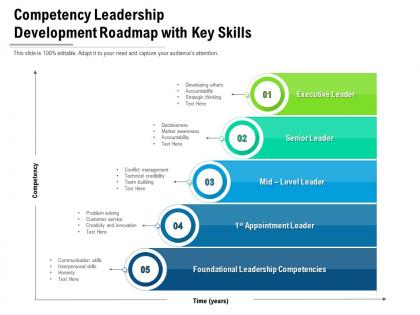




Try Before you Buy Download Free Sample Product
 Impress Your
 Audience
 100%
100% Editable
 Save Hours
 of Time


Our Competency Leadership Development Roadmap With Key Skills are topically designed to provide an attractive backdrop to any subject. Use them to look like a presentation pro.
People who downloaded this PowerPoint presentation also viewed the following :
Competency leadership development roadmap with key skills with all 2 slides:
Use our Competency Leadership Development Roadmap With Key Skills to effectively help you save your valuable time. They are readymade to fit into any presentation structure.
FAQs for Competency leadership development roadmap
Dude, there's like 5 main things you gotta nail down. Emotional intelligence is huge - seriously, I've watched super smart leaders crash and burn just because they couldn't read their team. Then there's adaptability since everything changes overnight these days. Communication skills are obvious but still crucial. You need strategic thinking to zoom out and see the whole picture, plus digital literacy because tech runs everything now (kinda scary tbh). Pick whichever one you're worst at and just focus on that for the next few months. Get feedback, practice it, whatever. They're all totally learnable if you actually put in the work.
Honestly, I'd start with having people rate their own skills, then compare that to what their managers think during regular one-on-ones. Performance reviews are perfect for this - they usually show exactly where someone's hitting walls. Look at actual project outcomes too, not just what people say they can do. 360 feedback is clutch because coworkers see blind spots that bosses miss completely. Don't rely on just one of these though - you'll get a way clearer picture combining a few different approaches. Once you've got that data, compare it to where you actually need people to be. That gap? There's your training roadmap right there.
Honestly, feedback is like having a map when you're lost - you need it to know if you're even heading in the right direction. Otherwise you're just wandering around hoping for the best. Get it from everyone: your boss, coworkers, maybe people who report to you. The golf swing comparison is cheesy but whatever, it works. Don't wait around for your yearly review either - that's way too slow. Ask for feedback regularly so you can fix stuff quickly instead of doing things wrong for months. Trust me, being proactive about it makes a huge difference.
So basically, competency frameworks show your people exactly what skills they need and how to grow. No more guessing games. Performance reviews become way less awkward too - instead of that weird "so...how do you think you're doing?" thing, managers can give real feedback about actual skill gaps. People get more engaged when they can see their path forward clearly. Honestly, it beats the old system where everyone just hoped for the best. Start simple though - pick 3-5 key competencies per role and spell out what each level looks like.
Honestly, just bake it into what people already do instead of making it feel like homework. Try quick skill swaps in regular meetings or set up some peer mentoring. Your leaders need to admit they're still learning stuff too - nobody trusts the "I know everything" boss anyway. Give folks maybe 30 minutes a week for development (sounds tiny but it adds up). Make sure people can mess up without getting in trouble. Oh, and don't go crazy launching ten different programs. Pick one or two things and actually stick with them. Consistency beats going all-out then burning out.
Honestly, e-learning platforms are perfect for this stuff. You can build learning paths that actually hit people's weak spots instead of generic training nobody cares about. Real-time tracking is huge - way better than crossing your fingers after some random workshop. People learn at their own speed, which is clutch. Oh, and you actually get data on what's bombing vs what's working, so you're not just guessing anymore. I'd start by matching your competencies to specific modules first. Makes everything way more focused and less scattered.
So basically you need both the hard numbers and the fuzzy stuff to really know if it's working. Performance metrics, before/after skill tests, how fast people actually use what they learned - that's your foundation. Employee engagement and retention tell you a ton too because honestly, people bail when they're not growing. Track completion rates and how long it takes to get up to speed with new skills. Oh and definitely survey people directly about whether the training was actually useful or just a waste of time. The trick is measuring everything beforehand, then checking back in like 6-12 months later to see if it moved the needle on business results.
Look, every industry's different when it comes to global skills. Tech companies are obsessed with digital stuff and staying flexible. Healthcare? They're all about cultural sensitivity and ethics - makes sense really. Manufacturing cares more about safety and talking across cultures. Finance is a whole mess of risk management and regulations (seriously, those compliance rules change like every month). Don't just copy what everyone else does. Figure out what actually matters in your field first. Check what you're already teaching against what your competitors are doing, then build training around those gaps. Way more effective than generic programs.
Honestly, the main thing that kills these programs is when leadership doesn't really care - employees can smell that from a mile away. You'll also run into vague job descriptions where nobody actually knows what "strategic thinking" means for their role. People get cynical fast when it feels like busy work from HR. Most companies go overboard creating these massive competency lists that look good on paper but don't connect to actual performance. Budget's always tight too. I'd say pick one critical role first, get those managers excited about it, and show real business results. Otherwise you're just checking boxes.
Dude, you HAVE to get employees involved from the start - like, it's literally the difference between success and total failure. Your people actually know their skill gaps and what kind of training works for them. HR can guess all they want, but they'll probably get it wrong. When employees help design the program, they're way more invested in following through. Don't just ask for feedback after you've built everything though - that's backwards. Get them in early when you're still figuring things out. Trust me, programs built without employee input usually crash and burn pretty spectacularly.
Honestly, I'd start by figuring out who you're actually dealing with - ages, experience, cultural stuff, how people like to learn. Younger folks usually love those bite-sized digital courses. Older employees? They're more into mentorship and actual face-to-face sessions in my experience. Some cultures are all about group learning while others want to work solo. Career stage matters too - new people need the basics, but senior staff want the strategic thinking skills. Oh, and definitely give people options on how they want to learn. Nobody likes being forced into one method.
Honestly, the best approach I've seen is pairing employees with mentors who've already nailed those specific competencies. Skip the gap analysis paralysis. Set up regular coaching sessions focused on targeted skill-building, but don't make it super rigid - that kills the vibe. Your coaching check-ins should track progress while mentors give real-world context and guidance. Pick one competency area to pilot first (trust me on this). The whole thing needs to feel supportive, not like another corporate checkbox exercise. Structure it enough so people know what they're working toward, but leave room for actual conversations.
Honestly, competency development is a game changer for keeping people happy at work. When you invest in your team's skills, they feel valued and stick around longer. Growing professionally makes people way more confident in their roles too. The trick is actually listening to what skills they want to build - not just pushing random training on them. I've seen this work so well when companies align development with where employees see their careers going. People literally crave that growth! Short version: help them grow, they'll love their jobs more and won't bail for the competition.
Look, you want people who can problem-solve creatively and actually work across departments without drama. Digital skills are obvious but don't forget the soft stuff - emotional intelligence matters way more than people think. Try running design thinking workshops or hackathons first. Gets everyone's brains working differently. Build programs around whatever future skills your industry's gonna need - but honestly, adaptability trumps everything else. The whole point is making people comfortable with taking smart risks and experimenting. Oh, and change management training. Trust me on that one - nobody teaches it but everyone needs it when things get messy.
Start by actually connecting skills to what you're trying to achieve as a company - like if you want better customer satisfaction, work on communication and problem-solving. So many places just throw random training at people without thinking it through! Get your managers involved in spotting the real skill gaps that matter for results. Then build clear development paths that employees can see will help their careers AND the business. People need to understand how their growth fits the bigger picture - otherwise what's the point? Track progress with real numbers so you can pivot when priorities change.
-
Unique design & color.
-
Visually stunning presentation, love the content.
-
Understandable and informative presentation.
-
Easily Understandable slides.
-
I discovered this website through a google search, the services matched my needs perfectly and the pricing was very reasonable. I was thrilled with the product and the customer service. I will definitely use their slides again for my presentations and recommend them to other colleagues.
-
Really like the color and design of the presentation.
-
Helpful product design for delivering presentation.