


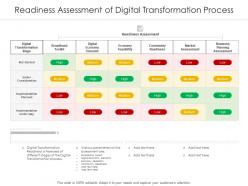
Readiness assessment of digital transformation process





Try Before you Buy Download Free Sample Product
 Impress Your
 Audience
 100%
100% Editable
 Save Hours
 of Time


Our Readiness Assessment Of Digital Transformation Process are topically designed to provide an attractive backdrop to any subject. Use them to look like a presentation pro.
People who downloaded this PowerPoint presentation also viewed the following :
Readiness assessment of digital transformation process with all 2 slides:
Use our Readiness Assessment Of Digital Transformation Process to effectively help you save your valuable time. They are readymade to fit into any presentation structure.

FAQs for Readiness assessment of
Digital transformation readiness indicators include technology infrastructure maturity, workforce digital skills, leadership commitment, data management capabilities, and change management processes. Organizations demonstrating strong readiness typically show integrated systems, employee adaptability to new technologies, and clear digital strategies, with many finding that cultural openness to innovation ultimately delivers faster implementation and sustainable competitive advantage.
Companies can assess their technological infrastructure by evaluating system integration capabilities, data management frameworks, cybersecurity protocols, scalability potential, and employee digital literacy levels. Through comprehensive audits and gap analyses, organizations identify bottlenecks, outdated systems, and skill deficiencies, while benchmarking against industry standards, ultimately enabling strategic investment prioritization and smoother transformation implementation.
Employee skills and training serve as the foundation for digital transformation readiness, determining how effectively organizations can adopt new technologies, adapt workflows, and leverage data-driven insights. Through comprehensive upskilling programs, companies enable workforce agility, reduce resistance to change, and accelerate implementation timelines, with many finding that strategic training investments ultimately deliver higher adoption rates and competitive advantage.
Corporate culture significantly impacts digital transformation by influencing employee adoption, leadership commitment, risk tolerance, and change management effectiveness. Organizations with collaborative, innovation-focused cultures typically accelerate transformation initiatives through faster technology integration and cross-departmental cooperation, while traditional hierarchical cultures may face resistance, ultimately requiring strategic cultural shifts alongside technological investments to achieve competitive advantage.
Common barriers include legacy system constraints, insufficient digital skills, cultural resistance to change, limited budget allocation, and unclear strategic vision. These challenges often interconnect, with many organizations finding that addressing cultural mindset shifts alongside technical infrastructure upgrades delivers better outcomes, while strategic leadership alignment streamlines implementation and enhances long-term competitive advantage.
Leadership strategies significantly influence digital transformation preparedness by establishing clear vision, fostering innovation culture, and driving organizational alignment across all levels. Effective leaders prioritize strategic technology investments, champion change management initiatives, and ensure cross-functional collaboration, with many organizations finding that strong leadership commitment accelerates adoption timelines and ultimately delivers sustainable competitive advantage in increasingly digital markets.
Companies should measure digital transformation readiness using metrics like technology infrastructure maturity, employee digital skills assessments, data quality scores, change management capacity, and leadership commitment levels. These metrics enable organizations to identify gaps in areas such as cloud adoption, cybersecurity frameworks, and workforce capabilities, ultimately delivering strategic insights that guide investment priorities and accelerate successful transformation outcomes.
Customer feedback is crucial in digital transformation strategies, helping organizations prioritize user experience improvements, identify technology gaps, and align digital initiatives with actual customer needs rather than assumptions. Through systematic feedback collection, companies like banks redesigning mobile platforms and retailers optimizing e-commerce experiences can accelerate adoption rates, reduce implementation costs, and ultimately deliver more competitive services that drive customer loyalty.
Organizations should prioritize cloud computing, data analytics platforms, cybersecurity frameworks, automation tools, and customer relationship management systems when assessing digital transformation readiness. These technologies work together by enabling scalable infrastructure, data-driven decision making, and streamlined operations, with many companies finding that this strategic combination ultimately delivers enhanced operational efficiency and competitive advantage.
Smaller businesses can compete by leveraging agility, focused implementation, and cost-effective cloud solutions that bypass traditional infrastructure investments. While larger enterprises face complex legacy system integration, smaller companies can adopt modern technologies more quickly, make faster decisions, and deliver personalized customer experiences, ultimately gaining competitive advantage through speed and flexibility.
Data governance establishes the foundation for digital transformation by ensuring data quality, security, compliance, and accessibility across organizational systems. Through robust governance frameworks, companies streamline decision-making processes, enhance operational efficiency, and minimize regulatory risks, with many financial services and healthcare organizations finding that strong data governance accelerates their transformation initiatives while delivering competitive advantage.
Organizations create digital transformation roadmaps by assessing current capabilities, defining clear objectives, prioritizing high-impact initiatives, and establishing measurable milestones with realistic timelines. Through strategic planning, companies systematically address technology infrastructure, workforce development, and process optimization, with many finding that phased implementation approaches enable smoother transitions while delivering incremental value and sustained competitive advantage.
Regulatory compliance presents both challenges and opportunities for digital transformation, requiring organizations to balance innovation with adherence to industry standards, data protection laws, privacy regulations, and sector-specific requirements. While compliance can initially slow implementation timelines, it ultimately drives more robust, secure, and scalable solutions, with many financial services and healthcare organizations finding that regulatory frameworks enhance customer trust and competitive advantage.
Cross-departmental collaboration enhances digital transformation readiness by breaking down silos, aligning strategic objectives, and pooling diverse expertise across IT, operations, and business units. This collaborative approach enables organizations to identify integration opportunities, streamline change management processes, and accelerate implementation timelines, with many companies finding that unified teams deliver more cohesive transformation outcomes.
Organizations should adopt practices including establishing cross-functional leadership teams, investing in employee digital literacy training, creating agile project management frameworks, implementing robust data governance policies, and building change management protocols. These approaches streamline transformation initiatives by enhancing collaboration, reducing skill gaps, and accelerating adoption timelines, with many enterprises finding that strategic workforce preparation ultimately delivers faster implementation cycles and sustainable competitive advantages.
-
Unique design & color.
-
Great designs, really helpful.
-
It saves your time and decrease your efforts in half.
-
Innovative and Colorful designs.
-
Illustrative design with editable content. Exceptional value for money. Highly pleased with the product.
-
Qualitative and comprehensive slides.
-
Out of the box and creative design.