


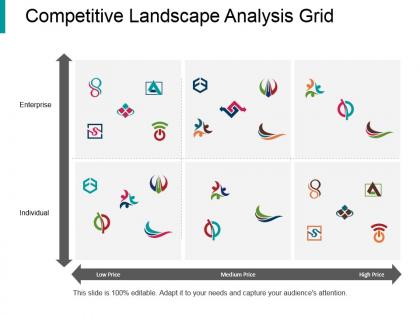
Competitive landscape analysis grid sample of ppt presentation




Try Before you Buy Download Free Sample Product
 Impress Your
 Audience
 100%
100% Editable
 Save Hours
 of Time


Bring insensitivity to an end with our Competitive Landscape Analysis Grid Sample Of Ppt Presentation. Induce feelings if compassion.
People who downloaded this PowerPoint presentation also viewed the following :
Competitive landscape analysis grid sample of ppt presentation with all 5 slides:
Indulge in the game with our Competitive Landscape Analysis Grid Sample Of Ppt Presentation. Accurately assess the capability of your competitors.


FAQs for Competitive landscape analysis grid sample
Key metrics include market share, pricing strategies, customer acquisition costs, revenue growth rates, and brand positioning effectiveness. These indicators enable businesses to benchmark performance, identify market gaps, and optimize resource allocation, with many organizations finding that comprehensive competitor analysis streamlines strategic planning and ultimately delivers sustainable competitive advantage.
SWOT analysis enhances competitive landscape assessments by systematically evaluating internal strengths, weaknesses, and external opportunities, threats across market players and positioning dynamics. This strategic framework enables organizations to identify competitive gaps, benchmark capabilities against rivals, and uncover market positioning opportunities, ultimately delivering actionable insights that drive strategic differentiation and competitive advantage.
**INPUT**: What tools can be employed for comprehensive competitor monitoring and data collection? **OUTPUT**: Comprehensive competitor monitoring tools include social media analytics platforms, SEO monitoring software, patent databases, financial reporting systems, and market intelligence services like SEMrush or Ahrefs. These technologies streamline competitive analysis by tracking digital footprints, analyzing market positioning, and monitoring pricing strategies, with many organizations finding that automated data collection delivers faster insights and enhanced strategic decision-making capabilities. **Word count: 60 words**
Market share percentages influence strategic decision-making by revealing competitive positioning, identifying growth opportunities, and highlighting market vulnerabilities that require immediate attention. These metrics enable organizations to allocate resources strategically, adjust pricing models, and develop targeted market penetration strategies, with many companies finding that consistent share analysis ultimately delivers enhanced competitive advantage and more informed investment decisions.
Customer feedback reveals competitor strengths, weaknesses, pricing strategies, service gaps, and market positioning through direct user experiences and comparisons. This intelligence enables businesses to identify differentiation opportunities, benchmark performance against rivals, and develop strategic responses that address unmet needs, ultimately delivering competitive advantages while enhancing customer satisfaction and market share.
Social media analytics reveal competitors' strengths and weaknesses by monitoring engagement rates, content performance, audience sentiment, follower growth patterns, and response times across platforms. Through these metrics, businesses can identify gaps in competitors' strategies, benchmark their own performance, and discover market opportunities, with many companies finding that consistent analysis enables more targeted positioning and enhanced competitive advantage.
Emerging trends can reshape competitive landscapes by introducing new technologies, changing consumer behaviors, creating regulatory shifts, and enabling novel business models across industries. These disruptions allow agile companies to gain market share through innovation, while traditional players must adapt quickly, with many financial services and retail organizations finding that early trend adoption delivers significant competitive advantages and operational efficiency.
Balancing qualitative and quantitative data in competitive landscape analysis involves combining numerical metrics like market share, pricing, and financial performance with insights from customer feedback, brand perception studies, and strategic positioning assessments. This strategic combination enables organizations to understand both measurable competitive gaps and nuanced market dynamics, ultimately delivering comprehensive intelligence that drives informed decision-making and sustainable competitive advantage.
Common mistakes include analyzing too few competitors, focusing solely on direct competitors while ignoring indirect threats, relying on outdated information, and concentrating on features rather than customer value propositions. Many organizations also fail to analyze competitor pricing strategies, underestimate emerging market disruptors, and neglect to translate insights into actionable strategic decisions, ultimately missing opportunities for competitive advantage.
Visual representation of competitive data enhances understanding by transforming complex market information into easily digestible charts, graphs, and dashboards that reveal patterns, trends, and positioning gaps instantly. These visualizations streamline communication across teams, enable faster strategic decision-making, and help organizations identify competitive advantages more effectively, ultimately delivering clearer insights and stronger market positioning strategies.
Product feature comparison should prioritize pricing models, functionality depth, user experience design, integration capabilities, and customer support quality. Through comprehensive analysis across these dimensions, businesses can identify market gaps, differentiation opportunities, and competitive positioning strategies, with many organizations finding that this systematic approach enables strategic product development and ultimately delivers stronger market positioning.
Pricing strategies vary through premium positioning, cost leadership, value-based pricing, penetration pricing, and dynamic pricing models. Competitors differentiate by targeting distinct customer segments, leveraging operational efficiencies, and emphasizing unique value propositions, with many organizations finding that strategic pricing combinations ultimately deliver market share growth and enhanced profitability.
Competitive landscape analysis influences product development by identifying market gaps, revealing competitor weaknesses, uncovering emerging customer needs, and highlighting successful feature combinations. Through systematic competitor evaluation, organizations can prioritize innovation investments, accelerate time-to-market for differentiated solutions, and develop strategic product positioning, with many companies finding that data-driven competitive insights ultimately deliver stronger market penetration and sustainable competitive advantage.
Businesses leverage competitive insights by identifying market gaps, analyzing competitor weaknesses, understanding customer pain points, and recognizing unmet needs within their industry landscape. Through comprehensive competitive analysis, organizations can differentiate their offerings, develop targeted messaging, and position unique features that competitors lack, ultimately delivering superior customer value and sustainable competitive advantage.
Technological advancements reshape competitive dynamics by accelerating innovation cycles, lowering market entry barriers, enabling data-driven decision making, and creating new business models that disrupt traditional industries. Companies leveraging AI, automation, and digital platforms gain significant advantages in operational efficiency, customer personalization, and market responsiveness, while those slow to adapt risk obsolescence in increasingly technology-driven markets.
-
Helpful product design for delivering presentation.
-
Informative presentations that are easily editable.