


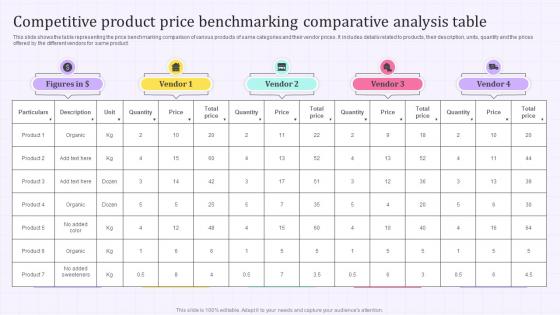
Competitive Product Price Benchmarking Comparative Analysis Table




Try Before you Buy Download Free Sample Product
 Impress Your
 Audience
 100%
100% Editable
 Save Hours
 of Time


This slide shows the table representing the price benchmarking comparison of various products of same categories and their vendor prices. It includes details related to products, their description, units, quantity and the prices offered by the different vendors for same product.
People who downloaded this PowerPoint presentation also viewed the following :
Competitive Product Price Benchmarking Comparative Analysis Table with all 6 slides:
Use our Competitive Product Price Benchmarking Comparative Analysis Table to effectively help you save your valuable time. They are readymade to fit into any presentation structure.





FAQs for Competitive Product Price Benchmarking
Look at three key areas: what competitors charge, your actual costs, and what customers think you're worth. Honestly, getting good competitor pricing data is such a headache - but start small with maybe 3-4 key players instead of trying to research everyone. Make sure your costs don't eat up all your profit margins. Customer perception is huge too. If you've positioned yourself as premium, you can usually get away with higher prices. Don't overthink it at first - just get a baseline from those main competitors and build from there.
Just hit up their websites first - you'd be shocked how much pricing they put right out there. Industry reports are solid too, plus those market research companies publish tons of stuff. I always check trade shows since people love showing off their prices there. Customer surveys work really well - just ask what they're seeing elsewhere. Oh and there are tools that automatically grab public pricing data, which saves time. The main thing is don't be sketchy about it - no asking their employees for inside info or anything like that. Stick to what's already public and you're golden.
Look, market demand is basically what sets your whole pricing game. High demand? You can benchmark against those premium prices. But if demand's weak, you gotta look at more competitive rates or you'll get left behind. Think about it - copying competitor prices without knowing if people will actually buy at those levels is kinda pointless, right? Like selling ice cream when it's freezing outside. I always tell people to check their benchmarking against real demand stuff - conversion rates, how fast things are selling. That combo gives you the actual picture of what'll work.
Quarterly is the bare minimum, but monthly's way better if your market moves fast. I got burned once when a competitor dropped prices and we didn't catch it for like 3 months - not fun explaining that to the boss lol. B2B stuff usually changes slower, so quarterly works. Retail and tech though? You need monthly updates, sometimes weekly. Really depends how often your competitors are actually switching things up. Oh and set up some alerts for big moves between your regular check-ins. Trust me on that one.
Look, price benchmarking is basically your sanity check against competitors - and honestly, it'll save your ass more than you think. Track what 3-5 key players are doing monthly because small tweaks can seriously boost your margins. You'll catch if you're pricing yourself out or being way too generous (both suck for different reasons). Once you know where everyone sits, you can get smarter about going premium or finding those sweet spots where customers will actually pay more. I know it sounds super dry, but the profit impact is real. Even tiny adjustments add up fast.
You're basically driving while staring at the rearview mirror, which is sketchy. Historical data misses current market shifts, supply chain chaos, new competitors - all that stuff. Your benchmarks could be trash within months, especially if markets are going crazy. Missing new pricing strategies competitors are testing is another problem. I've watched teams get completely blindsided by this more times than I can count. Real-time market intel helps a ton. Even just checking competitor websites monthly beats relying on old data. Oh, and forward-looking indicators too if you can swing it.
Honestly, price benchmarking is your best friend here. Check what your big competitors are charging regularly - they're usually slow to adjust prices, which works in your favor. You can either undercut them or charge more by offering something they don't (better service, faster shipping, whatever). Pick like 3-5 main competitors to watch consistently instead of going crazy tracking everyone. Google Shopping and their websites are good starting points - free too. Once you start seeing some wins, maybe invest in actual monitoring tools. Big companies mess up pricing all the time because they're not paying attention to smaller markets.
So pretty much any cutthroat industry benefits from this stuff. Retail, manufacturing, SaaS, telecom - they're all doing it. Commoditized markets like auto parts or electronics? Absolutely critical since pricing literally makes or breaks deals. Healthcare and financial services are jumping on board too, mainly because of regulatory heat. Here's the thing though - if your customers can google competitors (which is everyone now), you need to be tracking prices. I'd start simple: pick your top 3-5 direct competitors and check their pricing monthly. Sounds boring but you'll actually get useful data from just that.
Dude, just automate the whole data collection thing instead of doing those painful spreadsheet updates. You'll get real-time competitor pricing from multiple sources without losing your mind. The analytics tools are honestly pretty sick - they catch patterns you'd totally miss otherwise. Set up alerts so you know the second competitors change prices, then run some regression analysis to figure out price elasticity. Oh, and you can predict optimal pricing scenarios too which is clutch. Way less time gathering data means more time actually understanding what it all means. Just make sure whatever tools you pick play nice with your current systems first.
Check your benchmark prices against a few different sources - industry reports, competitor tools, whatever market research you can get your hands on. Your sales team is gold for this since they actually hear what customers are saying every day. Make sure you're comparing similar products too, not mixing different contract sizes or specs. I'd track changes over time because weird price jumps usually mean something's off with your data. Oh, and set up some kind of regular check-in, maybe every quarter? Keeps everything current and you won't get blindsided by outdated numbers.
Honestly, regional stuff will totally throw off your benchmarking if you don't watch out. Start by breaking things down by region first - don't even try doing some universal standard because it'll be garbage. Germany's pricing won't make any sense in Brazil, you know? The whole economic setup is different. Currency swings make it even messier, which is annoying but whatever. I'd look for patterns within similar economic zones instead. Way more realistic than pretending everywhere's the same market.
After you benchmark, focus on the big three: market share, revenue growth, and profit margins. Customer acquisition and retention rates show if your pricing actually works with real buyers. Keep an eye on competitors too - they might react and mess up your whole strategy. Sales velocity matters a lot (are deals closing faster?). Honestly, monthly reviews are kind of a pain but you need at least six months of data to spot real trends. That's when you can actually make smart adjustments instead of just guessing.
So basically, check what your competitors are charging and you'll spot the gaps. Maybe everyone's bunched up at similar price points but there's room for a premium option. Or they're all ignoring budget customers - that's your opening right there. Think of it like a chess board with empty squares you can claim. Map out where everyone sits price-wise, then look for the holes between clusters. That's where you can slide in with something new that nobody else thought to offer. Those sweet spots are usually sitting right there waiting.
You'll want to check prices way more often - weekly if things get crazy, not quarterly. Track supplier costs and commodity stuff before your competitors catch up because their pricing is already old news. Honestly the workload sucks but whatever. Regional differences matter too since some areas get hit harder than others. Weight your recent data heavier than old benchmarks - like, way heavier. Shrink your decision timelines down and keep backup pricing ready to go. Oh and build in bigger buffers for when everything goes sideways again.
Know your crowd first - execs want the big picture stuff while procurement digs into your actual methods and vendor breakdowns. Charts and dashboards are your friend here because let's be real, no one's reading through spreadsheets. What really matters is the "so what" factor. How do you stack up? Where are the gaps? What should they actually do about it? Don't just dump data once either - set up regular check-ins to keep people caring. Oh, and always throw in market context and timing. Otherwise people won't get why any of this matters right now.
-
“Thanks to SlideTeam. Now I can make smart presentations in a fraction of time without any hassle.”
-
I am not the best at presentations but using SlideTeam’s PPT template made it easier for me. Thank you SlideTeam!