


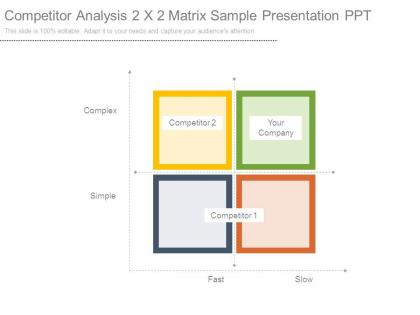
Competitor analysis 2x2 matrix sample presentation ppt




Try Before you Buy Download Free Sample Product
 Impress Your
 Audience
 100%
100% Editable
 Save Hours
 of Time


Judge the idea with our Competitor Analysis 2x2 Matrix Sample Presentation Ppt. Assess if it includes all inputs.
People who downloaded this PowerPoint presentation also viewed the following :
Competitor analysis 2x2 matrix sample presentation ppt with all 7 slides:
Impress folks with the feasibility of your ideas with our Competitor Analysis 2x2 Matrix Sample Presentation Ppt. It allows you to interact with your colleagues.

FAQs for Competitor analysis 2x2 matrix
Competitors showcase presentation templates through visual galleries with category filtering, interactive previews, customer testimonials, and free sample downloads. Many successful template providers like Envato and Creative Market enhance discoverability by featuring industry-specific collections, high-quality thumbnails, and user ratings, ultimately driving conversions through strategic social proof and seamless browsing experiences.
Competitors typically update their template offerings quarterly or bi-annually to align with emerging design trends, seasonal themes, and industry shifts. Through strategic market monitoring, leading platforms like Canva and Adobe continuously refresh their libraries with contemporary color schemes, typography styles, and layout formats, while smaller competitors often follow these trends within 3-6 months, ultimately ensuring their offerings remain competitive and visually current.
Competitors typically implement subscription-based models, one-time purchase options, freemium tiers, enterprise licensing, and pay-per-download structures for presentation templates. These pricing approaches enable market segmentation by targeting different customer needs, from individual users to large organizations, with many companies finding that hybrid models combining free offerings with premium subscriptions maximize both user acquisition and revenue generation.
Competitor design interfaces vary significantly in user-friendliness, with leading platforms offering intuitive navigation, clear categorization, robust search filters, and streamlined checkout processes. While some competitors excel in customization previews and drag-and-drop functionality, others present cluttered layouts or complex purchasing flows, with many businesses finding that superior interface design directly correlates with higher conversion rates and customer satisfaction.
Competitors typically receive feedback on template design quality, customization flexibility, content relevance, ease of use, and pricing value. Through customer reviews and testimonials, many businesses find that users prioritize professional aesthetics, industry-specific options, and seamless editing capabilities, with organizations increasingly seeking templates that enhance their brand presentation while streamlining preparation time.
Competitors leverage social media through visual storytelling showcasing template transformations, influencer partnerships with business professionals, targeted advertising campaigns, user-generated content featuring customer success stories, and platform-specific strategies optimized for each channel. These approaches streamline brand visibility by demonstrating real-world applications, building community engagement, and driving conversions, with many template providers finding that consistent social proof ultimately delivers higher customer acquisition rates.
Competitors differentiate their templates through specialized industry focuses, advanced interactive elements, extensive customization options, integrated collaboration tools, and proprietary design frameworks. These unique features enhance user experiences by streamlining workflow processes, enabling real-time team collaboration, and delivering sector-specific solutions, with many organizations finding that specialized templates significantly reduce preparation time while maintaining professional standards.
Competitors typically target healthcare, technology, finance, education, and consulting sectors with specialized presentation templates, alongside broader business categories like marketing, sales, and project management. Through industry-specific designs and content frameworks, companies like PresentationGo, SlideModel, and 24Slides deliver templates for financial reports, medical presentations, and tech pitches, with many organizations finding that niche-focused templates significantly enhance professional credibility and audience engagement.
Visual aesthetics in competitor templates resonate through strategic color psychology, typography choices, layout structures, and imagery styles that align with audience preferences and industry standards. Through comprehensive design analysis, businesses can identify effective visual patterns across demographics, sectors like healthcare or finance, and user engagement metrics, ultimately enabling more targeted template development and competitive positioning in increasingly crowded markets.
Differentiation opportunities include interactive presentation formats, industry-specific template collections, data visualization specializations, collaborative workflow integrations, and mobile-optimized designs that competitors often overlook. By focusing on underserved sectors like healthcare compliance, financial reporting, or educational assessments, companies can capture niche markets while delivering specialized functionality that enhances user productivity and presentation effectiveness.
Competitors engage customers through social media communities, loyalty programs, personalized content, exclusive events, and user-generated content campaigns. These strategies enhance brand connection by creating shared experiences, rewarding repeat purchases, and encouraging peer-to-peer advocacy, with many organizations finding that authentic community building delivers higher retention rates and sustainable competitive advantage.
Competitors provide template libraries with categorization systems, customization tutorials, design guidelines, and customer support resources. These tools streamline user adoption by offering step-by-step guidance, industry-specific examples, and technical assistance, with many organizations finding that comprehensive resource ecosystems significantly enhance user engagement and template utilization rates.
Competitors measure template effectiveness through presentation analytics, audience engagement metrics, user feedback surveys, conversion tracking, and A/B testing results. These measurement approaches enable organizations to assess visual impact, information retention, and audience response rates, with many businesses finding that data-driven template optimization ultimately delivers enhanced communication outcomes and stronger competitive positioning.
Competitors often establish partnerships with design agencies, software integrators, content management platforms, industry associations, and educational institutions to enhance their template offerings. These strategic collaborations enable access to specialized design expertise, broader distribution channels, and sector-specific content, while many organizations finding that such partnerships significantly expand their template variety, improve quality standards, and deliver more comprehensive solutions for diverse customer segments.
Competitors are addressing accessibility through high-contrast color schemes, screen reader compatibility, alternative text for images, keyboard navigation support, and WCAG-compliant design standards. Many presentation software companies like Microsoft and Google have integrated built-in accessibility checkers, automatic captioning, and inclusive design features, ultimately delivering broader market reach and legal compliance advantages.
-
Excellent products for quick understanding.
-
Innovative and attractive designs.