


Competitive analysis matrix sample ppt files





Try Before you Buy Download Free Sample Product
 Impress Your
 Audience
 100%
100% Editable
 Save Hours
 of Time


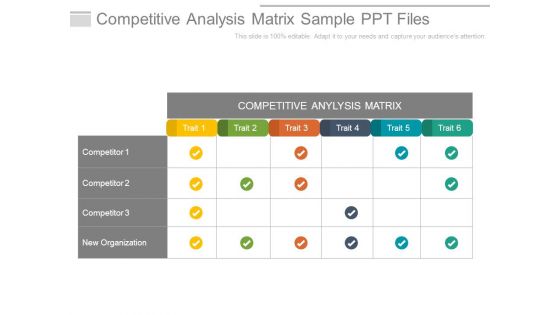
SlideTeam presents to you the Competitive Analysis Matrix Sample PPT files. Using this timetable shaped business template, you can easily make an assessment of the strengths and weaknesses of the current and potential competitors. This tabular diagram is an essential slide for presenting corporate strategy. If you use this deck of seven professionally designed slides, you will be able to identify opportunities and threats posed by your challengers. The corporation can function profitably only if you recognize your competitors well and it can be conveniently done with the help of our business template. Use this business PPT presentation to gain perspective and insight about your current market position. This PPT slideshow shows a sample slide in which you can easily change the content as per your wishes. You can easily compare various competitors using this strategy management table illustration. So simply download this professional template and enjoy its benefits. Our Competitive Analysis Matrix Sample Ppt Files will get you doing the jig. You will definitely feel like dancing.
People who downloaded this PowerPoint presentation also viewed the following :
Competitive analysis matrix sample ppt files with all 7 slides:
Our Competitive Analysis Matrix Sample Ppt Files are invariable attractive. Folks find them inherently inspiring.

FAQs for Competitive analysis matrix
Pick metrics that actually move the needle - pricing, features, market share, customer satisfaction. Then throw in performance stuff like website traffic, social media engagement, review scores. Geographic coverage and support quality matter too. Honestly, I'd cap it at like 8-12 metrics or you'll drive yourself crazy trying to track everything. Use a simple 1-5 scoring system so you can see at a glance where you're crushing it vs. where you're getting beat. Oh, and make sure whatever you pick actually ties back to your business goals - sounds obvious but you'd be surprised how many people miss that.
So basically you map out what all your competitors are doing - their features, pricing, whatever matters in your space. Then you look for the holes. Where's nobody playing? What are they all screwing up? It's honestly pretty eye-opening when you see it all spread out like that. The empty spots jump out at you. I always think the visual part is key - way easier to spot patterns than just keeping it all in your head. Once you find those gaps, figure out which ones actually make sense to go after first. Some might look tempting but be total resource drains.
Honestly, just start with whatever spreadsheet you've got - Excel or Google Sheets work fine for basic stuff. Airtable is where it's at though, seriously. The filtering and different views make it so much easier when you're juggling a million competitors. Lucidchart's pretty solid if your team needs to collaborate and you want something more visual. There are fancy tools like Crayon that are built just for this, but they're probably overkill unless you're doing this constantly. I'd stick with free options first and see how complex your matrix actually gets. You can always upgrade later if you need to.
So basically, a competitive analysis matrix is you checking out what your competitors are doing - like their prices, features, how much market share they've got. You're literally putting yourself side by side with them to see who's winning what. SWOT is totally different though. That's more like looking in the mirror at your own company - what you're good at, what sucks, what opportunities are out there, potential threats coming your way. Honestly, I think of competitive matrix as "how do we measure up against everyone else?" SWOT is more "what's going on with us internally?" Use the matrix when you need to figure out positioning or spot market gaps.
Your customers are the best reality check for competitive analysis - they'll tell you what actually matters vs what you think does. They know which competitor features rock or suck, plus pain points you totally missed. Honestly, their take on how they compare solutions when buying can be eye-opening. Use what they say to tweak your matrix criteria and update those competitor rankings. Regular surveys or quick interviews help you catch market shifts before your analysis gets stale. Sometimes I forget how much customers see that we don't!
Honestly, quarterly is the bare minimum but it really depends on your industry. Tech moves crazy fast so you might need monthly updates. More stable industries? Quarterly's probably fine. Here's what I actually do - assign someone to keep tabs on competitors weekly and have them flag when something big happens. New launches, pricing shifts, whatever. Don't just update on a schedule though, that's how you miss important stuff. Set those calendar reminders or it'll definitely slip through the cracks (learned that one the hard way). Major events should trigger immediate updates regardless of your regular timeline.
Dude, color coding is a game changer for these things. Different shades show performance levels instantly - way better than making people squint at numbers. Throw in some icons too (checkmarks, stars, whatever). Mini charts in the cells are pretty sick for showing trends over time. Most matrices I've seen are just... bland? Like pure text dumps that put everyone to sleep. Heat maps work great - darker colors for stronger performance. Oh and make it scannable so people can spot the good stuff without reading every damn cell. Nobody has time for that in meetings.
Okay so here's what I'd do - use that matrix to find spots where competitors suck but customers actually want something. That's where the money is. Check how everyone else positions themselves, then do something different with your messaging or features. Half the time you'll realize competitors aren't even solving basic problems, which is wild but happens more than you'd think. The matrix will also show you pricing gaps and feature combos nobody's tried yet. Don't go crazy though - just pick 2 or 3 solid insights and make actual plans around those instead of spreading yourself too thin.
Honestly, the biggest thing is don't go crazy with competitors - 3-5 max or you'll drown in data. Also, skip the random criteria that sound important but don't actually affect buying decisions. I've seen people rate themselves way too high because they can't be objective about their own product (guilty of this myself). Make sure you're looking at what competitors offer NOW, not from months ago - things change fast. Oh, and update it regularly or it becomes one of those charts that sits in a folder forever. Focus on what really makes customers choose one thing over another. Otherwise you're basically making corporate art.
So basically, a competitive analysis matrix is like a cheat sheet that shows where you stack up against other companies. You'll see exactly what features they have, how they price stuff, and where they position themselves. Super helpful for finding gaps you can exploit - or realizing you're way behind somewhere important. The cool part is combining it with what customers actually tell you. Sometimes you think a feature is crucial but users couldn't care less. Other times you discover everyone's missing something people desperately want. Don't just build what competitors have unless you can crush their version. Use the matrix to be ruthless about your roadmap priorities.
Look at product features first - that's where you'll actually stand out from competitors. Pricing and target market come next, plus how good the user experience is. So many startups get obsessed with funding rounds (customers literally don't care about that). Team expertise matters way more than people think. Check out their go-to-market approach and whether their tech can actually scale when they grow. Oh and distribution channels - I've seen great products die because they couldn't figure out how to reach people. Start simple with 3-5 competitors, focus on these basics, then dig deeper later.
Yeah, seasonal stuff messes with your competitive matrix big time. Holiday powerhouses? They're basically ghosts come January. Meanwhile other companies blow up during back-to-school or summer - it's wild how much things flip around. Pricing changes, product focus shifts, positioning gets turned upside down based on what season we're in. I'd probably update that matrix every quarter to catch these swings. Or honestly, just make separate versions for each season if your industry gets really crazy with the cycles. You don't want to be making decisions based on stale comparisons, you know?
Your matrix gets outdated super fast when competitors drop new products or features. Pricing shifts happen constantly too - it's honestly annoying how often you have to check. New companies jumping into your space will mess up your whole analysis. Plus existing competitors randomly pivot their strategies, which is fun. I'd say update quarterly minimum, but monthly is better if you're in something fast-moving like SaaS. Market changes hit out of nowhere sometimes. Oh, and if you're in e-commerce? Yeah, definitely go monthly because things move crazy fast there.
Honestly, just figure out what actually drives buying decisions in your industry - don't overthink it. SaaS? Pricing, features, integrations. Retail means location and product selection matter most. Manufacturing gets weird with capacity and supply chain stuff. Pick maybe 5-7 things that really count, not random business metrics that sound impressive. Here's what works: ask your sales people what customers complain about or question the most. Those objections basically tell you what criteria to focus on. I learned this the hard way when we were tracking completely useless stuff that nobody cared about.
Start with your top 3 direct competitors - companies doing exactly what you do. Then add a couple indirect ones (different product, same customer problem). Honestly, I'd skip the aspirational stuff for now unless you're really trying to impress investors or something. Look at who your prospects mention during sales calls - that's where the real intel is. Market share matters too, obviously. Don't track more than 6-8 max though. You'll burn out trying to monitor everyone and their cousin. Focus on the ones with similar business models or who keep popping up in your deals.
-
Excellent products for quick understanding.
-
Appreciate the research and its presentable format.