


Competitive Analysis Report Powerpoint Presentation Slides





Try Before you Buy Download Free Sample Product
 Impress Your
 Audience
 100%
100% Editable
 Save Hours
 of Time


Are you looking for the strategies that will provide you a distinct advantage over your competitors? SlideTeam presents you content-ready competitive analysis report PowerPoint presentation slides which will help you identify the different market opportunities. With the help of our content ready competitor identification presentation PPT, you can easily forecast the upcoming threats and opportunities, which can affect your organization. Under this professionally created competitive intelligence PowerPoint deck, we have included some significant slides like market analysis, market overview, industry size, target audience, porter’s 4 forces model, market trends, industry cost structure, distribution channel, key success factors and many more. By using these pre-designed market intelligence PPT templates, you can also represent various other closely related concepts like business rival investigation, opponent profiling, media scanning, new contender identification, participant intelligence, contestant marketing study. Hurry up and download this competitive analysis report presentation graphics immediately. Get a feel for the future with our Competitive Analysis Report Powerpoint Presentation Slides. They assist you to anticipate.
People who downloaded this PowerPoint presentation also viewed the following :
Content of this Powerpoint Presentation
Slide 1: This slide introduces Competitive Analysis Report. State Company Name and begin.
Slide 2: This is an Agenda slide. State your agendas here.
Slide 3: This slide is titled Market Analysis to move forward.
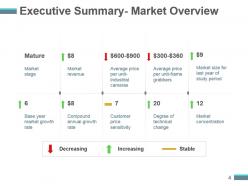
Slide 4: This slide showcases Executive Summary- Market Overview displaying- Market concentration, Market stage, Mature, Market size for last year of study period, Base year market growth rate, Market revenue, Compound annual growth rate, Average price per unit-industrial cameras, Customer price sensitivity, Average price per unit-frame grabbers, Degree of technical change.
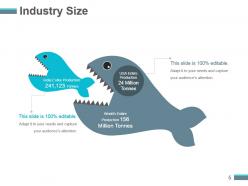
Slide 5: This slide showcases Industry Size with creative fish imagery. Show industry size in terms of market share, productivity etc. here.
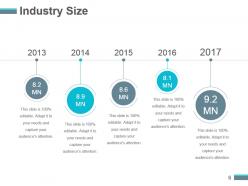
Slide 6: This slide showcases Industry Size in timeline form.
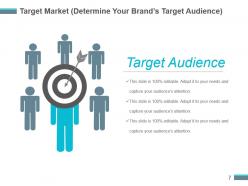
Slide 7: This slide shows Target Market (Determine Your Brand’s Target Audience).
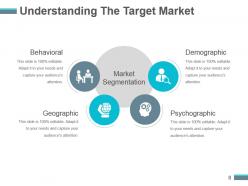
Slide 8: This slide showcases Understanding The Target Market categorized into- Behavioral, Geographic, Psychographic, and Demographic factors.
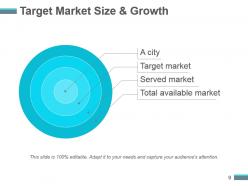
Slide 9: This slide showcases Target Market Size & Growth showing- Served market, Total available market, Target market.
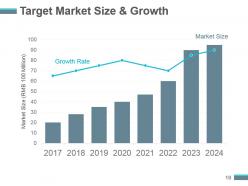
Slide 10: This slide presents Target Market Size & Growth in graph form displaying- Market Size and Growth Rate.
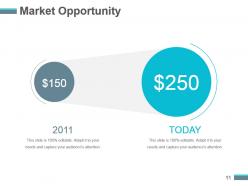
Slide 11: This slide showcases Market Opportunity. State relative facts, statistics etc. here.
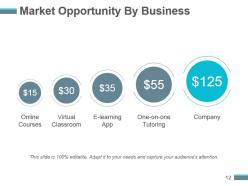
Slide 12: This slide showcases Market Opportunity By Business displaying- Online Courses, Virtual Classroom, E-learning App, One-on-one Tutoring, Company as factors to present.
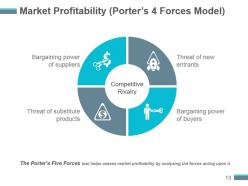
Slide 13: This slide shows Market Profitability (Porter’s 4 Forces Model) displaying- Bargaining power of buyers, Threat of new entrants, Threat of substitute products, Bargaining power of suppliers, Competitive Rivalry. The Porter's Five Forces tool helps assess market profitability by analysing the forces acting upon it.
Slide 14: This slide shows Market Trends to be shown.
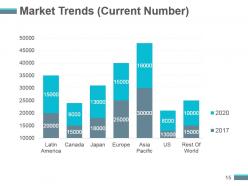
Slide 15: This slide showcases Market Trends (Current Number) in graph form.
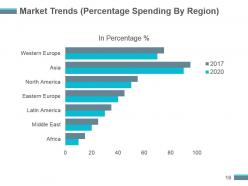
Slide 16: This slide shows Market Trends (Percentage Spending By Region) in bar graph form.
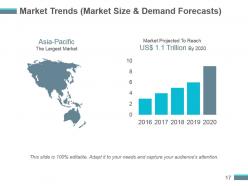
Slide 17: This slide presents Market Trends (Market Size & Demand Forecasts) in graph form with asia pacific map image.
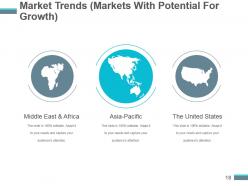
Slide 18: This slide presents Market Trends (Markets With Potential For Growth) showing- Middle East & Africa Asia-Pacific The United States map images to state geographical facts.
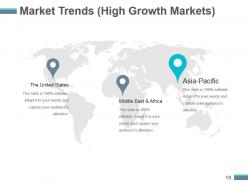
Slide 19: This slide presents Market Trends (High Growth Markets) with world map image.
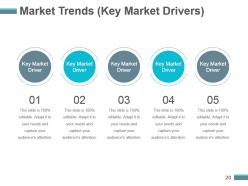
Slide 20: This slide showcases Market Trends (Key Market Drivers) to be displayed.
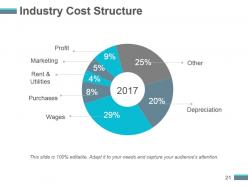
Slide 21: This slide shows Industry Cost Structure showing- Other, Depreciation, Purchases, Rent & Utilities, Marketing, Profit, Wages.
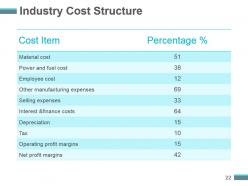
Slide 22: This slide displays Industry Cost Structure in tabular form.
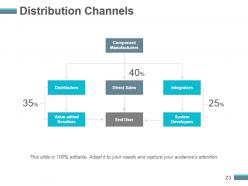
Slide 23: This slide shows Distribution Channels showcasing- Component Manufacturers, Direct Sales, Distributors, Integrators, End User, Value-added Resellers, System Developers.
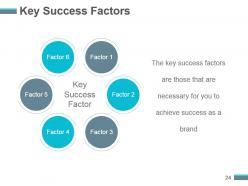
Slide 24: This slide showcases Key Success Factors. The key success factors are those that are necessary for you to achieve success as a brand.
Slide 25: This slide shows Competitor Analysis.
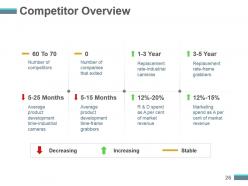
Slide 26: This slide shows Competitor Overview with- Number of competitors, Number of companies that exited, Average product development time-industrial cameras, Average product development time-frame grabbers, Replacement rate-industrial cameras, R & D spend as A per cent of market revenue, Replacement rate-frame grabbers, Marketing spend as A per cent of market revenue in, Decreasing, Increasing and Stable parameters.
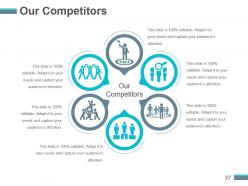
Slide 27: This slide shows Our Competitors with icon imagery to display.
Slide 28: This slide also shows Our Competitors with icon imagery to display.
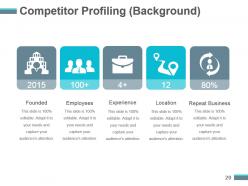
Slide 29: This slide presents Competitor Profiling (Background) showcasing- Founded, Employees, Experience, Location, and Repeat Business as factors to display.
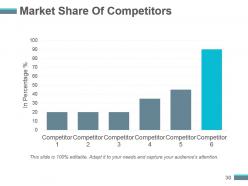
Slide 30: This slide presents Market Share Of Competitors in bar graph form.
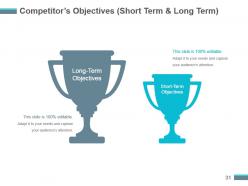
Slide 31: This slide shows Competitor’s Objectives (Short Term & Long Term).
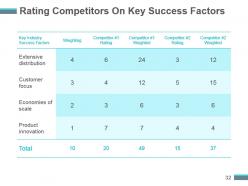
Slide 32: This slide displays Rating Competitors On Key Success Factors in tabular form.
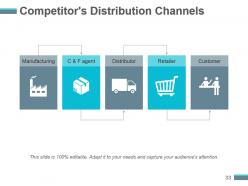
Slide 33: This slide showcases Competitor's Distribution Channels displaying- Manufacturing, Distributor, Retailer, Customer, C & F agent.
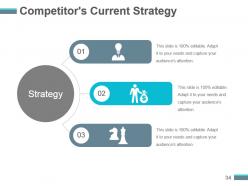
Slide 34: This slide shows Competitor's Current Strategy. State those aspects here.
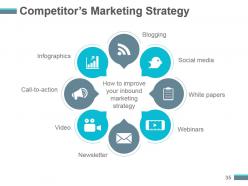
Slide 35: This slide presents Competitor’s Marketing Strategy displaying- Call-to-action, Infographics, Video, Newsletter, Social media, Blogging, White papers, Webinars.
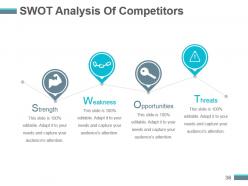
Slide 36: This slide showcases SWOT Analysis of Competitors.
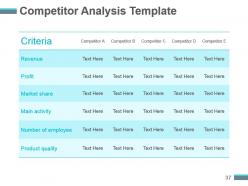
Slide 37: This is a Competitor Analysis Template slide.
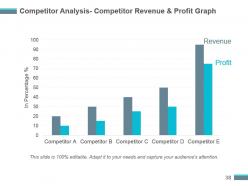
Slide 38: This slide shows Competitor Analysis- Competitor Revenue & Profit Graph showing- Revenue and Profit.
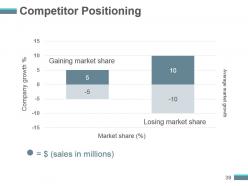
Slide 39: This slide shows Competitor Positioning stating- Losing market share, Gaining market share, Average market growth.
Slide 40: This slide is titled Additional slides. You can change the slide content as per need.
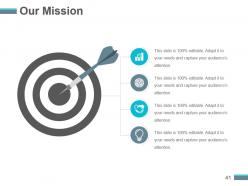
Slide 41: This is Our Mission slide with target imagery. State it here.
Slide 42: This is Our team slide with name, designation and text boxes to state information.
Slide 43: This is an About Us slide. State company/team specifications here.
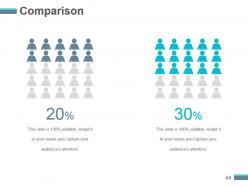
Slide 44: This is a Comparison slide to show comparison, information, specifications etc.
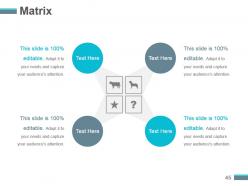
Slide 45: This is a MATRIX slide. Put relevant comparing data here.
Slide 46: This is an Our Goal slide. State your important goals here.
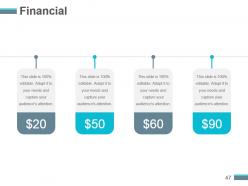
Slide 47: This slide presents Financial scores and stats to display.
Slide 48: This is a Quotes slide to highlight, or state anything specific. You may change the slide content as per need.
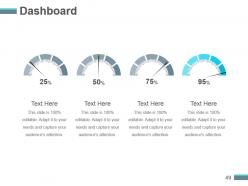
Slide 49: This is a Dashboard slide to state Low, medium and High aspects, kpis, metrics etc.
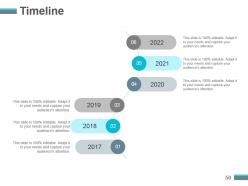
Slide 50: This is a Timeline slide to present important dates, evolution, milestones etc.
Slide 51: This is a Thank You slide with Address# street number, city, state, Contact Number, Email Address.
Competitive Analysis Report Powerpoint Presentation Slides with all 51 slides:
Our Competitive Analysis Report Powerpoint Presentation Slides will dazzle them with your brilliance. You will definitely get hand picked.






FAQs for Competitive Analysis Report
So you'll definitely need competitor profiles and pricing breakdowns - that's like the foundation. Direct competitors are obvious, but honestly? Keep an eye on the indirect ones too because they can totally catch you off guard. Product comparisons, how they position themselves, their marketing tactics, customer feedback - all that stuff matters. Oh and if you can dig up any financial info, even better. The whole point isn't just dumping a bunch of research though. Present it so your team can actually make decisions from it, then wrap up with clear recommendations about what to do next.
Templates are a lifesaver for competitive analysis presentations. You'll get consistent formatting without starting from scratch each time. They structure everything logically too - competitor profiles, SWOT comparisons, market positioning charts. I used to waste so much time just on layouts alone (ugh). Your audience can actually follow along and compare data easily when everything's organized. Missing key sections becomes way less likely. Find one with pre-built comparison slides and charts you can customize. Seriously cuts your prep time in half, maybe more.
Honestly, start with the free stuff - annual reports and press releases are gold mines. IBISWorld and Forrester have solid industry reports if you've got budget later. I'm weirdly obsessed with stalking competitors on LinkedIn for new hires and org changes (probably spend too much time there lol). Customer review sites like G2 show what people really think about their products. Conference presentations reveal way more strategy than they probably should. Oh, and don't sleep on patent filings - boring but surprisingly useful. Trade publications for your specific industry are clutch too.
Quarterly's the bare minimum, but really depends on your industry speed. Tech moves crazy fast - I'd go monthly there or you'll miss huge shifts. Stable industries? Every six months works fine. Here's what I actually do though - set a regular cadence but watch for those trigger moments. New product drops, big funding announcements, market drama - that stuff needs immediate attention regardless of your schedule. Don't get too rigid about it. Monthly feels right for most businesses honestly, gives you enough runway to spot trends without drowning in updates.
Track your revenue growth, market share changes, and pricing moves first - that's the bread and butter stuff. Then look at their website traffic, social media numbers, and how fast they're getting new customers. Product launches can really mess with everything though, so keep an eye on those too. Customer reviews and satisfaction scores are goldmines if you can get decent data. Honestly, don't go crazy trying to monitor everything. Pick maybe 5-7 things you can actually track consistently. Start with whatever matters most in your space and add more later.
Charts and graphs are total lifesavers when you're dealing with competitive data. People can actually see what's happening instead of drowning in spreadsheets. Heat maps work great for positioning stuff, and side-by-side screenshots make product comparisons super clear. I've found that comparison matrices click way faster than bullet points - honestly, who has time for endless slides about pricing? Your team will spot market share trends and feature gaps instantly. Oh, and flowcharts help too if you're mapping out processes. Makes everything way more actionable than just talking through numbers.
SWOT analysis is just a way to organize all that competitor research you've been doing. Map out their Strengths, Weaknesses, Opportunities, and Threats for each one. Sounds super basic, I know, but you'll actually catch stuff you'd miss otherwise. The magic happens when you line up multiple competitors' SWOTs next to each other—boom, suddenly you can see market gaps and figure out where you could actually beat them. Plus it helps you decide which competitive threats need your attention right now vs. what can wait.
Honestly, Google Alerts are your best friend here - just set them up for whatever terms matter in your space. I check Crunchbase and AngelList pretty regularly too. Patent filings might sound boring but they're actually goldmines for spotting what's coming. Social media monitoring catches the early buzz before companies officially launch. Trade shows are obvious but still worth it. The trick is being consistent about it rather than doing massive research binges. I usually spend like 30 minutes each week just scanning through everything. Industry forums can be surprisingly helpful too - people love to gossip about new players.
Focus too much on just features and pricing and you'll miss the actual strategic gold. Pick like 3-4 competitors max - any more and your analysis gets super watered down. Website info is fine but you gotta talk to real customers too, hit up review sites, maybe even pretend to be a buyer if that works. I learned this the hard way honestly. The biggest mistake though? Just throwing data at people without explaining what they should actually do with it. Connect everything back to your next moves.
Looking outside your industry can uncover crazy good ideas your competitors are totally blind to. Netflix's subscription thing? Now everyone from software companies to meal delivery uses it. Sometimes the best strategies come from completely random sectors - like how Uber's model jumped into food delivery, then scooters, whatever. You might find pricing tricks or customer experience stuff that works amazing elsewhere but nobody in your space has tried yet. Oh, and you'll also spot potential threats - companies that could easily expand into your territory. I'd start with industries facing similar problems or serving customers who want the same basic things yours do.
Dude, there's definitely stuff that'll make this easier. SEMrush and Ahrefs are solid for tracking what competitors are doing with SEO and ads. SimilarWeb's good for traffic data too. For social media monitoring, I'd go with Sprout Social or Hootsuite. If you want something more comprehensive, Crayon and Kompyte are pretty sweet - they pull data from everywhere and turn it into reports you can actually understand. I honestly get carried away with tools sometimes, but whatever works. Start with maybe one or two that hit your biggest headaches first, then add more later if you need them.
Dude, you definitely need qualitative data for competitive analysis. Numbers only tell you what's happening - the qualitative stuff shows you WHY customers pick your competitors over you. Reviews are gold mines honestly. Social media comments, user feedback, all that messy human stuff reveals how people actually feel about brands. I spent way too much time last week just scrolling through competitor reviews and found patterns I'd never catch in spreadsheets. Without understanding customer sentiment, you're just guessing at strategy. Hit up review sites and social platforms first - that's where the real insights hide.
Dude, competitor feedback is seriously underrated. Reviews and social media mentions show you exactly where they're screwing up - pricing issues, bad service, whatever. But also what people genuinely love about them (annoying but useful). I always look for patterns in complaints since those become your openings. Plus you'll find needs that nobody's really nailing yet. The big thing though? Understanding why people actually switch brands - it's usually emotional stuff. Just set up Google Alerts for their company names and start pulling reviews from the major sites. Bit tedious at first but totally worth it.
Honestly, just stalk your competitors a bit - see what they're totally whiffing on. Their pricing weird? Features missing something obvious? Customer complaints piling up about the same stuff? That's your opening right there. I get way too excited when I find those "seriously, NO ONE is helping these people??" situations. Map out like 3-5 big players first. Then hunt for where their offerings don't match what customers actually want. Sometimes you'll spot trends in their partnerships too - shows you where things are headed. The magic happens when unmet needs line up with what you're already good at.
Dude, PowerPoint's still your best bet tbh. Make it scannable - competitor tables, positioning charts, big findings right up front. Interactive dashboards are cool if you want engagement, but honestly depends on your crowd. C-suite? They want the strategic stuff, high-level insights. Product teams need the nitty-gritty details. Don't bury the lede though - start with why this matters to the business. I can't tell you how many presentations I've sat through where I'm like "okay but so what?" End with actual next steps they can do something with.
-
Easily Understandable slides.
-
Great designs, really helpful.