


Compliance Matrix Powerpoint Ppt Template Bundles





Try Before you Buy Download Free Sample Product
 Impress Your
 Audience
 100%
100% Editable
 Save Hours
 of Time


Our Compliance Matrix Powerpoint Ppt Template Bundles are topically designed to provide an attractive backdrop to any subject. Use them to look like a presentation pro.
People who downloaded this PowerPoint presentation also viewed the following :
Compliance Matrix Powerpoint Ppt Template Bundles with all 17 slides:
Use our Compliance Matrix Powerpoint Ppt Template Bundles to effectively help you save your valuable time. They are readymade to fit into any presentation structure.

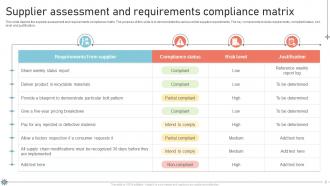
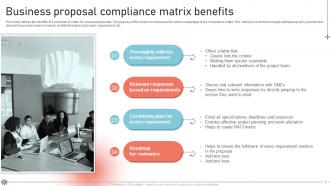
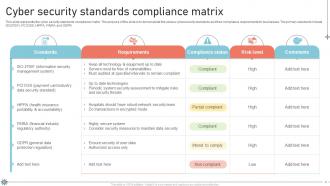
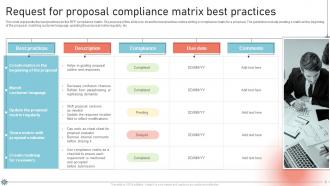






FAQs for Compliance Matrix Powerpoint
So a compliance matrix is basically your project's safety net - it maps all your requirements against whatever regulations or standards you gotta hit. I always think of it as the "oh shit, did we forget anything?" spreadsheet. You track each requirement, who's handling it, and whether it's done. Super boring but honestly saves your ass later when someone asks if you covered XYZ regulation. Build it early in the project (like, week one early) and keep updating it. Way better than scrambling at the end trying to prove you didn't miss something important. Trust me on this one.
Honestly, just make a compliance matrix first thing - it's basically a fancy spreadsheet that maps every single requirement to where you actually address it in your docs. Super boring but trust me on this one. I've watched so many teams think they can wing it and then panic during reviews when they realize they missed half the requirements. Short sentences work better for tracking stuff. The matrix shows what you've covered, where it lives, and what backs it up. Keep updating it while you write instead of trying to build it after. Way less painful than scrambling at the end.
So for your compliance matrix, start with the regulatory requirements you gotta hit and where you stand on each one right now. Map out who owns what and when gaps need fixing. Documentation references are clutch - auditors eat that up. Connect everything to your actual business processes and slap risk levels on there so you know what's urgent vs what can wait. Oh, and don't make it some insane 47-tab spreadsheet nightmare that nobody will touch. Keep it straightforward enough that people actually open the damn thing.
A compliance matrix maps your project requirements to industry standards - shows you what you're hitting and what's missing. Think of it as a really detailed checklist where you document each requirement, explain how your project handles it, and spot gaps. Honestly, it saves your butt during audits since everything's in one spot. Don't just build it once though - that's where people mess up. You'll want to update it as things change throughout the project. Get your team involved early and review it regularly. Way easier than scrambling later.
Ugh, honestly the worst part is tracking all the regulation changes and figuring out how they actually apply to what you're doing day-to-day. Different departments will give you completely different answers about the same requirement - it's maddening. And don't even get me started on overlapping rules that contradict each other. Your matrix will be obsolete before you're done building it since everything keeps changing. Start with just one regulatory area though, loop in legal from the beginning, and set up quarterly reviews. Oh and maybe grab coffee first because you'll need the caffeine for this headache.
Honestly, get some software to handle this stuff - it'll save you so much time. These tools track requirement changes automatically and catch gaps you'd probably miss. Report generation becomes actually useful instead of those awful spreadsheets everyone hates updating. My favorite feature? Automatic alerts when regulations change, because who has time to manually check that every month. Just make sure whatever you pick plays nice with your current project management tools. Trust me, you don't want another random system that doesn't talk to anything else.
So basically, a compliance matrix is like your master cheat sheet for audits. It maps all your regulatory stuff against what controls you actually have in place. Super helpful for spotting gaps before auditors walk through the door - trust me, finding issues early beats scrambling later. When audit time comes, you can quickly pull up whatever documentation they're asking for. I always tell people to start building theirs way before audit season hits, not during (learned that the hard way). Keep it updated throughout the year and you'll look way more organized than you probably are.
So basically, a compliance matrix saves you from that endless email hell where nobody knows what's actually required. You can see which standards hit which parts of your project, who owns what, and where things stand right now. Honestly, it makes those awful stakeholder meetings way less painful - people stop talking in circles when you can just point to the matrix and go "here's what we need." I'd set up regular check-ins using it as your agenda. Keeps everyone focused and nothing gets forgotten. Way better than trying to explain regulatory gaps for the millionth time.
Track your audit findings and how fast you're closing compliance gaps - that's what actually matters. Employee training completion rates tell you if people are paying attention. Honestly, most compliance matrices just create busy work, so do quarterly reviews to see if yours prevents real problems. Compare your compliance spending against what you're saving in penalties. Pick 3-4 metrics that make sense for your industry and stick with them. Don't overthink it though - incident response times are huge too.
Set up quarterly reviews - that timing hits the sweet spot for most teams. Someone needs to own this thing or it'll just sit there collecting virtual cobwebs (learned that the hard way). Track regulatory changes and map them to your controls. Version control is clutch so you know what shifted and when. Don't go it alone though - pull in legal, risk, and ops people because they spot stuff you totally miss. I swear they have radar for compliance gaps. Treat it like a living doc that actually evolves, not some checkbox exercise you do once and forget about.
So basically, a compliance matrix shows you exactly where you're falling short on regulations - like a dashboard for all your risk gaps. Super helpful for figuring out which issues need attention first. You can see weak spots in your controls right away and decide where to throw your resources. Honestly, auditors love this stuff because it proves you're actually doing something about problems. I'd start by documenting where you stand now, then use those gaps to map out what needs fixing. It's way better than flying blind and hoping nothing breaks.
Healthcare, pharma, and financial companies get the most value from compliance matrices - they're buried under regulations like HIPAA, SOX, and FDA stuff. Manufacturing sees huge wins too since they're dealing with safety plus environmental rules. Really, any industry where screwing up means massive fines should use these things. The matrix maps your requirements against actual controls so you don't miss anything important. Oh, and energy companies love them too - forgot to mention that earlier. I'd start by picking your top 3 regulatory frameworks and see where they overlap.
Color coding is your best friend here - green for good, red for problems, yellow for "eh, kinda." Makes scanning so much faster. Bold your headers and keep spacing consistent or you'll hate yourself later. I learned this the hard way after squinting at terrible matrices for way too long. Clean fonts help too, plus some light gridlines so everything doesn't blur together. Honestly, spending like 10 minutes making it look decent will save everyone from wanting to throw their laptop out the window. Your future self will thank you.
First thing - figure out which regulations actually matter for your specific project. Don't just grab some random template online. Your client's risk tolerance is huge here, plus any weird contractual stuff they've mentioned. Project complexity matters too. I've seen simple compliance matrices turn into total nightmares when people go overboard. Structure it around how your team actually reports progress, not some textbook approach. Oh, and customize the language so it makes sense to whoever's using it daily. Nothing worse than a matrix that sounds impressive but confuses everyone.
Look, compliance matrices are basically treasure maps showing you exactly where you're screwing up. Track which requirements always catch your team off guard - there's usually a pattern there. You'll spot where you're doing way too much documentation or repeating the same work twice. Teams I know treat them like scorecards, checking progress month to month. Here's the thing though: don't try fixing everything at once. Hit the big problems first - the stuff that comes up constantly and actually matters. Pull up your matrix every few months. Flag the repeat offenders for a process overhaul.
-
Definitely recommend SlideTeam to all who need help with PowerPoint presentations. Their design team can create anything you need.
-
The best and engaging collection of PPTs I’ve seen so far. Great work!