

Product Process Matrix Powerpoint Ppt Template Bundles





Try Before you Buy Download Free Sample Product
 Impress Your
Audience
 100%
Editable
 Save Hours
of Time


Our Product Process Matrix Powerpoint Ppt Template Bundles are topically designed to provide an attractive backdrop to any subject. Use them to look like a presentation pro.
People who downloaded this PowerPoint presentation also viewed the following :
Product Process Matrix Powerpoint Ppt Template Bundles with all 16 slides:
Use our Product Process Matrix Powerpoint Ppt Template Bundles to effectively help you save your valuable time. They are readymade to fit into any presentation structure.










FAQs for Product Process Matrix Powerpoint
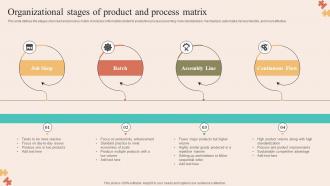
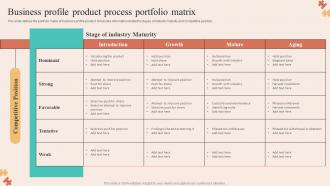
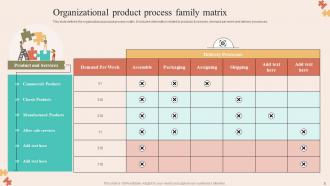
So there are two main things to think about - how much variety/customization you're doing versus your production volume. On one end you've got totally custom stuff, on the other it's mass production of the same thing. Process-wise, you're looking at everything from small job shops to those massive continuous operations. The whole point is matching your product mix to the right production method. Like, you obviously wouldn't run custom jewelry through an assembly line setup - that'd be ridiculous. The matrix basically shows you if your current process actually makes sense for what you're selling, or if you need to switch things up to stop bleeding money on inefficiencies.
So the Product Process Matrix is basically your cheat sheet for matching products with the right manufacturing setup. Look at your volume and variety first - that tells you everything. Custom, low-volume stuff? You'll want a job shop. Mass production of the same thing over and over? Go with continuous flow. Honestly, I wish more people used this upfront because it saves you from those "oh crap" moments later when you realize your design doesn't play nice with your manufacturing process. It's like a sanity check that shows you where mismatches might tank your efficiency or blow up costs. Super helpful for avoiding expensive do-overs down the road.
So there's basically five types of production setups you should know about. Project processes are like building a custom house - totally one-off stuff. Job shops do small batches with flexible equipment that can switch between different products. Batch processes make bigger quantities of the same thing before switching (bakeries doing 100 loaves, then cookies). Assembly lines? Classic Ford setup where stuff moves through stations. Continuous processes never stop - oil refineries going 24/7. Here's the thing though: more volume usually means less flexibility. Figure out where your products fit first, then you'll know what direction to go.
So basically, different process types are good at different things. Job shops are super flexible but you won't get crazy high volume. Assembly lines? Total opposite - massive throughput but forget about customization. Batch processes are kind of the middle ground (honestly probably what most people should consider first). Continuous processes are for when you need the same thing over and over at high volume. You really just need to match what you pick to your actual demand - like how much variety do you need vs. how much volume? Check if your current setup is creating bottlenecks where it shouldn't.
Moving between process types is honestly a huge deal - you're talking about a complete operational overhaul. Your team needs retraining, equipment usually needs major upgrades or total replacement, and sometimes you'll have to restructure everything. The matrix shows these transitions cost a ton and carry real risk because you're changing your company's core DNA. Most companies that pull it off do it slowly over months or years rather than rushing. Also, phased rollouts work way better than going all-in overnight. Start by mapping where you are now versus your target, then create a realistic timeline with solid milestones.
So basically, you want to look at two things: what you're actually making and how you're making it. Map out if your products are pretty standard or more custom. Then figure out if your process is flexible (like a job shop) or more rigid assembly-line style. Honestly, most places I've seen aren't lined up well - they'll do semi-custom stuff but with super standardized processes, which is just messy. Check your volumes and how much you're bouncing between different products. The whole point is spotting where your "what" doesn't match your "how," then you can fix those gaps.
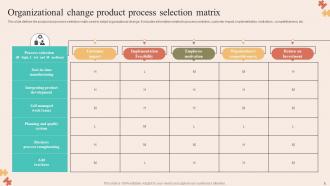
First thing - figure out your volume and variety situation. Making tons of identical widgets? Go with line or continuous processes. Custom stuff in small batches needs job shop flexibility though. Your tech requirements and quality standards matter too, plus obviously cost (some setups are insanely expensive upfront but worth it later). Space constraints can be a real pain depending on what you're working with. Don't forget about whether your team actually knows how to run whatever process you're considering. Honestly, just match what the process can do to what your product needs. Map out where you sit on that volume-variety thing first.
So the Product Process Matrix basically tells you how to set up your supply chain based on what you're selling. Custom, low-volume stuff? You'll want flexible suppliers who can pivot quickly - shorter chains work better here. Mass-produced items are the opposite - go for efficiency and cost-cutting with streamlined networks. Honestly, most companies mess this up by not matching their strategy properly. Short bursts work for some products, longer flows for others. Use the matrix to check if your suppliers, inventory spots, and distribution actually make sense for your product mix. Misalignment gets expensive fast.
Honestly, your tech stack is what really decides where you can even realistically land on that matrix. Got solid automation? You can probably push into that high-volume continuous territory. But if your tech is pretty basic, you're looking at job shop stuff - which isn't necessarily bad, just different. What's wild is how AI and flexible manufacturing are messing with these old categories now. Like, the boundaries aren't as clear-cut anymore. So yeah, start by being real about what your current tech can actually handle and where it's going. That'll give you a much better sense of your options.
So job shops are perfect for custom stuff - machine shops, print places, hospitals where every patient's different. Bakeries switching between bread types? That's batch processing. Assembly lines are obvious - Ford basically nailed this decades ago and everyone copied them. Then you've got continuous processes like oil refineries that literally never stop because shutting down costs a fortune. It's really about your volume vs variety trade-off. Tons of variety but low volume? You'll want job shops. High volume with barely any variety? Go continuous.
The matrix basically shows you where high production volume hits complex processes - that's where bottlenecks always pop up. Map your products against processes and you'll see the mismatches right away. Like when high-volume stuff gets stuck in job shop setups that can't handle the flow, or simple processes trying to deal with custom orders (which never goes well). Honestly, it's just a visual reality check for your operations. You can immediately spot where you're pushing certain stages too hard. Use it to figure out which processes need more capacity or workflow changes before they blow up on you.
Don't treat it like it's permanent once you map everything out. Companies get stuck thinking they have to stay on that diagonal line - honestly, some of the best opportunities are when you position off it strategically. Also watch out for oversimplifying your whole product mix or ignoring how customer needs shift. The worst mistake though? Pretending your actual capabilities match where you think you belong on the matrix. Be real about what you can actually handle. Oh and definitely review this stuff every quarter because things change fast.
Yeah, you can totally adapt the Product Process Matrix for services! Just think of your "products" as different service types and "processes" as how you deliver them. So like, mortgage applications vs ATM transactions at banks - completely different approaches, right? Custom consulting work needs flexible processes, while standardized stuff like support tickets should run through automated workflows. Manufacturing does this too - custom parts go through job shops, mass production hits assembly lines. Honestly, most companies have misalignments they don't even realize. List out your main services and see where you're overcomplicating simple stuff or under-delivering on complex work.
So basically the Product Process Matrix shows you if you're wasting money on the wrong stuff. Like, are you buying fancy automation for products you barely make? Or maybe you're not investing enough in flexibility when you need variety. Most companies mess this up honestly. It helps you figure out the sweet spot - when to hire skilled people vs buy equipment, stuff like that. I'd use it to look at where your resources are going now and spot the obvious mismatches. Then just move things around. Pretty straightforward once you see it laid out.
So demand volume basically determines where you sit on that Product Process Matrix. When you've got high demand, you're pushed toward continuous or assembly line setups - you need the efficiency to keep up. Low demand means job shop or batch processes make more sense. But here's what's tricky - it's not just about current demand. Predictable demand matters too. Steady, high volume lets you invest in specialized equipment that costs a fortune upfront. Sporadic demand though? You'll want flexible, general-purpose stuff instead. Honestly, I'd map out your demand patterns before anything else, then pick your process from there.
-
Like always a great experience with you guys. Always there on the drop of hat to help.
-
The pricing page of this website is very sorted. I felt no pain while buying the PPTs.