


Product Policy Powerpoint Ppt Template Bundles




Try Before you Buy Download Free Sample Product
 Impress Your
 Audience
 100%
100% Editable
 Save Hours
 of Time


Our Product Policy Powerpoint Ppt Template Bundles are topically designed to provide an attractive backdrop to any subject. Use them to look like a presentation pro.
People who downloaded this PowerPoint presentation also viewed the following :
Product Policy Powerpoint Ppt Template Bundles with all 19 slides:
Use our Product Policy Powerpoint Ppt Template Bundles to effectively help you save your valuable time. They are readymade to fit into any presentation structure.







FAQs for Product Policy Powerpoint
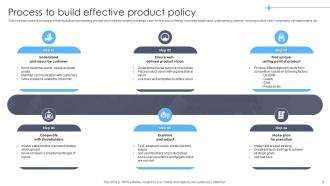
Key components of an effective product policy include clear product standards, quality assurance protocols, compliance requirements, lifecycle management guidelines, and stakeholder responsibilities. These frameworks streamline decision-making by establishing consistent evaluation criteria, standardizing development processes, and ensuring regulatory adherence, with many organizations finding that comprehensive policies ultimately deliver faster time-to-market and reduced operational risks.
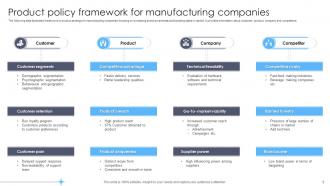
A well-defined product policy aligns development priorities, resource allocation, and market positioning with broader business objectives, ensuring consistent decision-making across teams. This strategic framework enables companies to streamline innovation processes, reduce time-to-market, and maintain competitive differentiation, with many organizations finding that clear policies ultimately deliver enhanced operational efficiency and sustainable growth.
Market research plays a fundamental role in shaping product policy by providing customer insights, competitive analysis, market trends, and demand forecasting that guide strategic decisions. Through comprehensive data collection, companies can identify consumer preferences, pricing strategies, and market opportunities, while understanding regulatory requirements and competitive positioning, ultimately enabling organizations to develop policies that align with market needs and drive sustainable growth.
Organizations should approach product lifecycle management by establishing clear stage-gate processes, defining roles and responsibilities across development teams, implementing regular review cycles, and creating standardized documentation requirements throughout each phase. This strategic framework enables seamless transitions between conception, development, launch, and retirement stages, while ensuring consistent quality standards, resource optimization, and market responsiveness, ultimately delivering faster time-to-market and sustained competitive advantage.
Product policy significantly influences pricing strategy through positioning decisions, quality standards, brand perception, product differentiation, and lifecycle management considerations. These policy elements determine whether organizations can pursue premium pricing for high-quality offerings, competitive pricing for market penetration, or value-based pricing models, with many companies finding that strategic alignment between product attributes and pricing approach ultimately delivers stronger market positioning and sustainable competitive advantage.
Companies ensure regulatory compliance through product policies by establishing clear quality standards, implementing regular audit procedures, maintaining detailed documentation protocols, and creating employee training programs. These frameworks streamline compliance across manufacturing, healthcare, and financial services sectors, with many organizations finding that structured policies reduce regulatory violations, accelerate approval processes, and ultimately deliver competitive advantage through consistent market access.
**INPUT**: What are the best practices for product policy communication within an organization? **OUTPUT**: Best practices for product policy communication include establishing clear channels, using standardized templates, conducting regular training sessions, creating accessible documentation repositories, and implementing feedback mechanisms. These approaches streamline organizational alignment by ensuring consistent messaging, reducing interpretation errors, and enhancing cross-functional collaboration, with many companies finding that structured communication frameworks ultimately deliver faster decision-making and improved product outcomes. [Word count: 58 words]
Product policy for digital products emphasizes data privacy, licensing terms, software updates, and intellectual property protection, while physical goods focus on manufacturing standards, warranty coverage, and safety regulations. Digital policies must address subscription models, user access rights, and platform compatibility, whereas physical product policies prioritize supply chain management, product recalls, and regulatory compliance, with many organizations finding that digital policies require more frequent updates.
When revising an existing product policy, consider regulatory compliance changes, market dynamics, customer feedback, competitive landscape shifts, and operational efficiency improvements. These factors work together to ensure policies remain relevant and effective, with many organizations finding that regular reviews incorporating stakeholder input, performance metrics, and industry best practices ultimately deliver enhanced customer satisfaction and streamlined operations.
Customer feedback informs product policy decisions by identifying pain points, revealing usage patterns, highlighting feature gaps, and uncovering emerging market needs through surveys, reviews, and user analytics. This data enables companies to prioritize development resources strategically, reduce costly missteps, and create policies that align with actual user experiences, ultimately delivering enhanced customer satisfaction and stronger competitive positioning.
Product policy drives innovation by establishing clear frameworks for experimentation, resource allocation, risk management, and cross-functional collaboration while setting strategic priorities that guide development teams. These policies enable companies to streamline decision-making processes, accelerate time-to-market, and foster creative problem-solving, with many organizations finding that structured innovation guidelines ultimately deliver competitive advantages and sustainable growth.
Product policy effectiveness metrics include user adoption rates, compliance percentages, customer satisfaction scores, support ticket reduction, and policy violation incidents. These measurements enable organizations to assess operational efficiency, user experience impact, and business outcomes, with many companies finding that tracking both quantitative compliance data and qualitative feedback delivers comprehensive insights into policy performance and strategic value.
Product policy drives sustainability initiatives by establishing environmental standards, resource efficiency requirements, and lifecycle assessment protocols that guide development decisions. Through comprehensive policies, organizations streamline sustainable material sourcing, minimize waste generation, and enhance energy efficiency across product lines, while ensuring regulatory compliance and ultimately delivering competitive advantage in increasingly eco-conscious markets.
Companies face challenges including employee resistance to change, integration complexities with existing systems, resource allocation constraints, compliance requirements, and maintaining consistent implementation across departments. These obstacles often arise during transition periods, with many organizations finding that inadequate training, unclear communication, and insufficient stakeholder buy-in can significantly delay policy adoption, ultimately affecting operational efficiency and competitive positioning.
Alignment between product policy and corporate values enhances brand reputation by creating authentic customer experiences, demonstrating consistent ethical standards, and building stakeholder trust through transparent decision-making. This strategic combination enables organizations to differentiate themselves in competitive markets, foster customer loyalty, and attract top talent, with many companies finding that value-driven policies ultimately deliver sustainable growth and stronger market positioning.
-
The content is very helpful from business point of view.
-
Their professional templates are very impressive, even my manager was curious about the source. I am very grateful.