


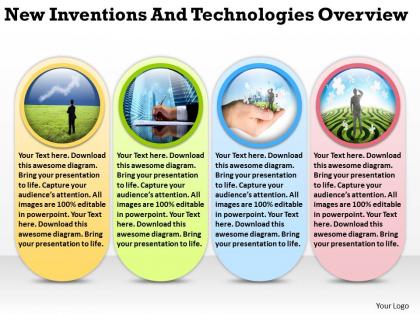
New inventions and technologies overview ppt powerpoint slides




Try Before you Buy Download Free Sample Product
 Impress Your
 Audience
 100%
100% Editable
 Save Hours
 of Time


Fashion your furfure with our New Inventions And Technologies Overview Ppt Powerpoint Slides. Your audience will buy into your designs.
People who downloaded this PowerPoint presentation also viewed the following :
New inventions and technologies overview ppt powerpoint slides with all 10 slides:
Our New Inventions And Technologies Overview Ppt Powerpoint Slides make a great collage. Give your thoughts that artistic feel.

FAQs for New inventions and technologies overview
Honestly, solid-state batteries are the real deal right now - way better than lithium-ion stuff. Carbon capture is finally getting cheaper, which is huge. Green hydrogen production isn't such an energy hog anymore either. Those perovskite solar cells are insane though, hitting 30%+ efficiency versus regular panels. Direct air capture companies like Climeworks are actually scaling up now. Manufacturing costs dropped enough that this stuff's becoming realistic to use. You should probably check what might work for your industry. Some of it's still pretty specialized but things are moving super fast lately.
Dude, AI is literally everywhere now. Healthcare's using it to spot diseases crazy fast, and banks are catching fraud with it. Manufacturing companies are predicting when machines will break before they actually do - which honestly seems like magic to me. Even creative stuff isn't safe anymore - AI's making art, music, you name it. The thing is, AI's just really good at finding patterns in tons of data that we'd never notice. Whatever industry you're in, I'd start watching what other companies are doing with AI tools. They might already be ahead of you.
Dude, you HAVE to get user feedback early - like, even when your product looks terrible. I can't tell you how many teams I've watched build something "perfect" that nobody actually wanted. Users will crush your ego but save your project. They'll tell you what's genuinely useful vs. what you think is brilliant (spoiler: usually different things). Don't just ask leading questions fishing for praise either. Set up those feedback loops from the start and keep them going. Trust me, it's way better than finding out months later you built the wrong thing entirely.
Here's the thing - big companies move like turtles when it comes to change, so you can beat them by being fast. Look for pain points they're totally ignoring or new tech they haven't caught onto yet. Honestly, some of the best ideas are almost embarrassingly simple - Uber literally just made calling a cab easier. You don't need tons of money, just the guts to try stuff and fail fast. Find one real problem your customers hate dealing with that nobody's fixing well. Build something super basic to test it. That's where you start.
Honestly, the big ones are privacy getting trashed, people losing jobs to automation, and the rich-poor gap getting worse. I mean, have you seen how fast AI is changing everything? It's wild. Companies rush to innovate but regulation can't keep up - so you get algorithmic bias screwing people over and data getting misused left and right. Your company needs to bake ethics reviews right into development from day one. Don't wait for disaster to strike. Always ask "who's gonna get hurt by this?" before you launch anything new.
Look, policies basically make or break tech companies. Smart governments throw money at startups through grants and tax breaks - that stuff works. Heavy regulations though? Total buzzkill for innovation. Privacy laws are annoying but probably needed after all the Facebook drama and whatever. Trade wars mess everything up too. Honestly, it's all about balance - you want rules that protect people without strangling new ideas. My advice? Watch policy news like a hawk because one new law can wreck your whole business model. Sounds dramatic but it's true.
Honestly, remote work tools are getting pretty wild lately. AI stuff is handling meeting summaries and scheduling - saves me like an hour a day, no joke. VR meetings don't suck anymore either, which is weird to say. You can basically work from anywhere now since everything's cloud-based. Digital whiteboards actually feel like real brainstorming instead of those clunky apps from a few years back. Async platforms are a lifesaver for coordinating with people in different time zones too - way better than endless email threads. I try testing one new tool every few months. Keeps you from falling behind while everyone else figures out the next big thing.
You'll love this - universities have all these smart people doing crazy research that could solve problems you didn't even know you had. Students are amazing too because they haven't learned what's "impossible" yet, so they come up with wild ideas. Access to fancy labs without buying the equipment? Yes please. The trick is finding professors actually working on stuff related to your business challenges. I mean, partnerships fail when there's no real overlap. Structure it so both sides get something concrete out of it, not just feel-good collaboration nonsense.
Oh man, where do I even start? COVID basically forced telemedicine on everyone, but turns out it's actually pretty great. AI can now catch diseases before doctors do - kinda wild if you think about it. Those mRNA vaccines were honestly incredible to watch happen in real time. Wearables got way smarter too, not just counting steps anymore. Gene therapy is finally working for rare diseases, and surgical robots are getting scary precise. The boring but huge win? Health records can actually talk to each other now. If this is for work stuff, I'd definitely look into AI diagnostics first.
So IoT is just making regular stuff smart and connected. Your thermostat figures out when you're home, your fridge can literally order milk when you're out - honestly it's kinda crazy how much these things track about us! But the real point is automation. Less energy waste, catching problems early, that sort of thing. Your car will ping you before it breaks down instead of leaving you stranded. Pretty neat concept. I'd start with maybe a smart thermostat or camera? See how you like having everything connected before going all-in.
Mix things up with your team's daily grind - cross-department brainstorming sessions work surprisingly well. People from different areas bring wild perspectives you wouldn't expect. Give everyone some "passion project" time each week (Google's 20% thing actually works). Physical spaces matter too - create spots where people naturally bump into each other and chat. Oh, and definitely celebrate the smart failures alongside wins. Makes people feel safer taking creative risks, you know? I'd start small though. Maybe one weekly creative session and see how it goes from there.
Yeah, culture totally changes how companies innovate. Americans love taking big risks and disrupting everything, but Japanese companies prefer small improvements and getting everyone on board first. Hierarchy plays a role too - some places have the CEO decide everything while others let anyone pitch ideas. Time's another factor. Quick results vs. years of R&D, you know? Honestly, trying to use the same innovation strategy everywhere is pretty dumb. You've gotta adapt to what actually works in each culture instead of forcing your approach on different markets.
Dude, you'll want to keep an eye on AI-powered banking first - it's getting scary good at predicting what you'll spend and catching fraud before it happens. Embedded finance is huge too, where you can get loans right through apps like Uber without dealing with your bank. DeFi is still pretty confusing honestly, but it's basically cutting out traditional banks entirely. Oh, and there's this whole green fintech thing happening - everyone's trying to make banking more sustainable now I guess. This stuff changes so fast it makes my head spin, so maybe grab a fintech newsletter or two to stay on top of it.
Honestly, ed tech can be a game changer if you pick the right stuff. Adaptive platforms adjust difficulty based on how kids are doing, AI tutors give instant feedback, and VR makes crazy abstract concepts actually make sense. Teachers can use data analytics to pinpoint exactly where students are stuck instead of just guessing. The trick is finding tech that actually improves how you teach, not just putting old lessons on a screen (which happens way too often). I'd start with one tool, see how it affects engagement and grades, then expand from there.
Most companies are throwing resources at psychological safety and giving people dedicated time to innovate. Google's 20% time is the classic example, plus you've got hackathons and cross-functional teams everywhere now. Leadership talks about celebrating "intelligent failures" - though honestly, half of them still freak out when things actually go wrong. The whole "fail fast" mentality sounds great on paper but implementation is messy. Physical innovation spaces are huge right now, and upskilling programs too. Oh, and if you're trying to push this at your own company? Start with team retrospectives focused on what you learned from experiments, not just whether they worked.
-
Understandable and informative presentation.
-
Topic best represented with attractive design.