


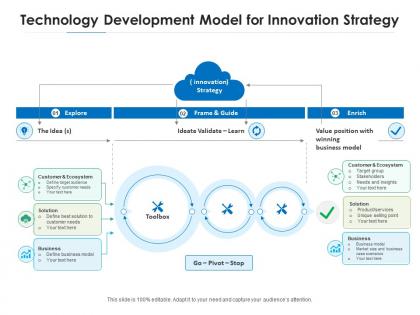
Technology development model for innovation strategy




Try Before you Buy Download Free Sample Product
 Impress Your
 Audience
 100%
100% Editable
 Save Hours
 of Time


Our Technology Development Model For Innovation Strategy are topically designed to provide an attractive backdrop to any subject. Use them to look like a presentation pro.
People who downloaded this PowerPoint presentation also viewed the following :
Technology development model for innovation strategy with all 2 slides:
Use our Technology Development Model For Innovation Strategy to effectively help you save your valuable time. They are readymade to fit into any presentation structure.
FAQs for Technology development model
Honestly, you need three main things sorted first. Clear vision of where you're going, actual resources (people, money, time), and some kind of system for coming up with ideas then figuring out which ones are worth pursuing. Leadership support is huge though - can't tell you how many innovation projects I've watched crash because executives talked a good game but didn't really back it. Also define what kind of innovation you're after - small improvements or big breakthroughs? And how you'll know if it's working. Start by looking at what you're already doing innovation-wise, then spot the gaps.
You've gotta track both sides - the early stuff and the results. So like number of ideas coming in, how many people actually participate in your innovation programs, time-to-market. Then the obvious ones: revenue from new products, customer satisfaction, market share. Most companies just obsess over the money metrics and totally miss what's happening upstream. Pick maybe 3-5 things max and stick with them - otherwise you'll drown in spreadsheets (been there). Oh, and figure out what "winning" actually looks like for your specific goals first. Makes everything else way clearer.
Honestly, leadership makes or breaks innovation culture. Your team won't take risks if you freak out over every failure - I've watched so many companies kill creativity this way. Model curiosity instead of pretending you have all the answers. Ask questions. Celebrate smart failures alongside wins. Here's what actually works: give people 10% time for passion projects and don't let it disappear when things get crazy (which they always do). If you're not protecting that experimental space, you're just paying lip service to innovation. Start there.
Honestly, you gotta separate these completely - jamming innovation into your day-to-day stuff just murders any creative thinking. What I'd do is carve out maybe 10-15% of your resources specifically for the experimental projects. Keep everything else humming along as usual. The biggest mistake I see? Companies launching these "innovation sprints" right when they're drowning in their busiest season. Like, what did you expect? Your team needs to know when they're in problem-solving mode versus when they can think completely outside the box. They're not competing against each other - they actually work together pretty well once you stop forcing it.
Honestly, get your team involved in figuring out what problems need solving instead of just dumping solutions on them. Nobody likes being told what to do without context. Explain the real "why" - skip the corporate buzzwords about competition and tell them what's actually happening. Set up small test runs where people can mess around without getting in trouble if things go sideways. Those failed experiments? Celebrate them too. Find the people who get excited about new stuff and let them spread that energy around. Once your respected team members are into it, everyone else usually follows. It's weird how that works, but it does.
Honestly, just bake feedback into every step instead of tacking it on at the end. Get surveys and user interviews going during ideation - I've watched so many teams skip this and then hate themselves later. Beta users are gold during development too. The trick is making it routine, not random. Set up regular check-ins with customers and actually do something with what they tell you (they can smell BS from a mile away). Oh, and don't blow your budget before validating ideas - use early feedback to pivot if needed.
Honestly, most companies just can't execute properly. They fall in love with the flashy concept but never figure out if it actually makes sense for their business. Time and budget? Always way underestimated - I've seen this so many times. Plus leadership treats innovation like some separate department instead of getting everyone involved. Oh, and don't believe those "fail fast" posts on LinkedIn lol. My take: start with something tiny, test it quickly, and get your ops people on board from day one. Otherwise you're just burning money.
Dude, cross-functional stuff is honestly a game changer. You get way better ideas when your product people actually talk to sales and engineering instead of just guessing what users want. Different perspectives = breakthrough solutions you'd never think of solo. I mean, customer service knows all the real pain points! Short brainstorms work better than those marathon sessions anyway. Try mixing up who's in the room each time - maybe rotate people from different departments. It's actually fun when you're not stuck with the same voices. You'll solve problems way faster too.
Honestly, tech can flip entire industries on their head. Look at Uber - completely wrecked the taxi business overnight. Manufacturing got crazy efficient with IoT sensors tracking everything. AI predicts when machines will break before they actually do, which is pretty wild if you think about it. Mobile apps let you skip middlemen and go straight to customers. Blockchain makes supply chains way more transparent too. But here's the thing - don't just throw tech at problems. Figure out what's actually broken in your industry first, then find the right solution. Otherwise you're just burning money on fancy gadgets that don't help anyone.
Big companies play it safe - they've got shareholders to keep happy, so they stick to incremental improvements and scaling what already works. Stage-gate processes, extensive testing, the whole nine yards. Startups? Totally different game. They're betting everything on disruptive ideas and pivoting when stuff doesn't pan out. Honestly, the "fail fast" thing sounds cliche but it's pretty much their reality. If you're stuck in a big org, maybe try setting up small innovation teams that can actually move quickly - kind of like internal startups but without all the ramen noodles.
Track both early and late-stage stuff - time-to-market, how fast customers actually adopt your new features, plus revenue from launches in the first year or so. But honestly? The early signals matter way more than most people realize. Watch your experiment velocity, how teams respond to prototype feedback, pivot speed when things go sideways. Those predict success better than the obvious metrics. Set up dashboards showing pipeline health AND real market impact. Oh, and don't get stuck only looking at lagging indicators - you'll miss chances to fix problems early.
Honestly, most teams mess this up by only looking at ROI. Build a scoring matrix with three things: potential impact, how doable it actually is, and whether it fits your business goals. Then plot your projects on a simple 2x2 grid - impact vs effort. You'll spot those "high impact, low effort" gems right away. Those are your quick wins. The harder stuff? That's where you decide if it's worth the long haul. I'd start with your top 5 projects and see what actually deserves your time. Trust me, this beats guessing every time.
Look, open innovation can actually help you stay ahead - just not the old-school "lock everything down" approach. Collaborating externally speeds up your innovation and gets you access to stuff you'd never build yourself. Plus it saves a ridiculous amount of money. The trick is picking what to share vs. what stays yours. Your real advantage comes from executing better, moving faster, and creating ecosystems around your core tech. Honestly, the companies that win aren't the ones hoarding ideas - they're the ones who know how to blend outside insights with their own vision.
Honestly, start protecting your IP from the very beginning - don't wait. Provisional patents are your best friend here, they're super cheap and give you a year to figure things out. Always get NDAs signed before talking to anyone outside your team (learned this the hard way lol). Document everything with dates, use secure file sharing, and think about what should stay as trade secrets vs what to patent. Oh, and if something's impossible to reverse-engineer, maybe keep it internal? The biggest mistake I see is treating IP as something you'll "deal with later" when you're launching. Make it part of your routine instead.
Honestly, it depends on where you're at and how much risk you can handle. Early stage? Go for VC or innovation funds - they live for the risky bets. Corporate venture arms are pretty sweet too since they understand startups but have actual money. Government grants work if you're doing heavy R&D, but man the paperwork is a nightmare. For smaller innovations, just use internal budgets - you'll move way faster. Here's what I'd do: start small with your own funds to prove it works, then chase external money once you've shown it's not completely crazy. Much easier sell that way.
-
Perfect template with attractive color combination.
-
Top Quality presentations that are easily editable.
-
It saves your time and decrease your efforts in half.
-
Attractive design and informative presentation.