Business Plan Innovation Powerpoint Presentation Slides

Rating:
100%
Business Plan Innovation Powerpoint Presentation Slides
Slide 1 of 25
Favourites Favourites

Try Before you Buy Download Free Sample Product

Audience Impress Your
Audience
Editable 100%
Editable
Time Save Hours
of Time
The Biggest Sale is ending soon in
0
0
:
0
0
:
0
0
Rating:
100%
Presenting business plan innovation presentation slides. This professionally designed deck consists of total of 25 PPT slides. This deck has been designed after an extensive research done by the experts. Our PowerPoint experts have crafted this deck by adding all the necessary design elements. You will find visuals according to the content. This ready-to-use deck has professional visuals, layouts, diagrams, icons, charts, graphs, and more. These templates are completely editable. Edit the color, text, icon, and font size as per your need. Click the download button now.

Content of this Powerpoint Presentation

"Business has only two basic functions - marketing and innovation." - Peter Drucker

Today's competitive business landscape largely relies on innovation. Business organizations constantly look for new ways to develop their business. Innovation is a critical process for an industry. Therefore, you need to understand the process thoroughly before starting. Innovation is nothing but changing an existing business model or creating a better one to satisfy customers' needs.

Are you looking for a strategic business plan? Click here to unlock the opportunity for continuous improvement.

To encourage innovation in a business, an individual needs to have a proper idea about the strategy. Therefore, SlideTeam has introduced a set of templates that helps unleash groundbreaking ideas. These templates are the blueprint of creativity that guides you to transform your Vision into success.

Click here to get 5-year strategic business plan ideas.

These templates are 100% customizable and editable. Therefore, you can change the information to meet your requirements. Let's begin!

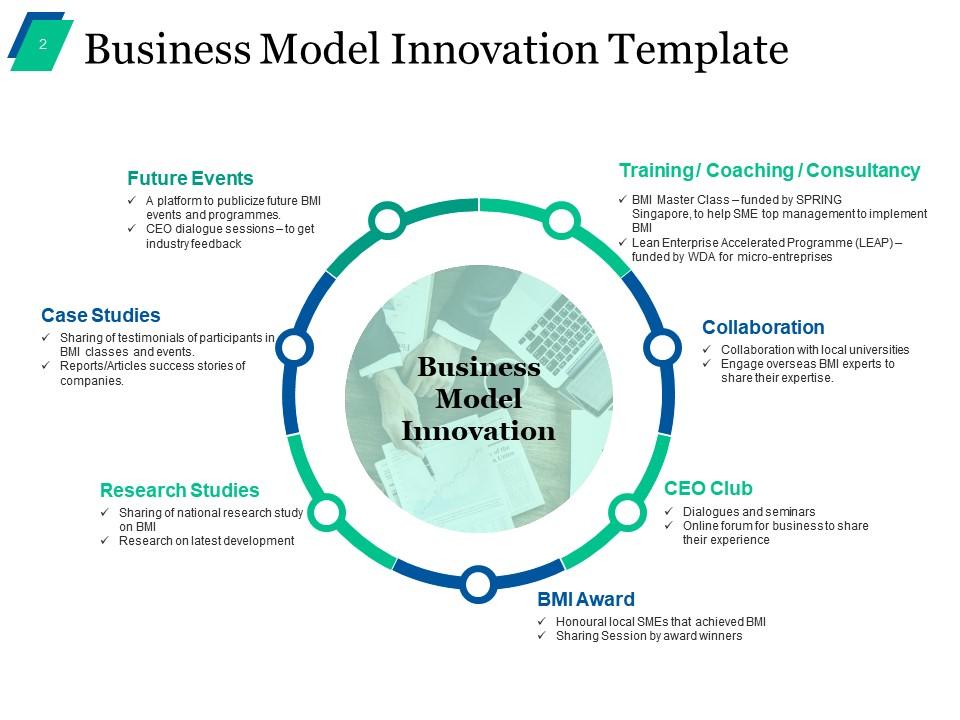
Template 1- Business Model Innovation Template

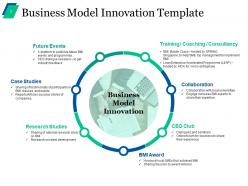
Use our business model innovation PPT Template to increase efficiency and competitive advantage. This slide showcases the factors, including case studies, research studies, future events, training facilities, collaboration, awards, etc. It helps you stay competitive in today's business environment and increase your value proposition. Download this now.

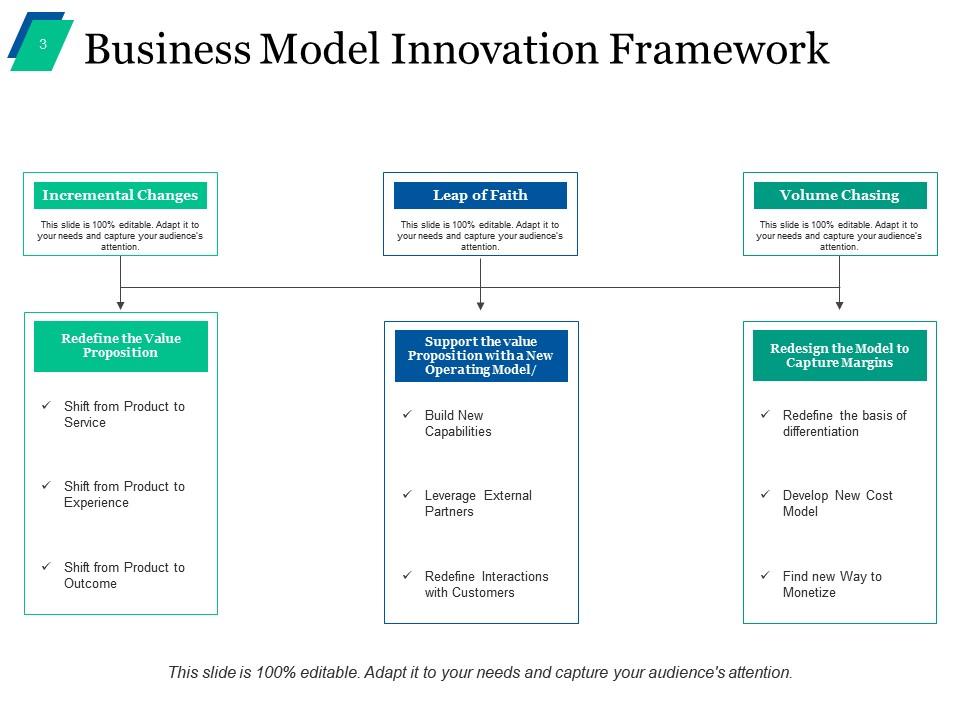
Template 2- Business Model Innovation Framework Template

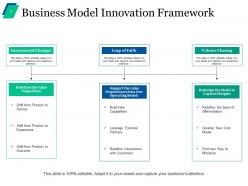
Check out our Business Model Innovation Framework PPT Template to create a more systematic innovation process. It showcases three factors responsible for business model innovation: incremental changes, leaps of faith, and volume chasing. Also, it highlights the value proposition, supporting the value proposition with a new operating model and redesigning the model to capture margins. Use this template to continue the reinvention of the business model. Download this now.

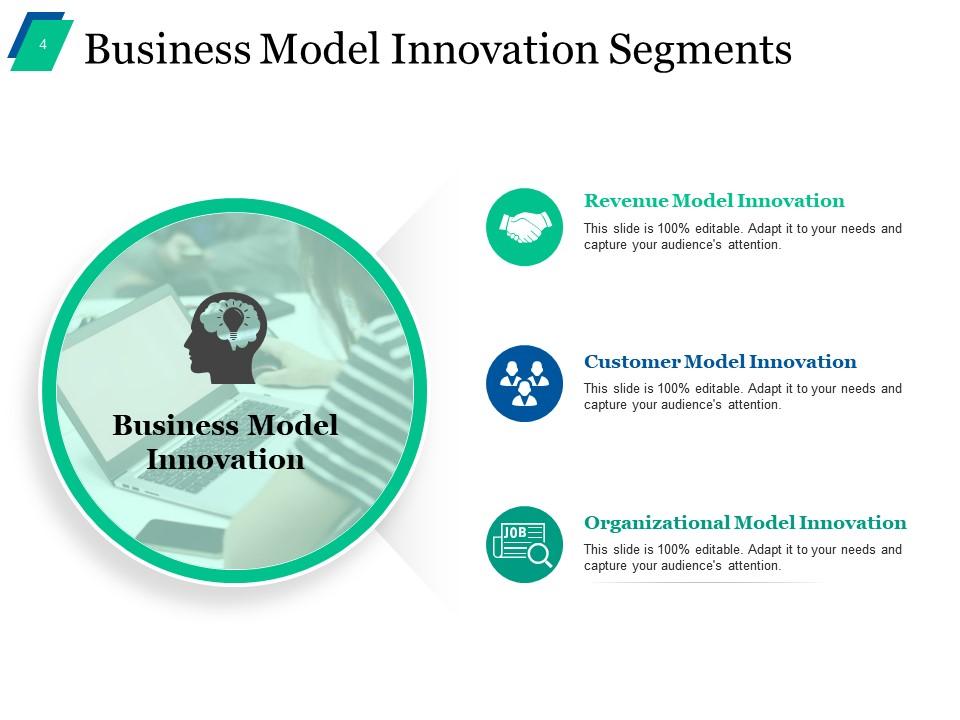
Template 3- Business Model Innovation Segments Template

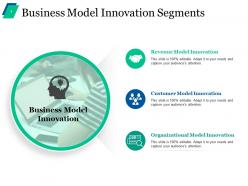
This PPT Template provides a clear framework that outlines the critical components of a business model. This slide highlights three models of innovation: the revenue model, the customer model, and the organizational model. Use this slide to identify the areas of innovation since it breaks down the business model into three different structures. Also, it provides a competitive advantage to your company. Download this now.

Template 4- Approaches to Business Model Innovation Template

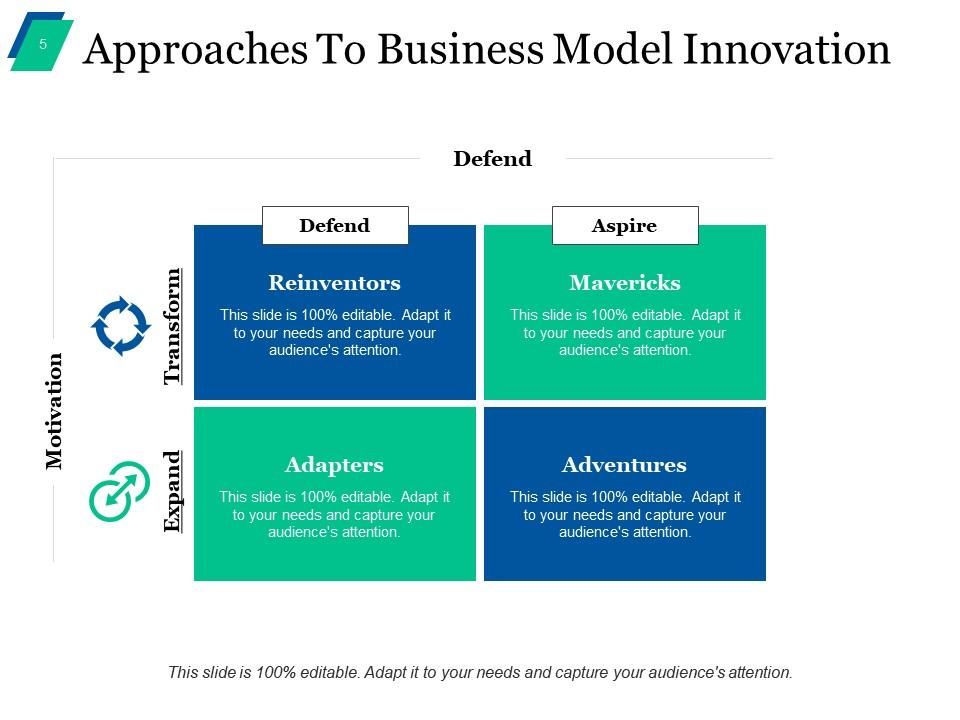
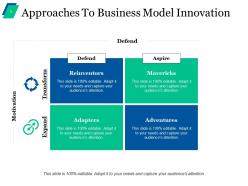
Adopting a business model innovation helps to create a big picture instead of focusing on specific innovation topics. This PPT Template is divided into two sections: motivation and defense. Use this slide to maintain the customer-centric approach and data-driven decision-making. Download this now.

Template 5- Business Model Innovation in Different Field Template

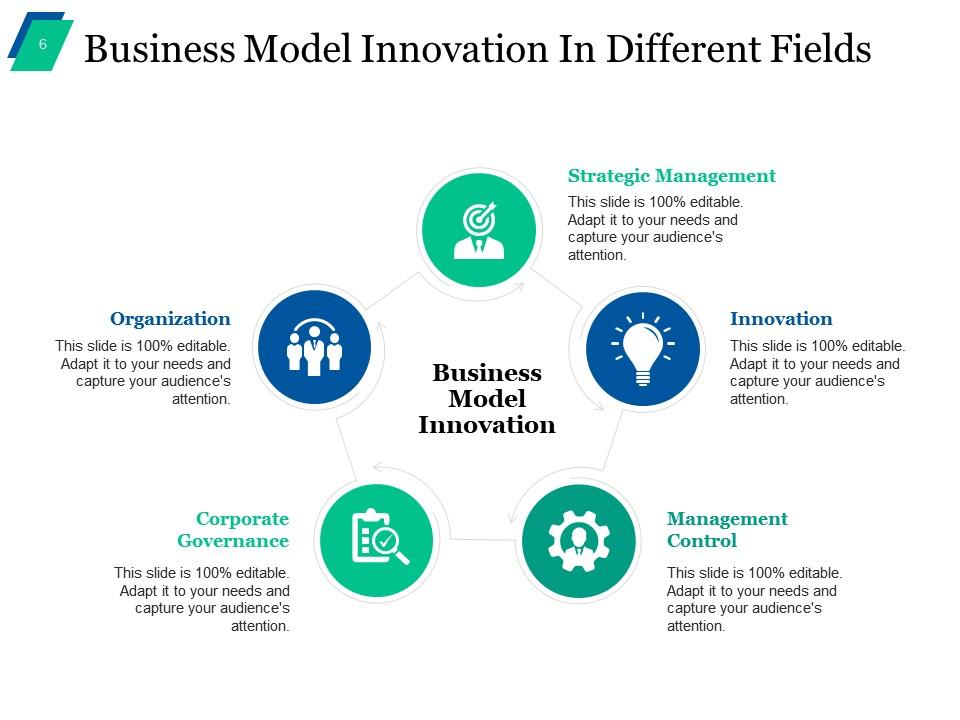
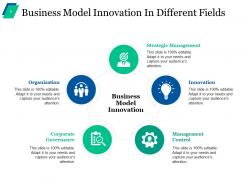
Download our business innovation model PPT Template, which shows how to apply business innovation in different fields. It mentions fields such as organization, corporate governance, strategic management, innovation, and management control. You can use this slide to remain flexible in your business, which leads to more efficient operations, reduced costs, and increased revenues. Download this now.

Template 6- Strategy of Innovation Template

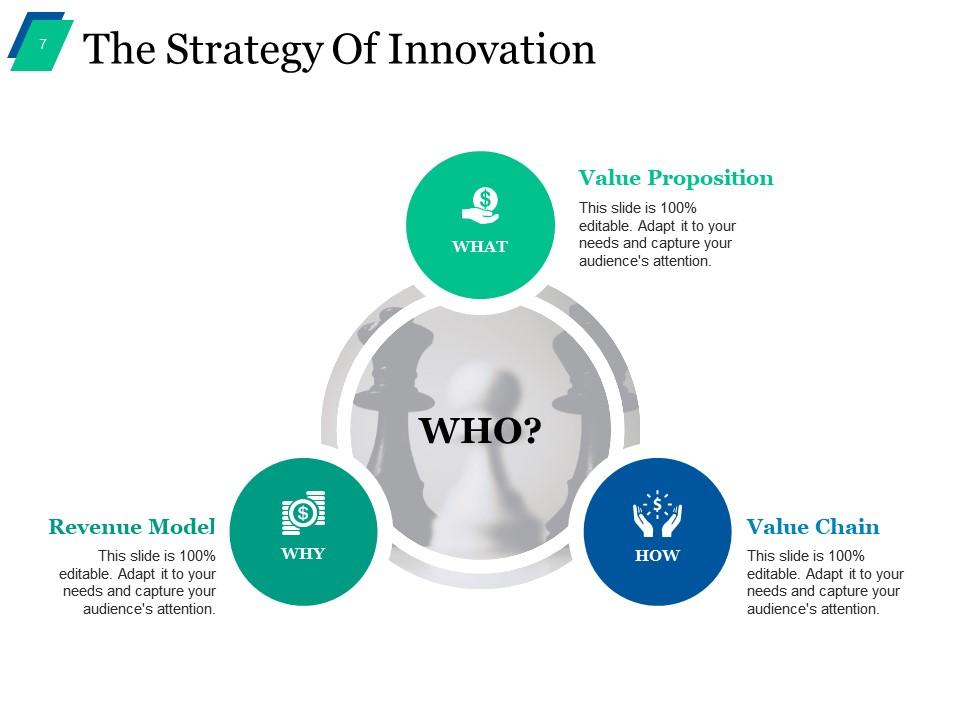
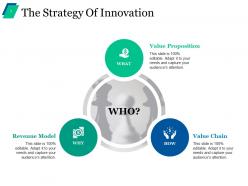
The strategy of innovation is the cornerstone of looking forward to organizations. It guides the organization in harnessing creativity to navigate the ever-changing landscape of their industry. This PPT Template outlines the critical questions of the strategy of innovation, such as "what," "why," and "how." The answer to what a value proposition is, the answer to why is the revenue model, and the value chain is the answer to how. These three significant aspects enable an organization to gain a competitive advantage. Download this now.

Template 7- Business Model Innovation Equation Template

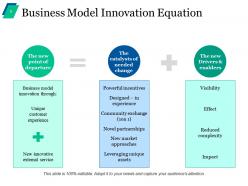
Check out the business model innovation equation PPT Template that shows the new point of departure is the addition of the catalysts of needed change and the new drivers and enablers. It also showcases the factors of the above equation, such as visibility, effect, reduced complexity, impact, powerful incentives, community exchange, unique customer experience, and new innovative external service. Use this template to redesign your business models. Also, it provides a structured framework to help businesses identify and implement new ways to value for customers and capture market opportunities. Download this now.

Template 8- Business Model Innovation Framework Template

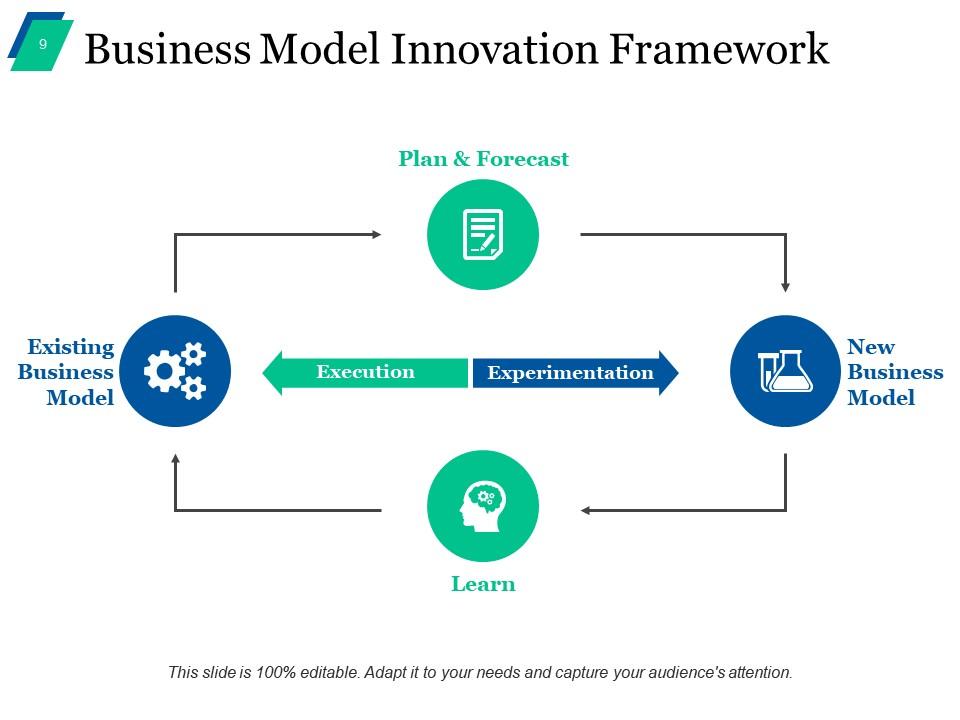
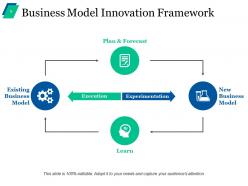
Grab our business model innovation framework template that illustrates the business model in a graphical form. It shows that there are two aspects: execution and the other is experimentation. One can execute the existing business model and plan or forecast the innovation process. On the other hand, you can plan and forecast a new business model and then start experimenting. From both the results, you can learn about your strategy. Therefore, you can use this template to increase revenue growth and operational efficiency. Download this now.

Conclusion

A business plan innovation template is a roadmap toward success, but it can be challenging. By outlining unique ideas with the help of our templates, you can easily target markets and communicate effectively with your potential customers and stakeholders. Adapt it to your innovation process and use it to redefine your Vision. This will turn your idea into reality.

Are you planning to start to start a real estate business? Here's a set of business plan templates for real estate businesses.

FAQs for Business Plan Innovation

Honestly, start with your value prop - what problem are you actually solving that people will pay for? Then figure out who your target market is (be specific, not "everyone"). You'll need a financial model that shows multiple ways to make money, plus a realistic look at your competition. I know it's tempting to think you have zero competitors, but trust me, you do. Map out how you're gonna reach customers and what your day-to-day operations look like. Oh, and don't skip the risk assessment part - investors love seeing you've thought through what could go wrong. The innovation stuff comes from how you stand out and pivot based on feedback.

Don't just dump market trends in one section - sprinkle them throughout your entire plan. Pick 3-4 trends that actually matter for your business, then show how you're positioning around them. Financial projections should reflect these too, btw. The cool part is proving you're not just chasing whatever's trendy - you're being smart about timing. Like, why does launching now make sense? What's happening in the market that works in your favor? Use trends to back up your differentiation strategy. It's basically your chance to show you get the bigger picture and aren't just winging it.

Honestly, customer feedback is like having a cheat code for your business plan. It tells you what's actually broken instead of what you think might be wrong. I've watched way too many founders build stuff nobody wants because they didn't listen to their users first. Get feedback through surveys, interviews, whatever works. Then actually use it to fix your plan - don't just collect it and ignore it. The data helps you avoid expensive mistakes and might even show you opportunities you never considered. Way better than guessing what people want.

Ditch PowerPoint - seriously, investors are so tired of it. Try Prezi or Canva instead for something that actually looks modern. If you've got a physical product, AR/VR demos are amazing because people can literally touch and experience your idea. Live dashboards with real data work well too, though honestly even just getting a decent presentation remote makes you seem more professional. Video prototypes are solid. Don't go crazy with tech though - pick one thing and get good at it first. The worst thing is when someone tries to use five different tools and none of them work properly.

Honestly, figure out what makes you different first - that's everything. Most business plans I see are boring carbon copies of each other. What problems are your competitors totally missing? Show me something fresh, whether it's how you make money or find customers. Your team matters huge too btw. Why can you pull this off when others can't? Don't just dump features and numbers at me. Tell me a story that actually makes sense and gets me excited about backing you.

Track stuff like customer acquisition rates and revenue from new products - those are your bread and butter metrics. But also check if people actually USE your new features, not just if they buy them. User feedback is honestly way more valuable than most people think. Here's what I learned the hard way: get your baseline numbers BEFORE you launch anything new. Otherwise you're just throwing darts blindfolded. Check progress every quarter and don't be stubborn about pivoting if something's flopping. Focus on metrics that actually move the needle for your business, not just what sounds impressive in meetings.

Honestly, start with the boring stuff first - what regulations you're dealing with. I've seen good ideas die because someone didn't check compliance early enough. Customer patterns matter too, like seasonal swings and how fast people actually adopt new tech in your space. Supply chains can totally screw you over (trust me on this one). Profit margins vary wildly between industries, so does competition. Are you in a mature market or something newer? That changes everything. Innovation cycles are different everywhere - some move fast, others don't. Map this out before you get creative.

Honestly, good visual design is a game changer for business plans. Charts and clean layouts beat boring walls of text every time - investors will actually pay attention instead of zoning out. Breaking up your financials with some graphs makes everything way clearer. Plus it shows you're not sloppy about presentation, which matters more than people think. White space is your friend too. I'd start with consistent fonts and maybe throw in an infographic or two. It's wild how much difference it makes when everything looks organized instead of like a college essay.

Honestly, the worst thing you can do is fall head over heels for your own idea without checking if customers actually give a damn about it. I've watched so many genius concepts crash and burn this way. Don't assume your team can suddenly learn rocket science overnight either - that's just setting yourself up. Oh, and resist the urge to revolutionize everything at once. Pick one thing to nail first. My advice? Talk to real customers before you get emotionally invested. Be honest about what'll actually cost and how long things take. Test something small, see what happens, then double down on whatever doesn't suck. Way less painful than betting everything on a maybe.

Working with others is honestly like having superpowers for creativity. Everyone's got their own weird perspective, right? So when you're stuck on something, bouncing ideas around helps you catch stuff you'd totally miss on your own. The energy builds on itself too - someone says something that sparks your idea, which gives them another thought. It's pretty cool how that works. Make sure people feel safe throwing out dumb ideas though (we all have them). I'd suggest splitting brainstorming into two parts - first just go crazy with ideas, then pick the good ones later. Keeps things flowing better.

Revenue-based financing could be perfect for you - investors just take a cut of monthly revenue instead of equity. Kickstarter's solid if you're doing consumer products. P2P lending's another route that skips banks entirely. Government grants are basically free money if you qualify (though the paperwork's a pain). Oh, and there's newer stuff like revenue sharing deals and even crypto funding now. Honestly, the options have exploded compared to like 5 years ago. I'd map out maybe 3-4 different funding sources rather than banking everything on VCs.

Don't just slap sustainability onto the end of your business plan - weave it throughout the whole thing. Look for eco-friendly stuff you can actually do: cutting waste, renewable energy, better sourcing. Here's the thing though - you've gotta show how it saves money and pulls in customers (Gen Z basically won't buy from you otherwise). Track real numbers like carbon reduction or waste percentages. The trick is proving green practices boost your bottom line, not just make you feel good. Make it part of what sets you apart from competitors.

Netflix saw streaming coming and ditched DVDs before it was too late - honestly brilliant timing. Then you've got Airbnb basically saying "hey, why not rent out your spare room?" and boom, entire hotel industry gets shaken up. Uber did something similar with rides, no cars needed. These companies didn't just tweak their products, they completely flipped their whole approach. The smart move? Don't lock yourself into one way of doing things. Stay flexible so when something big shifts, you can pivot instead of getting left behind.

Oh man, adaptability is HUGE. Like, probably the biggest thing for long-term planning. Market changes, new tech, customer preferences - you can't see any of that stuff coming 3-5 years out. I've watched companies crash because they wouldn't budge from their original plan. Super stubborn about it. What works better is having solid core goals but keeping your tactics flexible. Review things quarterly, adjust as needed. It's like... you know where you're headed but you'll take different roads to get there depending on traffic, you know?
Honestly, ditch those crazy long-term plans. I do quarterly check-ins instead—way more realistic. My "brilliant" annual strategy once died after like 2 months lol. Keep your business plan flexible, not set in stone. Watch competitors regularly and actually listen to customer feedback (shocking concept, right?). Track industry trends too. The real trick? Have clear criteria ready for making quick decisions. When shit hits the fan, you'll move fast instead of scrambling. Trust me on this one.
Ratings and Reviews

100% of 100
Write a review
Most Relevant Reviews
  1. 100%

    by Dewey Stephens

    Informative presentations that are easily editable.
  2. 100%

    by Devin Daniels

    Visually stunning presentation, love the content.

2 Item(s)

per page: