


Construction Project Portfolio Management Dashboard Construction Playbook




Try Before you Buy Download Free Sample Product
 Impress Your
 Audience
 100%
100% Editable
 Save Hours
 of Time


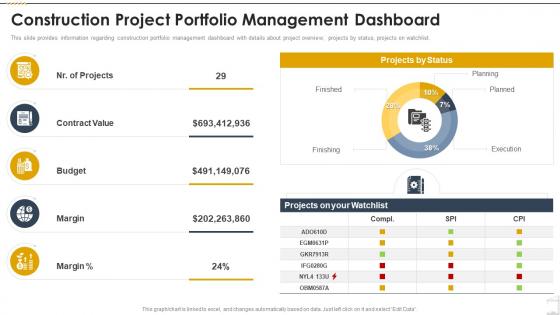
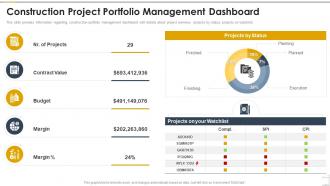
This slide provides information regarding construction portfolio management dashboard with details about project overview, projects by status, projects on watchlist.
People who downloaded this PowerPoint presentation also viewed the following :
Construction Project Portfolio Management Dashboard Construction Playbook with all 7 slides:
Use our Construction Project Portfolio Management Dashboard Construction Playbook to effectively help you save your valuable time. They are readymade to fit into any presentation structure.





FAQs for Construction Project Portfolio Management
Honestly, it's all about getting four things right: strategic alignment, resource allocation, risk management, and performance tracking. Make sure every project actually ties back to your business goals (you'd be shocked how many companies mess this up). Don't spread your teams too thin - balance resources so nobody's drowning. Risk assessment is huge for catching problems before they explode. Set up consistent KPIs across everything so you can actually see what's working. The game-changer though? Regular portfolio reviews where you can kill projects that aren't delivering. Sounds harsh but it's necessary.
Think of it as your safety net across all projects at once. Weather hits multiple sites? Now your whole timeline's screwed, not just one job. Dependencies are huge - Project A delays can totally cascade into Project B. I learned this the hard way honestly. Map out how your projects connect first, then diversify by location and type. Always keep backup resources that can jump between sites when stuff goes wrong. Oh, and tackle your biggest cross-project weak spots right away - those'll bite you if you ignore them.
Track your SPI and CPI first - those'll tell you if projects are on time and budget. Budget variance too, obviously. Then watch quality scores, safety incidents, and how often you're dealing with change orders (ugh, those are the worst). Resource utilization is critical because idle crews kill your margins while other sites are desperate for people. Client satisfaction matters since you want them coming back. Oh, and set up some kind of dashboard so you can catch problems early. Way easier to fix stuff before it completely falls apart than after.
Dude, get a good project management platform first - it'll centralize everything instead of you digging through random spreadsheets. The dashboards are actually pretty sweet, showing budgets and timelines for all your projects in one spot. Cloud sync keeps everyone on the same page, plus mobile apps mean your field teams can update stuff right away. The AI analytics are kinda wild too - they'll flag potential issues before they blow up. Honestly? Start simple with something that plays nice with your current tools. You can always add the fancy analytics later once you're not drowning in chaos.
Honestly, the hardest part is everyone fighting over the same good workers. Like, every contractor wants your best electrician at once and you're stuck playing referee. Money gets weird too - you've got all these different payment schedules hitting at random times while you're trying to buy materials for three different sites. I can't be everywhere checking quality (found that out when one crew decided "close enough" was good enough lol). Communication turns into a total mess with all the different clients and deadlines. Get decent project management software early and figure out your priorities before things get crazy.
Honestly, stakeholder interests run the whole show when it comes to portfolio decisions. You've got investors wanting their returns, communities worried about environmental stuff, and government agencies obsessing over compliance. It's like being pulled in ten directions at once - kind of exhausting tbh. Map out who wants what and how much power they actually have. Then pick projects that keep your biggest stakeholders happy without creating too much drama. I'd start with a simple matrix for each project, scoring people on their influence versus how much they care. Sounds boring but it actually helps you see the politics clearly.
So for construction portfolios, start with a basic scoring matrix - maybe 3-5 criteria like ROI, risk, and whether your team actually has bandwidth. Weighted scoring models work well here. MoSCoW method is solid for quick sorting too (Must have, Should have, etc). NPV matters for bigger projects obviously. Honestly, I've watched teams overthink this stuff and get paralyzed by fancy frameworks. Keep it simple at first. Factor in your crew's expertise - no point taking on something you can't execute well. Strategic fit matters too, though that's harder to quantify. Refine the system as you figure out what actually drives wins for your specific market.
So with portfolio management, you get this big picture view of everything happening across your construction sites. Game changer honestly. You can actually see where your skilled guys and equipment need to be instead of scrambling project by project. Think of it like resource Tetris - except when you screw up, it costs serious money. The cool thing is catching conflicts before they blow up and making sure your biggest projects don't get starved for resources. I'd start by just mapping what you've got committed right now. You'll probably find some obvious gaps pretty quick.
Look, sustainability isn't just a nice-to-have anymore - it's basically required now. Clients expect it, regulations are getting stricter, and honestly? The numbers back it up too. Sustainable buildings usually crush it financially long-term. So when you're picking projects, start weighing LEED certs and environmental impact right alongside your usual ROI stuff. Track carbon footprint as a real KPI. Focus on lifecycle costs instead of just upfront spending - that's where you'll see the real difference. Maybe add some kind of sustainability scoring to how you evaluate everything? Trust me, it's worth the extra work.
So basically these tools give you one spot where everyone can see what's going on instead of the usual chaos of emails and random calls. Your site managers, architects, contractors - they're all posting updates, sharing files, messaging in the same place. Honestly, the biggest win is just getting everyone on the same system for reporting problems and tracking stuff. Makes it way easier to spot trends when you're not digging through a million different spreadsheets. My advice? Pick one tool and actually make your project leads stick with it - don't let them fall back to their old habits.
Honestly, agile works way better in construction than you'd think. Short sprint cycles let you adjust priorities weekly instead of getting stuck with monthly plans that go nowhere. When problems hit (and they always do), you can pivot fast rather than watching everything fall apart. Your teams actually start talking to each other regularly, which is huge. Resource allocation between projects gets smoother too. The continuous feedback thing is probably the biggest game-changer - no more waiting around for milestone meetings to figure out you're heading in the wrong direction. I'd start small though, maybe test it on just one segment of your portfolio first.
Honestly, you've gotta watch market trends like a hawk - they'll totally dictate which projects get priority and where your money goes. Take the data center craze lately, or how warehouse construction is exploding. When stuff like that happens, you need to jump on it fast while pulling back from whatever's tanking. Think of it like rebalancing your 401k, except with actual buildings instead of boring stocks. Keep tabs on local economic stuff, interest rates, all that jazz. The trick is staying flexible enough to pivot when things shift - because trust me, they always do. Being stuck chasing last year's hot trend is the worst.
Build buffer time into everything - seriously, I had three projects crash and burn at once and it was a nightmare. Different phases for different projects helps a lot, then you can move people around when stuff goes sideways. Multiple subcontractors are your friend too, don't get stuck with just one supplier. Oh and that quarterly review thing? Game changer. Way better than waiting a whole year to realize something's off. Honestly, treat the whole thing like it's alive and needs tweaking constantly. Rigid plans are basically asking for trouble.
Honestly, you should start tracking what goes wrong and right on your projects - even if it's just a basic spreadsheet for now. Sounds super boring, I know. But patterns will jump out at you pretty quickly. Like which vendors always flake or what types of projects consistently go over budget. Then you can actually score future opportunities based on real data instead of just gut feelings. The trick is doing these lessons learned sessions right after projects wrap up while everyone still remembers the drama. Trust me, your future self will thank you when you're not repeating the same mistakes over and over.
Honestly, bad portfolio management will absolutely wreck you in construction. Projects start bleeding money and running late constantly. Your reputation tanks because clients get fed up and bounce. Meanwhile your crews are exhausted from putting out fires instead of doing actual quality work - which sucks for everyone involved. Plus you can't allocate resources properly when everything's competing for attention without any real strategy. Look, even basic tracking and regular portfolio check-ins will save you tons of pain later. Don't overthink it, just start somewhere.
-
Very unique, user-friendly presentation interface.
-
Use of icon with content is very relateable, informative and appealing.