


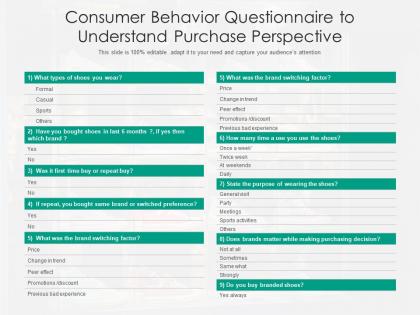
Consumer behavior questionnaire to understand purchase perspective




Try Before you Buy Download Free Sample Product
 Impress Your
 Audience
 100%
100% Editable
 Save Hours
 of Time


Our Consumer Behavior Questionnaire To Understand Purchase Perspective are topically designed to provide an attractive backdrop to any subject. Use them to look like a presentation pro.
People who downloaded this PowerPoint presentation also viewed the following :
Consumer behavior questionnaire to understand purchase perspective with all 2 slides:
Use our Consumer Behavior Questionnaire To Understand Purchase Perspective to effectively help you save your valuable time. They are readymade to fit into any presentation structure.
FAQs for Consumer behavior questionnaire to
So there are basically four things that mess with how people buy stuff. Psychological stuff comes first - like what motivates someone, how they see your product, their attitudes. Social pressure is huge too (honestly, adults are just as bad as teenagers with this). Family and friends definitely sway decisions. Personal factors matter - age, lifestyle, how much cash they actually have. Oh, and cultural background shapes everything more than people realize. When you're figuring out your customers, just think about which of these hit hardest for what you're selling. Makes targeting way easier.
Loyalty acts like a shortcut in people's heads when they're shopping. With everyday stuff like toothpaste, customers just grab their usual brand without thinking. Cars or phones? Different story - even loyal buyers will do their homework first, though they're still biased toward what they know. Luxury brands get crazy loyal customers because it becomes part of who they are. But honestly, all those review sites make it way harder to keep people locked in these days. Bottom line: don't get comfortable just because you have loyal customers - you've gotta keep earning it.
Okay so culture basically determines how people shop, and it's wild how different it gets. Family decisions vs individual choices? Totally depends where you're from. Religious stuff matters too, plus what counts as a status symbol varies everywhere. Gift-giving is huge - like, some places go crazy for holidays while others barely care. Colors and packaging can literally kill your product if you get it wrong. I learned this the hard way trying to sell stuff online to different countries. Bottom line: research the specific culture first. What works in the US might completely flop in Japan or Brazil. Don't just assume people think like you do.
Honestly, influencers are like word-of-mouth but way more powerful. When they recommend stuff, followers trust it because it feels like getting advice from a friend, not watching some random ad. Here's what's wild though - those smaller micro-influencers often work better than big celebrities. People actually engage with them more. You'll want to figure out which ones your customers are already following and actually care about. Oh, and track their engagement rates too, not just follower counts. Getting the right influencer can completely change how people see your brand compared to regular advertising.
Dude, emotional appeals totally bypass people's rational thinking. Like, when you hit someone with fear or nostalgia, they'll act on impulse instead of comparing prices and features for hours. It's kinda wild how well it works, honestly. People remember feelings way longer than facts - I learned that the hard way with my own marketing fails lol. Joy, fear, FOMO... those emotions make customers buy NOW instead of thinking it over. So yeah, lead with the emotional story first, then sprinkle in your product details after you've hooked them.
When money gets tight, people instantly switch to survival mode. Food and healthcare stay. Everything else? Gone. Dining out, vacations, that nice jacket they were eyeing - nope. Suddenly everyone's hunting for deals and buying generic brands instead of name stuff. Major purchases like cars get pushed off indefinitely. What's crazy is how fast this shift happens - like a switch flips overnight. For your business, you've gotta make whatever you're selling feel absolutely necessary, not nice-to-have. Price becomes everything during downturns.
Dude, personalization is seriously a game changer. When people see their name in emails or get recommendations that actually match what they've been looking at, they feel like you actually understand them. Makes them way more likely to buy stuff. I've seen conversion rates jump 10-30% just from basic personalization - people hate making decisions, so when you make it easier they'll choose you. Oh and start with your email lists first, segment them by what people bought before. Super easy and you'll see results pretty quickly. It's honestly crazy how well this works.
Honestly, personalization is where it's at. Don't post generic crap - talk to your audience's actual problems. Reply to comments and DMs instead of just posting into the void. User-generated content is gold because people eat up seeing themselves featured. Oh, and build that community vibe! Make customers feel like they're part of something cool, not just buying stuff. I'd pick one platform first though and nail it before jumping around everywhere. Trust me, doing one thing well beats being mediocre on five platforms.
Look, consumers don't just compare price tags - they're doing this whole mental calculation about what they're actually getting. There's the practical stuff (does it work?), how it makes them feel, plus what their friends might think. I've seen people drop $200 on face cream because they're convinced it'll change their life, but then complain about a $5 store brand being "expensive." Weird, right? Price matters, sure, but you really need to tell people WHY your thing is worth it. Show the whole picture, not just how you stack up against competitors.
Dude, packaging is literally make-or-break for getting people to notice your stuff. Shoppers spend like 3-7 seconds looking before they move on, so it has to scream quality and show what your brand's about right away. Colors and fonts trigger all these subconscious feelings that drive buying decisions - honestly, we all do it without thinking. I probably judge half the products I buy based on how cool the package looks, which is kinda ridiculous but whatever. Make sure yours pops on the shelf but still feels authentic to your brand. Oh, and definitely test a few versions with real people first!
Okay so each generation shops totally differently, right? Boomers stick with brands they trust and still love going to actual stores. Gen X just wants convenience and good quality - they're not falling for gimmicky ads. Millennials? They're the ones who made "experiences over things" a whole movement, plus they actually care if companies are doing good in the world. Gen Z cranks that up to eleven with the authenticity thing - they can smell fake from a mile away and won't buy from you if you're trashing the planet. You've gotta tailor your messaging for each group instead of blasting the same content everywhere.
Oh man, impulse buying gets me every time! It's basically your emotions messing with your brain - whether you're stressed, happy, or just bored scrolling online. Those "limited time" deals are pure evil because they make you panic-buy without thinking. Plus your self-control is basically nonexistent by evening, which is why late-night Amazon binges are so dangerous. Social proof doesn't help either - you see those "customers who bought this" suggestions and suddenly you *need* that random kitchen gadget. Try waiting 24 hours before buying anything you don't actually need. Works most of the time!
Yeah, people definitely care about sustainability when they're shopping, but honestly? There's usually a big gap between what they say they'll do and what actually happens at checkout. Price and convenience still rule most of the time. Younger people are way better at actually following through though. Food, beauty, and clothes are where you see the most willingness to pay extra for eco-friendly stuff. If you're thinking business-wise, just make your sustainable options easy to find and explain the benefits clearly - but don't oversell it or people will smell the BS from a mile away.
Reviews and testimonials are like shortcuts to trust - people would rather lean on someone else's experience than roll the dice on something new. Detailed reviews work best because they mention actual benefits or issues customers faced. This kills that purchase anxiety we all get. Testimonials feel more polished, which honestly can backfire if they seem too fake. Both tap into social proof though - we naturally copy what others do. Make sure you put real reviews where people can actually see them, and don't ignore the bad ones. Responding professionally to complaints actually builds more trust.
Honestly, customer feedback is like having a crystal ball for your product. You'll catch issues early instead of finding out the hard way later. Plus it shows you what features people actually care about - not just what sounds good in meetings. Without it, you're basically guessing and hoping for the best (spoiler: that rarely works out). Grab feedback everywhere - surveys, reviews, even those angry support emails. The key is looking for patterns and then doing something about it. When customers see you actually listen and make changes? That's how you build real loyalty. Way better than shooting in the dark.
-
Good research work and creative work done on every template.
-
Use of icon with content is very relateable, informative and appealing.
-
It saves your time and decrease your efforts in half.