


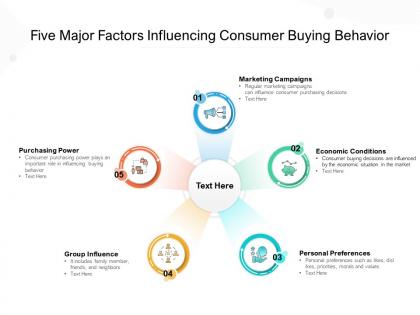
Five major factors influencing consumer buying behavior




Try Before you Buy Download Free Sample Product
 Impress Your
 Audience
 100%
100% Editable
 Save Hours
 of Time


Advise folks to indulge in forthright behavior with our Five Major Factors Influencing Consumer Buying Behavior. It encourages candid comments.
People who downloaded this PowerPoint presentation also viewed the following :
Content of this Powerpoint Presentation
Description:
The image is a PowerPoint slide illustrating "Five Major Factors Influencing Consumer Buying Behavior." It is designed to educate or inform an audience about the key determinants that affect how consumers make purchasing decisions. The slide is sectioned into five parts, each representing a different factor:
1. Marketing Campaigns - Highlighting the impact of regular marketing activities on consumer choices.
2. Economic Conditions - Describing how market economics can sway consumer buying patterns.
3. Personal Preferences - Emphasizing the role of individual likes, dislikes, priorities, morals, and values in shopping behavior.
4. Group Influence - Acknowledging the effects of family, friends, and neighbors on consumer decisions.
5. Purchasing Power - Asserting that a consumer's financial capability is a significant influencer of their buying behavior.
Use Cases:
Each section has a placeholder for additional text, allowing the presenter to elaborate on each point. This slide is versatile and can be utilized across multiple industries for different purposes:
1. Retail:
Use: Training on customer engagement strategies.
Presenter: Sales Manager.
Audience: Sales Staff.
2. Marketing:
Use: Planning marketing strategies.
Presenter: Marketing Analyst.
Audience: Marketing Team.
3. Consumer Electronics:
Use: Understanding customer choices to inform product development.
Presenter: Product Development Manager.
Audience: Product Team.
4. Automotive:
Use: Sales approach based on market trends.
Presenter: Dealer Principal.
Audience: Sales Consultants.
5. Real Estate:
Use: Tailoring property offerings to market demand.
Presenter: Real Estate Broker.
Audience: Sales Agents.
6. Financial Services:
Use: Advising on investment products suited to economic conditions.
Presenter: Financial Advisor.
Audience: Clients.
7. E-commerce:
Use: Enhancing online shopping experiences.
Presenter: E-commerce Strategist.
Audience: E-commerce Team.
Five major factors influencing consumer buying behavior with all 2 slides:
Advise folks to be candid with our Five Major Factors Influencing Consumer Buying Behavior. Encourage them to express their actual feelings.
FAQs for Five major factors influencing
So there's four big ones: perception, motivation, learning, and attitudes. People basically filter everything through their own weird lens - what catches their eye, how they read into stuff, what actually makes them buy things. Past experiences totally shape what they'll purchase next (like once you find a good coffee brand, you're probably sticking with it). Attitudes about brands or pricing run super deep though - that's usually what seals the deal. Memory and personality matter too I guess, but honestly those first four are where the magic happens. When you're doing campaigns, just figure out what drives your people and how they see you compared to everyone else.
Oh man, culture totally changes everything about buying habits. Family opinions matter way more in places like Asia compared to here where we just buy whatever we personally want. Colors are wild too - red screams "lucky" in China but "warning" to us. Religious stuff and social expectations mess with timing and how people shop. Honestly, I learned this the hard way when my company launched something that flopped overseas. Research the local scene first instead of assuming everyone thinks like your home market. Don't just copy-paste campaigns globally - it never works.
Brand loyalty is like a mental shortcut for customers. They stop comparing prices and just grab what they trust - you know how you probably buy the same toothpaste every time? Once people are loyal, they'll actually pay more for your brand over cheaper options. Pretty crazy but it works. The trick is creating those emotional connections from day one. Honestly, I think it's one of the most underrated business strategies. Get real loyalty and you've basically got customers on autopilot who'll keep coming back without you having to convince them every single time.
Honestly, influencers work because people actually trust them - way more than some random ad. Like when that fitness girl you follow swears by a protein powder, you'll probably buy it. I've definitely fallen for this with skincare lol. The crazy part? Smaller influencers often sell more stuff than huge celebrities because their followers are super engaged. FOMO plays a big role too - everyone wants that lifestyle. If you're trying to market something, don't just go for whoever has the most followers. Find someone whose vibe actually matches your brand.
So there are five stages customers go through: recognizing they have a problem, searching for info, comparing options, making the purchase, and then the whole post-buy thing where they second-guess themselves. Your customer figures out they need something first. Then they're googling like crazy, comparing brands and reading reviews. The actual buying decision comes next - though honestly, people change their minds constantly at this stage, which is super frustrating. After they buy, they'll evaluate whether it was worth it. The info search phase is where you really want to show up. That's when they're most open to discovering new options. Makes your marketing way more effective than just throwing ads everywhere.
Think of values as invisible shopping filters. Someone obsessed with sustainability? They'll drop extra cash on eco-friendly stuff without blinking. Religious customers might completely skip certain products. It gets weird though - I've noticed people who are all about "authenticity" will literally choose some random small brand over Nike just because it feels real. The trick isn't selling features anymore. You gotta figure out what actually matters to your audience deep down, then craft your whole message around that. Way more effective than just listing what your product does.
Dude, packaging design is SO underrated. People make like 70% of their buying choices right there in the store, and your package has maybe 3 seconds to catch their eye. Colors and fonts matter way more than you'd think. I literally bought this overpriced granola last week just because the box looked fancy - totally worked on me. It's wild how much packaging tells you about quality before you even try the product. If you're launching something, don't cheap out on the design. Good packaging isn't just about looking pretty, it's doing your marketing work for you.
Honestly, people go crazy for discounts but it's kinda wild how their brains work. Sales definitely boost purchases right away - that part's obvious. But get this: shoppers think discounted stuff is higher quality even when stores jack up the "original" price first. Weird, right? Time limits make people panic-buy, and percentage off feels better than dollar amounts on expensive things. Just don't go discount-crazy or you'll train customers to never pay full price. I learned that one the hard way with my old business. Use sales strategically instead of constantly.
Dude, reviews are HUGE for buying decisions now. People don't trust ads anymore - they want to hear from real customers who've actually used the product. I literally won't buy anything over $20 without checking reviews first, even weird stuff like phone cases. It's basically replaced asking your friends for recommendations. Online shopping makes this even more important since you can't touch anything before buying. Your customers are definitely doing this too, so you should be collecting good reviews and putting them front and center on your site. Makes people way less nervous about hitting "buy now."
Dude, sensory stuff is HUGE for getting people to buy things. Like, way bigger than you'd think. Your brain gets totally hijacked when you smell that Starbucks coffee or hear soft music in fancy stores - it bypasses all your logical thinking. Bright colors, sounds, scents... they all trigger emotions that make you want to spend money. That's why impulse buys happen so easily, honestly. If you're setting up any kind of customer experience, focus on creating good sensory moments that match your brand vibe. It's kinda scary how well it works, but also genius from a business perspective.
Oh man, people are SO picky about this stuff now. Everyone's checking if companies treat workers fairly - like decent wages, no child labor, that kind of thing. Environmental impact is massive too. Carbon footprint, wasteful packaging, whether they're actually green or just pretending to be. It's wild how mainstream this has gotten compared to like 5 years ago. Plus with social media, you can't really hide sketchy practices anymore. If you're working in marketing or whatever, being genuinely ethical isn't just nice - it's basically required now or you'll get called out.
Age and income totally shape how people shop - it's wild to see the differences. Young folks blow money on experiences and the latest tech. Older buyers? They want stuff that'll actually last. Income's obvious - more money means fancier brands and paying extra for convenience. But here's what's crazy: a 25-year-old making $50k shops nothing like a 50-year-old with that same salary. Budget shoppers hunt down every deal while rich people just buy whatever's easiest. When you're doing campaigns, you've gotta segment by both age AND income or your messaging will be all over the place.
People are getting super picky about what they buy now. Quality over quantity is huge - especially with Gen Z, but honestly my parents are doing it too. They want to see actual proof that companies aren't just BS-ing about being green. Supply chain transparency matters way more than it used to. Local businesses are having a moment because of this whole circular economy thing. What's crazy is consumers will actually pay more for sustainable stuff now - like significantly more. If you're marketing anything, ditch the generic green packaging and show real environmental data. People want receipts, not pretty labels.
Dude, peer recommendations are seriously game-changing. Your best friend tells you about some restaurant? You're probably gonna try it. Compare that to seeing some random ad - there's just no contest. People trust other people way more than marketing BS, especially for expensive stuff like cars or phones. Though honestly, it works for literally everything - I bought my last face wash because my coworker wouldn't shut up about it. Point is, you gotta get your customers talking and sharing their experiences. Reviews and testimonials should be front and center in whatever you're doing marketing-wise.
Dude, scarcity stuff works like crazy - "only 2 left" or whatever gets people every time. Social proof is solid too, like those "customers also bought" sections. I swear placement is everything though - anything at checkout or eye level just gets grabbed without thinking. Emotional hooks are big, especially if you can hit that FOMO feeling or make them want it right now. Oh and make buying super easy - streamline checkout and use buttons that actually make people want to click. Basically you want them deciding fast before they talk themselves out of it.
No Reviews