


Content Marketing Dashboard For Effective Tracking SEO And Social Media Marketing Strategy




Try Before you Buy Download Free Sample Product
 Impress Your
 Audience
 100%
100% Editable
 Save Hours
 of Time


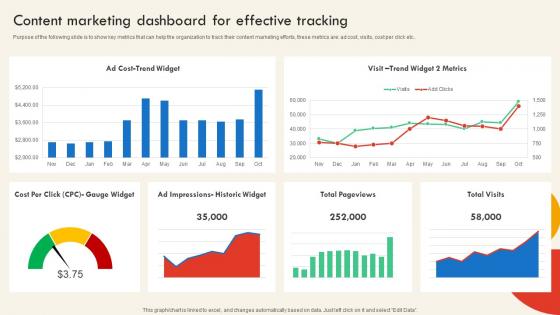
Purpose of the following slide is to show key metrics that can help the organization to track their content marketing efforts, these metrics are ad cost, visits, cost per click etc.
People who downloaded this PowerPoint presentation also viewed the following :
Content Marketing Dashboard For Effective Tracking SEO And Social Media Marketing Strategy with all 7 slides:
Use our Content Marketing Dashboard For Effective Tracking SEO And Social Media Marketing Strategy to effectively help you save your valuable time. They are readymade to fit into any presentation structure.






FAQs for Content Marketing Dashboard For Effective Tracking SEO And Social
**INPUT**: What key metrics should be included in a content marketing dashboard? **OUTPUT**: Content marketing dashboards should include website traffic, engagement rates, lead generation, conversion rates, social media reach, and content performance by channel. These metrics enable marketing teams to track ROI, optimize content strategies, and demonstrate value to stakeholders, with many organizations finding that comprehensive dashboards streamline reporting while enhancing strategic decision-making across campaigns.
A content marketing dashboard improves decision-making by providing real-time performance metrics, audience insights, content ROI analysis, and campaign tracking in one centralized view. These comprehensive analytics enable marketing teams to quickly identify top-performing content, optimize underperforming campaigns, and allocate resources strategically, ultimately delivering faster pivots and improved marketing effectiveness across all channels.
**INPUT**: What tools are best for creating a visually appealing content marketing dashboard? **OUTPUT**: Top content marketing dashboard tools include Tableau, Power BI, Google Data Studio, HubSpot, and Salesforce Analytics Cloud. These platforms streamline campaign visualization by integrating multiple data sources, automating reporting workflows, and delivering real-time performance insights, with many marketing teams finding that comprehensive dashboards enhance strategic decision-making and demonstrate clear ROI to stakeholders. [Word count: 58 words]
Content marketing dashboards should be updated daily for real-time metrics like website traffic and social engagement, weekly for campaign performance analysis, and monthly for comprehensive strategic reviews. This tiered approach enables marketers to respond quickly to trending content, optimize ongoing campaigns, and make informed strategic decisions, with many organizations finding that regular updates ultimately deliver better audience engagement and measurable ROI improvements.
Tracking audience engagement metrics in a content marketing dashboard delivers improved content performance, enhanced audience understanding, real-time optimization capabilities, strategic resource allocation, and measurable ROI insights. These analytics enable marketers to identify high-performing content types, refine targeting strategies, and adjust campaigns instantly, with many organizations finding significantly improved conversion rates and streamlined content creation processes.
Businesses measure content marketing ROI through dashboards by tracking lead generation metrics, conversion rates, customer acquisition costs, and revenue attribution from specific content pieces. These platforms integrate data from multiple channels, enabling marketers to analyze engagement patterns, content performance, and sales pipeline contributions, ultimately delivering clear visibility into which content drives measurable business growth and competitive advantage.
KPIs serve as the foundation for content marketing dashboards, determining which metrics get tracked, how data is visualized, and what strategic insights emerge from performance analysis. These key performance indicators enable marketing teams to measure engagement rates, conversion metrics, and ROI across different channels, with many organizations finding that well-chosen KPIs ultimately streamline decision-making and enhance campaign effectiveness.
A content marketing dashboard helps identify content gaps by tracking performance metrics across topics, audience segments, and funnel stages, while analyzing competitor content and keyword opportunities. Through automated reporting and visual analytics, marketing teams can quickly spot underperforming content areas, missing seasonal campaigns, and untapped audience interests, ultimately enabling more strategic content planning and competitive advantage.
When selecting content marketing dashboard software, look for analytics tracking, content calendar integration, multi-platform publishing, performance metrics, team collaboration tools, and automated reporting capabilities. These features streamline campaign management by centralizing content workflows, tracking engagement across channels, and providing real-time insights, with many marketing teams finding that comprehensive dashboards ultimately enhance strategic decision-making and improve ROI measurement.
Data visualization enhances content performance understanding by transforming complex analytics into intuitive charts, graphs, heatmaps, and trend lines that reveal patterns instantly. Through interactive dashboards, marketing teams can identify top-performing content, audience engagement behaviors, and conversion pathways more effectively, while spotting underperforming assets quickly, ultimately enabling faster strategic adjustments and improved ROI.
Content marketing dashboards should monitor blog posts, social media content, email campaigns, video content, infographics, whitepapers, and webinar materials. These diverse content types enable organizations to track engagement patterns, conversion rates, and audience preferences across multiple channels, with many marketing teams finding that comprehensive monitoring ultimately delivers better content ROI and strategic insights.
A content marketing dashboard refines your target audience by analyzing engagement metrics, demographic data, conversion patterns, and content performance across channels. Through detailed analytics, marketers can identify which audience segments respond best to specific content types, optimize messaging for high-performing demographics, and eliminate low-converting segments, ultimately delivering more targeted campaigns and improved ROI.
Common mistakes when creating content marketing dashboards include tracking vanity metrics without business impact, overwhelming displays with too many data points, ignoring audience segmentation, and failing to align metrics with strategic objectives. Many organizations find that focusing on actionable insights rather than comprehensive data visualization, establishing clear stakeholder access permissions, and regularly updating dashboard relevance ultimately delivers more strategic value and measurable content performance.
A content marketing dashboard facilitates collaboration by providing centralized content calendars, real-time performance metrics, shared task assignments, workflow status tracking, and unified communication channels. Through integrated project management features, marketing teams can coordinate campaign development, align content strategies, and monitor collective progress seamlessly, ultimately enhancing productivity and ensuring consistent messaging across all marketing initiatives.
Social media metrics on a content marketing dashboard reveal engagement rates, reach and impressions, follower growth, click-through rates, and conversion tracking across platforms. These insights enable marketers to identify high-performing content types, optimize posting schedules, and measure ROI, with many organizations finding that integrated social analytics streamline campaign optimization and enhance audience targeting strategies.
-
Nice and innovative design.
-
The best and engaging collection of PPTs I’ve seen so far. Great work!