


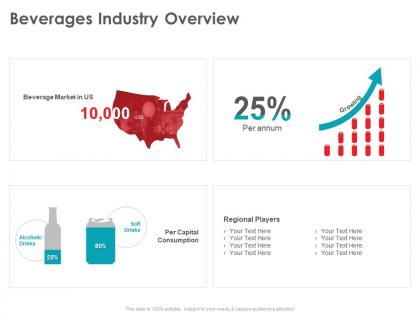
Beverages industry overview regional ppt powerpoint presentation infographic template visuals




Try Before you Buy Download Free Sample Product
 Impress Your
 Audience
 100%
100% Editable
 Save Hours
 of Time


Our Beverages Industry Overview Regional Ppt Powerpoint Presentation Infographic Template Visuals are topically designed to provide an attractive backdrop to any subject. Use them to look like a presentation pro.
People who downloaded this PowerPoint presentation also viewed the following :
Beverages industry overview regional ppt powerpoint presentation infographic template visuals with all 2 slides:
Use our Beverages Industry Overview Regional Ppt Powerpoint Presentation Infographic Template Visuals to effectively help you save your valuable time. They are readymade to fit into any presentation structure.
FAQs for Beverages industry overview regional ppt powerpoint presentation
Key trends include plant-based alternatives, functional beverages with health benefits, sustainable packaging solutions, personalized nutrition drinks, and premium craft offerings. These innovations streamline consumer choice while enhancing wellness positioning, with many beverage companies finding that strategic combinations of sustainability and functionality ultimately deliver competitive advantage in an increasingly health-conscious marketplace.
Sustainability is revolutionizing beverage manufacturing through water conservation technologies, renewable energy adoption, eco-friendly packaging solutions, and waste reduction systems. These innovations streamline operations by minimizing resource consumption, reducing carbon footprints, and enhancing supply chain efficiency, with many breweries and soft drink manufacturers finding that sustainable practices ultimately deliver cost savings and stronger consumer loyalty.
Technology streamlines beverage supply chain operations through automated inventory management, real-time tracking systems, predictive analytics, IoT sensors, and blockchain transparency. These solutions enable companies like Coca-Cola and Heineken to minimize waste, optimize distribution routes, and reduce delivery times, while enhancing quality control and ultimately delivering cost savings and improved customer satisfaction.
Consumer preferences are shifting towards healthier beverage options through increased demand for low-sugar, organic, functional, and plant-based alternatives, driven by growing health consciousness and wellness trends. Many beverage companies are responding by reformulating existing products, introducing natural ingredients, and expanding portfolios with kombucha, cold-pressed juices, and enhanced waters, ultimately delivering better nutritional profiles while maintaining taste appeal.
Beverage companies are penetrating new markets through localized product development, strategic partnerships with regional distributors, direct-to-consumer digital channels, and targeted marketing campaigns tailored to cultural preferences. These approaches enable companies to understand local tastes, streamline distribution networks, and build brand awareness efficiently, with many beverage manufacturers finding that combining traditional retail presence with e-commerce platforms ultimately delivers faster market entry and sustainable competitive advantage.
Regulatory changes significantly impact beverages through labeling requirements, health warnings, sugar taxes, alcohol content restrictions, and advertising limitations. These regulations reshape product formulation and marketing strategies, with soft drink manufacturers reformulating to reduce sugar content and alcohol producers adapting to stricter age verification and distribution rules, ultimately driving innovation while increasing compliance costs.
Beverage innovation challenges include changing consumer preferences, regulatory compliance across markets, supply chain complexities, high development costs, and intense competition from established brands. These hurdles require strategic resource allocation, extensive market testing, and agile product development, with many beverage companies finding that successful innovation demands balancing creativity with operational efficiency and consumer insights.
Beverage brands can leverage social media through influencer partnerships, user-generated content campaigns, interactive stories, targeted advertising, and community building around lifestyle themes. These strategies enhance brand visibility by showcasing products in authentic contexts, engaging younger demographics through platforms like Instagram and TikTok, ultimately driving sales and customer loyalty.
Climate change significantly impacts beverage raw material sourcing through altered precipitation patterns, temperature fluctuations, and extreme weather events affecting crop yields and quality. These environmental shifts force companies to diversify supplier networks, invest in sustainable farming partnerships, and develop climate-resilient sourcing strategies, with many beverage manufacturers finding that proactive adaptation ultimately delivers supply chain stability and competitive advantage in an increasingly volatile market.
The craft beverage trend is driving large-scale producers to diversify portfolios, acquire smaller craft brands, and innovate premium product lines to compete with artisanal offerings. Many major beverage companies are investing in smaller-batch production facilities, unique flavor profiles, and local sourcing strategies, while craft breweries and distilleries increasingly influence mainstream taste preferences, ultimately reshaping industry standards.
**INPUT**: What are the key considerations for creating effective beverage packaging? **OUTPUT**: Key considerations include product protection, brand differentiation, sustainability, consumer convenience, and regulatory compliance. These elements work together by preserving freshness, attracting target demographics, and meeting environmental standards, with beverage companies finding that strategic packaging ultimately drives purchase decisions while reducing costs and enhancing shelf appeal. **Word count: 50 words**
Cultural differences significantly influence beverage consumption through religious practices, traditional ceremonies, climate preferences, social customs, and historical heritage. While tea dominates in Asian markets like China and India, coffee culture thrives in European and Latin American regions, with local festivals, business meetings, and daily rituals ultimately shaping distinct regional preferences and consumption behaviors.
Branding creates emotional connections, differentiates products, builds trust, establishes premium positioning, and fosters repeat purchases within the beverages industry. Through consistent messaging and quality experiences, companies like Coca-Cola and Starbucks cultivate devoted customer bases, ultimately delivering sustained market share and pricing power in an increasingly competitive marketplace.
**INPUT**: What are the best practices for managing waste in beverage production? **OUTPUT**: Best practices for managing waste in beverage production include water recycling systems, ingredient optimization, packaging reduction, byproduct repurposing, and energy recovery from organic waste. These approaches streamline operations by minimizing raw material costs, reducing disposal expenses, and enhancing sustainability compliance, with many beverage manufacturers finding that integrated waste management delivers significant cost savings while strengthening their competitive advantage. [Word count: 60 words]
E-commerce is revolutionizing beverage distribution by enabling direct-to-consumer sales, subscription models, and personalized product recommendations while bypassing traditional retail intermediaries. Through digital platforms, beverage companies streamline inventory management, reduce distribution costs, and access real-time consumer data, with many brands finding that online channels deliver faster market penetration and enhanced customer engagement.
-
Qualitative and comprehensive slides.