


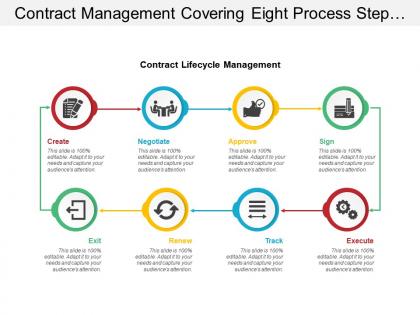
Contract management covering eight process step of create negotiate approve and sign




Try Before you Buy Download Free Sample Product
 Impress Your
 Audience
 100%
100% Editable
 Save Hours
 of Time


Pick it up at our Contract Management Covering Eight Process Step Of Create Negotiate Approve And Sign store. You will get more than you can carry.
People who downloaded this PowerPoint presentation also viewed the following :
Contract management covering eight process step of create negotiate approve and sign with all 5 slides:
Our Contract Management Covering Eight Process Step Of Create Negotiate Approve And Sign make for an excellent gambit. Begin the day brilliantly.




FAQs for Contract management covering eight process step of create negotiate
The contract management process involves contract initiation, negotiation, approval, execution, performance monitoring, renewal evaluation, and termination or extension. These stages streamline legal compliance, financial tracking, and vendor relationships by establishing clear timelines, automating approval workflows, and ensuring deliverable accountability, with many organizations finding that structured contract management reduces operational risks while enhancing strategic partnerships and cost control.
Effective contract management reduces legal risks by ensuring comprehensive compliance monitoring, standardizing approval workflows, and maintaining detailed audit trails throughout contract lifecycles. Through automated tracking systems, organizations can proactively identify renewal deadlines, monitor performance obligations, and flag potential disputes before escalation, ultimately delivering enhanced regulatory compliance and significantly reduced exposure to costly legal challenges.
Essential contract management tools include automated workflow platforms, digital signature solutions, contract lifecycle management (CLM) systems, AI-powered analytics tools, and centralized document repositories. These technologies streamline operations by reducing manual processing, accelerating approval cycles, and enhancing compliance tracking, with many organizations finding that integrated platforms deliver faster contract execution and improved risk management.
Contract compliance requires systematic monitoring through automated alerts, regular performance reviews, milestone tracking, and standardized reporting mechanisms. Many organizations leverage contract management software to streamline oversight processes, enabling legal teams to identify potential breaches early, maintain audit trails, and ensure all parties meet their obligations, ultimately reducing risks and strengthening vendor relationships.
Collaboration enables seamless coordination between legal, procurement, finance, and business teams throughout contract creation, negotiation, and execution phases. Through shared platforms and streamlined workflows, organizations enhance contract accuracy, reduce approval delays, and minimize compliance risks, with many companies finding that collaborative approaches accelerate deal closure while maintaining stronger stakeholder alignment.
Organizations improve contract milestone visibility through centralized contract management systems, automated alerts, real-time dashboards, milestone tracking templates, and regular review processes. These digital solutions enable teams to monitor key dates, deliverables, and performance metrics across all contracts simultaneously, while automated notifications prevent missed deadlines, ultimately delivering enhanced compliance and stronger vendor relationships.
Effective contract renewal strategies include automated alerts for expiration dates, centralized renewal tracking systems, early stakeholder engagement, performance evaluation protocols, and standardized renewal workflows. These approaches streamline renewal processes by eliminating last-minute scrambles, enabling proactive negotiations, and maintaining comprehensive renewal histories, with many organizations finding that systematic renewal management reduces costs while strengthening vendor relationships.
Post-signing contract performance assessment involves monitoring key performance indicators, tracking deliverable completion rates, conducting regular milestone reviews, and measuring compliance against agreed terms and service levels. Through automated tracking systems and periodic stakeholder evaluations, organizations streamline oversight processes, identify potential issues early, and ensure optimal contract value realization, ultimately delivering improved vendor relationships and strategic cost management.
Automation significantly enhances contract management efficiency by streamlining document creation, accelerating approval workflows, and reducing manual review time from weeks to days. Through AI-powered tools, organizations automate compliance tracking, deadline monitoring, and risk assessment, while minimizing human errors, ultimately delivering faster contract cycles and improved operational efficiency across legal and procurement teams.
Cultural differences significantly influence international contract management through varying communication styles, negotiation approaches, legal frameworks, and business relationship expectations. These variations affect contract interpretation, dispute resolution preferences, and timeline expectations, with many multinational organizations finding that cultural sensitivity training and localized contract adaptations ultimately deliver stronger partnerships and reduced conflicts across diverse markets.
Organizations should track contract cycle time, compliance rates, cost savings achieved, renewal rates, and vendor performance scores to evaluate contract management success. These metrics enable businesses to identify bottlenecks, reduce legal risks, and optimize vendor relationships, with many companies finding that comprehensive measurement ultimately delivers improved negotiation outcomes and significant operational efficiency gains.
Organizations handle disputes and breaches through structured escalation procedures, alternative dispute resolution methods, clear documentation protocols, and predefined remediation frameworks. These approaches streamline conflict resolution by enabling faster negotiations, reducing legal costs, and maintaining business relationships, with many companies finding that proactive dispute management ultimately delivers better outcomes than traditional litigation processes.
Best practices for drafting clear contracts include using plain language, defining key terms upfront, structuring clauses logically, specifying deliverables with measurable criteria, and establishing clear timelines and responsibilities. These approaches streamline negotiations, reduce disputes, and enhance compliance, with many organizations finding that standardized templates and collaborative review processes ultimately deliver faster execution and stronger business relationships.
Training and development enhance contract management skills by improving negotiation techniques, risk assessment capabilities, and regulatory compliance knowledge across team members. Through structured programs focusing on legal fundamentals, technology platforms, and industry-specific requirements, organizations streamline contract lifecycles, reduce approval times, and minimize costly errors, with many teams finding that comprehensive training ultimately delivers better vendor relationships and significant cost savings.
Risk assessment enables organizations to identify potential legal, financial, and operational vulnerabilities before they become costly problems, while establishing mitigation strategies throughout the contract lifecycle. Through systematic risk evaluation, companies streamline compliance monitoring, enhance vendor relationships, and minimize contract disputes, ultimately delivering improved operational efficiency and competitive advantage in increasingly complex business environments.
No Reviews