


Management Review Powerpoint Ppt Template Bundles




Try Before you Buy Download Free Sample Product
 Impress Your
 Audience
 100%
100% Editable
 Save Hours
 of Time


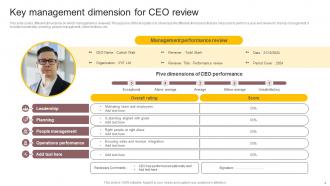
Management review is a systematic and structured evaluation process conducted by organizational leaders to assess the overall performance, effectiveness, and alignment of business strategies and operations. This comprehensive examination involves reviewing key performance indicators, financial results, and other relevant metrics to gauge the achievement of organizational goals. Management reviews often serve as a platform for decision makers to discuss challenges, opportunities, and areas for improvement. This process plays a vital role in fostering accountability, enhancing communication, and steering the organization toward continuous improvement by identifying and addressing issues at both strategic and operational levels.This template includes a comprehensive presentation emphasizing the significance of implementing a management review for business success. It outlines the key components that contribute to an effective management review, elucidating the major outputs derived from the process. A structured five step management review process is detailed, accompanied by solutions to tackle common challenges. Necessary guidelines for conducting a management review with ISO adherence are provided, including the implementation of performance reviews for top management. The template introduces financial metrics to track the management review process, identifies key dimensions for CEO review, and summarizes key performance indicators KPIs in a concise top management review. Various types of management performance reviews and organization centric methods are explored, with visual icons integrated for clarity. Lastly, it includes a succinct summary of these vital components.
People who downloaded this PowerPoint presentation also viewed the following :
Management Review Powerpoint Ppt Template Bundles with all 28 slides:
Use our Management Review Powerpoint Ppt Template Bundles to effectively help you save your valuable time. They are readymade to fit into any presentation structure.












FAQs for Management Review Powerpoint
Stick to what execs actually care about - financials, operational stuff, customer happiness, and how you're tracking against big picture goals. Retention and productivity numbers are good too since they always ask about those. Honestly, less is more here. Pick maybe 5-7 key things that paint the real picture instead of drowning them in charts. Know the story behind your trends though - they'll definitely ask why numbers went up or down. Oh, and prep some backup slides with more detail. Trust me, there's always that one person who wants to dig deeper into something random.
Honestly, visual aids are a game changer for management reviews. People absorb info so much faster when they can actually see the data instead of drowning in spreadsheet hell. Charts and graphs make trends pop out immediately. Your audience stays way more engaged too - I mean, who wants to stare at endless rows of numbers? That's torture. Even something basic like a PowerPoint chart transforms the whole vibe from "please kill me now" to actually productive. Plus everyone's literally on the same page when you've got clear visuals up there. Makes discussions flow better since there's no confusion about what you're talking about.
Don't rush through it like you're just checking a box - that's the worst mistake. Come with actual data, not just your gut feelings about what went wrong. Also avoid turning it into a blame game because then people clam up and you get nowhere. Focus on solutions, not just problems. Oh and make sure you invite the right people from day one instead of scrambling to catch them up later when everything's already decided. Honestly, most teams don't block enough time for these either. You want people walking away with clear action items, not more confusion.
Honestly, I'd go with quarterly for most companies. Monthly feels like overkill - you'll burn everyone out and people won't prep properly anyway. Annual is way too long unless you're in some super predictable industry (which, let's be real, doesn't really exist anymore). Quarterly gives you enough time to collect actual data and see if your action items are working. Plus you won't lose sight of bigger goals while still catching problems before they spiral. Fast-growing companies might need monthly, but I'd start quarterly and see how it feels. You can always adjust if your business changes quickly.
Stakeholder feedback is your reality check before management reviews. Customers, employees, suppliers - get their input first so leadership isn't just staring at spreadsheets all day. Here's the thing: there's usually a huge gap between what executives think is happening and what's actually going down. This outside perspective catches blind spots and shows if your strategies are bombing or winning. Plus it surfaces problems that haven't hit the reports yet. Just don't cherry-pick the positive stuff - I've seen companies do that and it backfires hard. Collect everything systematically. Short story: it keeps you honest.
So basically, management reviews make you pause and check if what you're doing daily actually matches your big picture goals. You'll catch teams going in opposite directions before it becomes a mess. Honestly, I've seen so many companies think everyone's on the same page when they're literally working toward different things - it's wild. The trick is making these reviews structured enough to spot where strategy and execution don't line up. Then you can shuffle resources around and get people focused on what actually matters. Those regular checkpoints are clutch for keeping everyone headed in the same direction.
Start with the big stuff - customer satisfaction, financials, operational metrics, compliance issues. People tune out after 30 minutes so hit the important topics early. Always review last meeting's action items first, then dive into new risks or opportunities. Send the agenda 48 hours ahead so people can prep (nobody reads it anyway, but at least you tried). Block out specific time for each topic or you'll waste forever on random tangents. Honestly, I've seen teams spend half a meeting arguing about parking spots while completely ignoring budget overruns. End with clear next steps.
Keep a simple tracker for all your action items - spreadsheet, project tool, whatever works for your team. Honestly, I've seen Word docs work just fine if everyone's comfortable with that. Update it regularly and share before each review meeting. Be super transparent about what's done, in progress, or running late. Don't archive old stuff that's still hanging - those items have a way of disappearing forever if you're not careful. Walk through the tracker right at the start of your next meeting so nothing falls through the cracks.
Honestly, get yourself a solid agenda template first - that alone will save your sanity. I swear by dashboards that auto-track KPIs because scrambling for numbers at the last minute is the worst. Monday or Asana work great for keeping action items straight afterward. Executive summary templates are clutch for consistent reporting, and pre-meeting questionnaires actually get people to show up prepared (shocking, I know). Set up automated data pulls from whatever systems you use. My advice? Just pick one thing and start there - don't try to overhaul everything at once.
Honestly, data analytics is a game-changer for management reviews. Instead of sitting around guessing what went wrong, you're looking at actual proof. Real-time dashboards show your KPIs, customer feedback, and performance metrics all together - no more "I think this happened" conversations. You'll spot trends way faster and catch problems before they become disasters. The trick is figuring out your top 3 business questions first, then building everything around those. I mean, it beats the old-school approach where everyone just shares their gut feelings and hopes for the best. Way more efficient.
Honestly, you've got to be upfront that you actually want the real deal, not just sunshine reports. I always share something I'm struggling with first - makes everyone else feel safer about opening up too. Ask specific stuff like "what's broken right now?" instead of those useless "how's it going?" questions that get you nowhere. Give people heads up before meetings so they can think through their answers (introverts will thank you). Here's the big thing though - when someone finally tells you something's wrong, don't immediately jump into fix-it mode. Just ask more questions first. Try opening with "what should I know that I probably don't?" Works every time.
Build a lessons learned database and actually review it before management meetings. Grab insights from finished projects - wins AND failures - then sort them by stuff like resource planning or stakeholder issues. Most teams create these then never touch them again, which drives me crazy. When you're facing current project problems, compare them against what happened before. Make it a regular agenda item so you're not just winging it every time. Oh, and definitely include risk management patterns too. You'll stop making the same dumb mistakes if you actually use what you've learned.
Document everything right in the meeting - who's doing what and by when. Otherwise stuff just disappears. Send notes within 24 hours while it's all still fresh in everyone's head. For the big action items (you know, the ones that always get pushed), actually schedule follow-up check-ins. Track progress somewhere visible - could be your project tool or honestly just a Google sheet. The part everyone forgets? Close the loop. Don't assume things got done, actually confirm it. I've learned this the hard way too many times.
Oh man, this is such a headache but super important to get right. Germans will straight-up tell you what's wrong - no sugar-coating whatsoever. Meanwhile, Japanese colleagues communicate through hints and context. Timing varies too; some cultures expect quarterly check-ins while others prefer annual deep dives. Individual vs team focus is huge - Americans love personal achievements, but many Asian cultures prioritize group success. Honestly, the hierarchy thing trips up so many companies. Train your managers on these communication differences first, then adapt your framework locally while keeping your core standards the same across regions.
Honestly, adding risk assessments to your management reviews is a game changer. You'll spot problems while they're still small and fixable instead of waiting for everything to blow up. Gets your team thinking ahead too, which is huge - though yeah, you'll still have random crises pop up because that's just how it goes. The documentation piece is nice for compliance stuff and makes you look like you actually know what you're doing to higher-ups. Just try throwing 10 minutes into your next review to talk through your biggest 3 risks. Super simple start.
-
One word for SlideTeam–Versatile!
-
The quality of the templates is as fine as it could get. It was a purchase well made!