


Core areas of artificial intelligence industrial automation explainable ppt powerpoint presentation display




Try Before you Buy Download Free Sample Product
 Impress Your
 Audience
 100%
100% Editable
 Save Hours
 of Time


Our Core Areas Of Artificial Intelligence Industrial Automation Explainable Ppt Powerpoint Presentation Display are topically designed to provide an attractive backdrop to any subject. Use them to look like a presentation pro.
People who downloaded this PowerPoint presentation also viewed the following :
Content of this Powerpoint Presentation
Description:
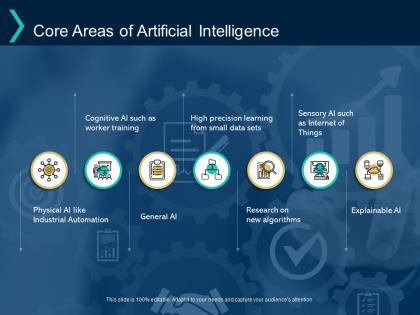
The image here is a slide from a presentation, titled "Core Areas of Artificial Intelligence." The slide identifies five core areas of AI, each represented by an icon and a brief descriptor:
1. Cognitive AI such as worker training:
This represents AI technologies focused on simulating human thought processes, used in worker training to enhance learning and decision-making skills.
2. Physical AI like Industrial Automation:
Physical AI relates to the embodiment of AI within physical systems, such as robots or autonomous vehicles, particularly in automating industrial processes.
3. General AI:
A term that refers to a type of artificial intelligence that can understand, learn, and apply knowledge in a broad, versatile manner, similar to human intelligence.
4. High precision learning from small data sets:
This area involves AI algorithms capable of learning effectively from limited amounts of data, which is critical in situations where large data sets are not available.
5. Sensory AI such as Internet of Things:
Sensory AI includes systems that process data from sensors and IoT devices, enabling machines to perceive their environment.
6. Research on new algorithms:
This relates to the ongoing investigation and development of novel AI algorithms to advance the field further.
7. Explainable AI:
The focus here is on AI systems that are transparent, and their decision-making process can be understood by humans.
Use Cases:
These AI areas are crucial to various industries. Below are seven industries where this slide could be applied:
1. Technology:
Use: To provide an overview of different AI research and application areas
Presenter: A technology consultant or AI specialist
Audience: Tech entrepreneurs, investors, or professionals
2. Manufacturing:
Use: Discussing the deployment of AI in industrial automation and process optimization
Presenter: A manufacturing engineer or operations expert
Audience: Plant managers, engineers, and manufacturing stakeholders
3. Healthcare:
Use: Explaining AI applications in patient diagnosis, treatment plans, and medical data analysis
Presenter: A healthcare technologist or medical researcher
Audience: Doctors, medical staff, and healthcare administrators
4. Education:
Use: Presenting AI's role in personalized learning and educational tools development
Presenter: An educational technologist or academic researcher
Audience: Educators, policy makers, and educational technology developers
5. Retail:
Use: Describing how AI can analyze customer data and automate supply chain management
Presenter: A retail strategist or market analyst
Audience: Retail business owners, marketing teams, and supply chain managers
6. Automotive:
Use: Illustrating the impact of AI in autonomous driving and vehicle sensory systems
Presenter: Automotive engineer or AI researcher in transportation
Audience: Automotive industry professionals, transportation officials, and investors
7. Financial Services:
Use: AI's contribution to fraud detection, risk management, and algorithmic trading
Presenter: A financial analyst or AI specialist in finance
Audience: Bank executives, financial service providers, and regulatory agency representatives
Core areas of artificial intelligence industrial automation explainable ppt powerpoint presentation display with all 5 slides:
Use our Core Areas Of Artificial Intelligence Industrial Automation Explainable Ppt Powerpoint Presentation Display to effectively help you save your valuable time. They are readymade to fit into any presentation structure.




FAQs for Core areas of artificial intelligence industrial automation explainable ppt
Primary AI applications in industrial automation include predictive maintenance, quality control, supply chain optimization, robotic process automation, and intelligent scheduling systems. These technologies enhance operational efficiency by reducing downtime, minimizing defects, and streamlining production workflows, with manufacturing facilities increasingly finding that AI-driven automation delivers significant cost reductions and competitive advantages.
Machine learning improves predictive maintenance by analyzing sensor data, identifying equipment failure patterns, and predicting maintenance needs before breakdowns occur. Through advanced algorithms, manufacturers can reduce unplanned downtime by up to 50%, optimize maintenance schedules, and extend equipment lifespan, with many industrial facilities finding that predictive approaches significantly lower operational costs while enhancing productivity.
AI-driven robotics enhance operational efficiency by automating repetitive tasks, optimizing production workflows, and enabling predictive maintenance through real-time monitoring and data analysis. These intelligent systems streamline manufacturing processes, reduce human error, and minimize downtime, with automotive and electronics manufacturers finding that robotic integration delivers faster production cycles, lower operational costs, and significantly improved quality control.
Computer vision revolutionizes quality control by automatically detecting defects, measuring dimensions, verifying assembly accuracy, and ensuring product consistency through real-time image analysis. This technology enables manufacturers to identify issues instantly during production, significantly reducing waste and rework costs, while delivering faster inspection speeds and higher accuracy than traditional manual methods, ultimately enhancing operational efficiency.
Natural language processing enables human operators to communicate with automated systems through conversational interfaces, voice commands, and plain-language queries, eliminating complex programming or technical interfaces. This technology streamlines operations by allowing real-time system monitoring, intuitive troubleshooting, and seamless data retrieval, with manufacturing and logistics facilities finding that operators can respond faster to alerts and optimize workflows more efficiently.
Ethical considerations include worker displacement concerns, algorithmic bias in decision-making, data privacy protection, transparency in automated processes, and accountability for AI-driven outcomes. While these challenges require careful planning, organizations increasingly find that proactive ethical frameworks, retraining programs, and transparent implementation strategies enable them to harness AI benefits while maintaining workforce trust and regulatory compliance.
AI algorithms optimize supply chain management by analyzing demand patterns, predicting inventory needs, automating procurement decisions, and identifying bottlenecks across production networks. Through machine learning and predictive analytics, manufacturers streamline warehouse operations, reduce carrying costs, and enhance delivery schedules, with automotive and electronics companies finding that these systems ultimately deliver faster production cycles and significantly improved operational efficiency.
AI transforms workforce dynamics by shifting employees from repetitive tasks to strategic roles requiring creativity, problem-solving, and AI system oversight, while simultaneously creating new positions in data analysis and system maintenance. Through automation of routine processes, manufacturing and logistics companies enable workers to focus on quality control, process optimization, and customer relationship management, ultimately delivering enhanced job satisfaction and competitive skill development.
Reinforcement learning enables manufacturing systems to optimize processes through trial-and-error learning, adapting to changing conditions, minimizing waste, and improving quality control without human intervention. Through continuous feedback loops, manufacturers achieve enhanced production efficiency, reduced downtime, and better resource allocation, with automotive and electronics industries finding that these self-improving systems deliver significant competitive advantages.
Integrating AI solutions into existing industrial systems presents challenges including legacy system compatibility, data quality inconsistencies, workforce training requirements, cybersecurity vulnerabilities, and substantial upfront investments. However, manufacturers increasingly find that phased implementation approaches, starting with pilot programs in specific production areas, help minimize disruption while delivering measurable improvements in operational efficiency and predictive maintenance capabilities.
AI assists in real-time data analytics by continuously monitoring production metrics, identifying bottlenecks instantly, and predicting equipment failures before they occur. Through machine learning algorithms and sensor integration, manufacturers can optimize assembly line speeds, reduce material waste, and enhance quality control processes, with automotive and electronics companies finding that this approach delivers significantly faster decision-making and improved operational efficiency.
Industrial automation AI systems require multi-layered security including network segmentation, encrypted data transmission, access controls, regular security audits, and anomaly detection protocols. Manufacturing plants, energy facilities, and chemical processing companies increasingly implement these measures by isolating critical systems, monitoring unusual patterns, and maintaining updated security patches, ultimately protecting against cyber threats while ensuring operational continuity.
AI contributes to energy efficiency and sustainability in manufacturing through predictive maintenance, real-time energy monitoring, demand forecasting, automated resource optimization, and waste reduction algorithms. These technologies streamline operations by minimizing equipment downtime, optimizing power consumption patterns, and reducing material waste, with many manufacturers finding that AI-driven systems deliver 15-30% energy cost reductions while enhancing overall operational sustainability.
AI technologies revolutionize design and prototyping phases by enabling predictive modeling, automated design optimization, digital twin simulations, and rapid iterative testing. Through machine learning algorithms and advanced analytics, manufacturers streamline product development cycles, reduce physical prototyping costs, and enhance design accuracy, with automotive and aerospace industries finding significantly faster time-to-market and improved operational efficiency.
Emerging trends include autonomous manufacturing systems, predictive maintenance algorithms, collaborative AI-human workflows, edge computing integration, and digital twin technologies. These advancements streamline operations by reducing downtime, enhancing quality control, and optimizing resource allocation, with many manufacturers finding that strategic AI deployment delivers significant competitive advantages in increasingly automated industrial environments.
-
Professional and unique presentations.
-
Easily Understandable slides.
-
Perfect template with attractive color combination.
-
Great designs, Easily Editable.
-
Design layout is very impressive.