

Corrective Action Plan To Prevent Fraud In Future Fraud Investigation And Response Playbook





Try Before you Buy Download Free Sample Product
 Impress Your
 Audience
 100%
100% Editable
 Save Hours
 of Time


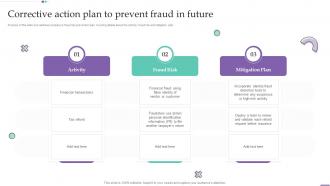
Purpose of this slide is to address companys fraud risk prevention plan covering details about the activity, fraud risk and mitigation plan.
People who downloaded this PowerPoint presentation also viewed the following :
Corrective Action Plan To Prevent Fraud In Future Fraud Investigation And Response Playbook with all 6 slides:
Use our Corrective Action Plan To Prevent Fraud In Future Fraud Investigation And Response Playbook to effectively help you save your valuable time. They are readymade to fit into any presentation structure.





FAQs for Corrective Action Plan To Prevent Fraud In Future Fraud Investigation
Key components of an effective Corrective Action Plan include problem identification, root cause analysis, corrective measures, implementation timelines, and monitoring mechanisms. These elements work together by systematically addressing issues, preventing recurrence, and ensuring accountability, with many organizations finding that comprehensive plans enhance operational efficiency, reduce compliance risks, and ultimately deliver sustained process improvements across departments.
Organizations identify root causes through systematic investigation methods including root cause analysis, fishbone diagrams, 5-why analysis, data trend analysis, and stakeholder interviews. These approaches enable teams to trace problems beyond surface symptoms to underlying systemic issues, with many manufacturing and healthcare organizations finding that comprehensive root cause identification reduces recurring incidents and enhances operational efficiency.
Data analysis plays a crucial role in developing Corrective Action Plans by identifying root causes, measuring problem scope, analyzing failure patterns, and establishing baseline metrics for improvement tracking. Through comprehensive data review, organizations can prioritize corrective actions based on impact severity, predict potential future issues, and create measurable success criteria, ultimately delivering more targeted solutions and sustainable operational improvements.
A Corrective Action Plan aligns with business objectives by directly addressing operational gaps that impede strategic goals, ensuring resource allocation supports priority initiatives, and establishing measurable outcomes that advance organizational performance. Through systematic integration with strategic planning processes, organizations streamline corrective measures with growth targets, quality standards, and competitive positioning, ultimately delivering enhanced operational efficiency and sustained business success.
Common pitfalls include inadequate root cause analysis, setting unrealistic timelines, lacking stakeholder buy-in, insufficient resource allocation, and poor communication throughout the process. Many organizations find that rushing implementation without proper planning, failing to establish clear accountability measures, and neglecting regular progress monitoring ultimately undermines effectiveness, while successful corrective actions require strategic coordination and sustained commitment.
Organizations ensure accountability for corrective actions through clear ownership assignments, regular progress monitoring, defined deadlines with milestone checkpoints, and performance metrics tied to completion rates. These accountability frameworks enhance transparency by establishing reporting structures, conducting periodic reviews, and linking action plan execution to employee evaluations, ultimately delivering improved compliance outcomes and organizational resilience.
Monitoring and evaluating Corrective Action Plan effectiveness ensures issues are genuinely resolved, prevents recurrence, and validates resource allocation decisions. This systematic tracking enables organizations to identify implementation gaps, measure improvement outcomes, and refine processes continuously, with many companies finding that regular evaluation cycles ultimately deliver sustained operational excellence and competitive advantage.
Stakeholder feedback can be incorporated through regular consultation sessions, feedback surveys, review meetings, and collaborative workshops throughout the corrective action process. This approach ensures diverse perspectives are captured, enhances buy-in across departments, and improves solution effectiveness, with many organizations finding that inclusive planning ultimately delivers more sustainable outcomes and stronger stakeholder commitment.
Corrective Action Plan tools include project management platforms like Asana and Trello, quality management systems such as MasterControl and TrackWise, and enterprise solutions like ServiceNow and Salesforce. These technologies streamline tracking, automate workflows, and enhance collaboration across teams, with many organizations finding that integrated platforms significantly reduce resolution times while improving accountability and compliance outcomes.
Timelines and responsibilities should specify clear deadlines for each corrective step, assign accountable individuals or teams, include milestone checkpoints, and establish escalation protocols for delays. These structured frameworks enable organizations to track progress systematically, ensure accountability across departments, and maintain momentum toward resolution, with many finding that detailed timelines significantly reduce implementation delays and enhance overall corrective effectiveness.
A Corrective Action Plan addresses existing problems or non-conformities that have already occurred, focusing on immediate fixes and root cause elimination, while preventive action strategies proactively identify potential issues before they manifest. Corrective actions involve investigation, containment, and remediation of current defects, whereas preventive measures emphasize risk assessment, process improvements, and systematic controls, with many organizations finding that combining both approaches delivers comprehensive quality management and sustainable operational excellence.
Failing to implement Corrective Action Plans promptly can lead to recurring problems, escalated compliance violations, operational inefficiencies, and eroded stakeholder confidence. Organizations across industries, from manufacturing to healthcare, increasingly find that delayed corrective actions result in higher remediation costs, regulatory penalties, and competitive disadvantage, ultimately compromising long-term business sustainability.
Communication strategies enhance Corrective Action Plan effectiveness by establishing clear channels, ensuring stakeholder alignment, and maintaining transparency throughout implementation. Through regular updates, feedback loops, and structured reporting mechanisms, organizations streamline accountability, accelerate problem resolution, and minimize resistance to change, with many companies finding that proactive communication ultimately delivers faster corrective outcomes and stronger organizational buy-in.
Corrective Action Plans are particularly critical in healthcare, manufacturing, aviation, financial services, and pharmaceuticals, where operational failures can result in serious consequences, regulatory penalties, or safety risks. These industries face stringent compliance requirements and high-stakes environments, with many organizations finding that structured corrective action processes enable faster issue resolution, minimize regulatory exposure, and ultimately deliver enhanced operational reliability and competitive advantage.
Training and development integration occurs through skills gap assessments, targeted learning modules, competency evaluations, mentoring programs, and continuous monitoring systems. Organizations like manufacturing firms and healthcare institutions find that structured training components address root causes while building preventive capabilities, ultimately reducing recurring issues and enhancing operational resilience across teams.
-
The PPTs are extremely simple to modify. Thank you for providing the slides that are ready to be used. They assist me in saving a lot of time.
-
Requested a complete pitch deck. Delivered immediately and with high quality well researched content.