


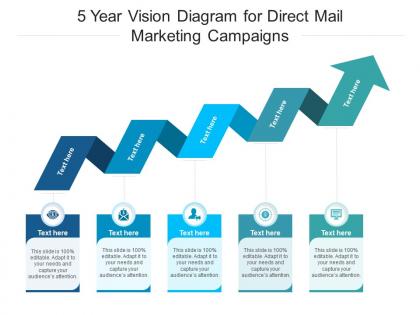
5 year vision diagram for direct mail marketing campaigns infographic template




Try Before you Buy Download Free Sample Product
 Impress Your
 Audience
 100%
100% Editable
 Save Hours
 of Time


This is a 5 Year Vision Diagram For Direct Mail Marketing Campaigns Infographic Template that can be used by professionals belonging to any domain. It is a powerful illustrative tool that can be deployed to showcase consumer behavior, sales reports, progress reports, IT research results, and many more. In short, this PPT layout works for every industry, irrespective of its operations. The combination of compelling information and visual content added in this template makes it a very resourceful layout to grab. Utilize it to present information and insightful details about your business or the finished product that can be visualized from the onset. This PPT design features high quality elements like graphics, icons, etc. that can be used to further enhance the illustrative properties of a presentation. It can also be reproduced as PNG, JPG and PDF, for the users convenience.
People who downloaded this PowerPoint presentation also viewed the following :
5 year vision diagram for direct mail marketing campaigns infographic template with all 2 slides:
Use our 5 Year Vision Diagram For Direct Mail Marketing Campaigns Infographic Template to effectively help you save your valuable time. They are readymade to fit into any presentation structure.
FAQs for 5 year vision diagram for direct mail marketing
Direct mail marketing delivers higher response rates, tangible engagement, precise targeting capabilities, reduced digital noise competition, and enhanced brand memorability compared to digital channels. Through physical touchpoints, businesses achieve stronger emotional connections and improved conversion rates, with many retail and financial services companies finding that strategic direct mail campaigns complement digital efforts while reaching demographics less engaged online.
Businesses can effectively segment their direct mail audiences by demographics, purchase history, geographic location, behavioral patterns, and engagement levels. Through customer data analysis and CRM integration, companies in retail, financial services, and healthcare deliver highly targeted messages, reduce campaign costs, and significantly improve response rates, ultimately enhancing ROI and customer relationships.
Successful direct mail infographics should include compelling headlines, clear value propositions, visual data representations, strong calls-to-action, and consistent brand elements like logos and color schemes. These components work together by capturing attention quickly, communicating benefits effectively, and driving recipient engagement, with many businesses finding that well-designed infographics significantly increase response rates and customer conversions.
**INPUT**: How can the design of a direct mail piece influence customer response rates? **OUTPUT**: Direct mail design significantly influences response rates through compelling visuals, clear messaging hierarchy, strategic color choices, and prominent call-to-action placement that guides reader attention. These design elements work together by reducing cognitive load, building brand trust, and creating emotional connections, with many retail and financial services companies finding that well-designed pieces deliver response rates 3-5 times higher than generic alternatives. [Word count: 60]
Effective direct mail call-to-action strategies include personalized offers with urgency deadlines, QR codes linking to exclusive landing pages, toll-free numbers for immediate response, limited-time discounts, and clear next-step instructions. These approaches streamline customer engagement by combining physical touchpoints with digital conversion paths, ultimately delivering higher response rates and measurable ROI for businesses across retail, financial services, and healthcare sectors.
Demographic response patterns vary significantly, with older generations (55+) showing higher engagement rates for direct mail due to familiarity and trust preferences, while younger demographics (18-34) typically respond better to digital channels through social media and mobile optimization. However, strategic combination approaches increasingly deliver competitive advantage, with many organizations finding that integrated campaigns leveraging both channels enhance overall conversion rates and customer acquisition across all age segments.
Key metrics include response rate, conversion rate, return on investment (ROI), cost per acquisition, and customer lifetime value. These measurements enable businesses to optimize campaign effectiveness by tracking engagement levels, calculating revenue generated per dollar spent, and identifying which demographics respond best, ultimately delivering data-driven insights that enhance targeting strategies and maximize marketing budget efficiency.
Personalization enhances direct mail effectiveness by increasing response rates, improving customer engagement, and boosting conversion rates through targeted messaging, customized offers, and relevant content delivery. Through data analytics and segmentation technologies, retailers, financial services, and healthcare organizations achieve significantly higher ROI, with many finding that personalized campaigns deliver 20-30% better results than generic approaches.
Mailing list quality significantly determines direct mail marketing success by influencing delivery rates, response rates, and overall campaign ROI through accurate targeting and reduced waste. High-quality lists with verified addresses, updated demographics, and proper segmentation enable retailers, healthcare providers, and financial services to achieve response rates 3-5 times higher, while minimizing costs and maximizing customer acquisition efficiency.
Common direct mail pitfalls include poor targeting, weak headlines, cluttered design, unclear calls-to-action, and inadequate tracking mechanisms. These mistakes significantly reduce response rates by confusing recipients, failing to capture attention, and missing qualified prospects, with many retailers and service providers finding that addressing these issues through strategic segmentation and clean, focused messaging ultimately delivers higher engagement and measurable ROI.
Direct mail marketing integrates with online strategies through QR codes linking to digital campaigns, personalized URLs tracking customer journeys, and coordinated messaging across channels. This omnichannel approach enables retailers and service providers to bridge physical touchpoints with digital experiences, ultimately delivering higher engagement rates, better customer data collection, and enhanced brand consistency across all marketing platforms.
Direct mail marketing typically delivers ROI rates of 15-17%, often outperforming many digital alternatives like display advertising (2-5%) and social media campaigns (8-12%). While digital channels offer broader reach and real-time analytics, direct mail's tangible format creates stronger emotional connections and higher response rates, with many retail and financial services companies finding that strategic combinations of both channels ultimately maximize customer acquisition costs and lifetime value.
Timing significantly impacts direct mail success by aligning with customer purchasing cycles, seasonal trends, and competitive landscapes. Strategic timing enables retailers to capitalize on holiday seasons, financial services to target tax periods, and B2B companies to reach decision-makers during budget planning cycles, ultimately delivering higher response rates and improved ROI.
Direct mail marketing requires compliance with CAN-SPAM Act regulations, data privacy laws like GDPR and CCPA, postal service guidelines, and industry-specific regulations. These legal frameworks ensure transparency through accurate sender identification, proper opt-out mechanisms, and responsible data handling, with many organizations finding that proactive compliance ultimately delivers customer trust and competitive advantage.
Innovative direct mail marketing trends include personalized variable data printing, augmented reality integration, QR code campaigns, eco-friendly sustainable materials, and hybrid digital-physical experiences. These approaches enhance customer engagement by delivering targeted messaging, interactive experiences, and seamless omnichannel integration, with many retailers and financial services finding that personalized mail significantly increases response rates and brand loyalty.
-
Excellent design and quick turnaround.
-
Excellent template with unique design.
-
The content is very helpful from business point of view.
-
The Designed Graphic are very professional and classic.
-
Easily Editable.