

Cost Justification Of Employee Training Program




Try Before you Buy Download Free Sample Product
 Impress Your
 Audience
 100%
100% Editable
 Save Hours
 of Time


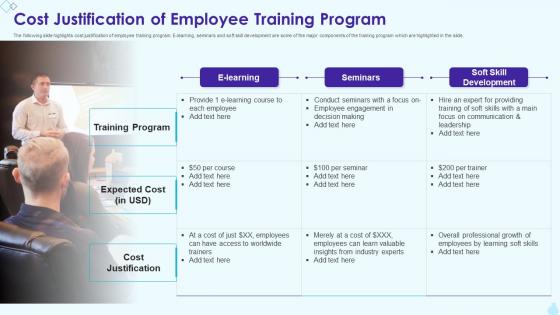
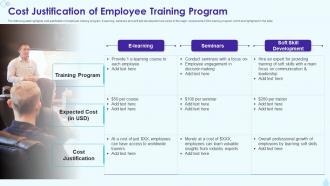
The following slide highlights cost justification of employee training program. E learning, seminars and soft skill development are some of the major components of the training program which are highlighted in the slide.
People who downloaded this PowerPoint presentation also viewed the following :
Cost Justification Of Employee Training Program with all 6 slides:
Use our Cost Justification Of Employee Training Program to effectively help you save your valuable time. They are readymade to fit into any presentation structure.





FAQs for Cost Justification Of
Key components include detailed cost-benefit analysis, ROI calculations, implementation timelines, risk assessments, and competitive comparisons. These elements work together by demonstrating financial impact, addressing stakeholder concerns, and providing clear decision-making frameworks, with many organizations finding that comprehensive presentations accelerate approval processes and secure necessary investment commitments.
Organizations can quantify costs through comprehensive tracking systems, detailed activity-based costing, time-and-motion studies, and cross-departmental impact assessments. These methodologies enable businesses to capture direct expenses like materials and labor, while identifying indirect costs such as overhead allocation, productivity losses, and opportunity costs, ultimately delivering more accurate ROI calculations and strategic investment decisions.
Qualitative benefits in cost justification include improved employee morale, enhanced customer satisfaction, better brand reputation, increased operational flexibility, and stronger competitive positioning. These intangible advantages can be effectively communicated through customer testimonials, employee surveys, market research data, and case studies from similar organizations, ultimately demonstrating strategic value that complements quantitative ROI metrics.
Visual aids transform complex cost justification data into digestible insights by converting abstract numbers into charts, graphs, infographics, and comparison tables that stakeholders can quickly comprehend. Through strategic visualization, organizations streamline decision-making processes, reduce presentation time, and enhance stakeholder buy-in, with many finding that visual cost breakdowns and ROI projections significantly accelerate approval cycles and build stronger business cases.
Common pitfalls include underestimating implementation costs, overlooking hidden expenses, failing to quantify intangible benefits, and presenting unrealistic timelines for ROI realization. These mistakes undermine credibility by creating overly optimistic projections, inadequate risk assessments, and insufficient stakeholder buy-in, ultimately leading to budget rejections and delayed project approvals across organizations.
Stakeholder analysis significantly shapes cost justification approaches by identifying each stakeholder's priorities, concerns, and decision-making criteria, enabling tailored financial narratives that resonate with different audiences. Through strategic stakeholder mapping, organizations can emphasize ROI metrics for executives, operational efficiency for managers, and user experience benefits for end-users, ultimately delivering more persuasive and comprehensive justifications.
Effective ROI metrics include cost savings, revenue generation, efficiency gains, time reduction, and risk mitigation, typically presented through percentage returns, payback periods, and net present value calculations. These quantitative measures work best when combined with operational improvements like faster processing times, reduced errors, and enhanced customer satisfaction, with many organizations finding that linking financial metrics to specific business outcomes creates more compelling justification narratives.
Historical data strengthens cost justification arguments by providing concrete evidence of past expenditures, performance trends, and ROI patterns that validate proposed investments. Through documented metrics, organizations can demonstrate proven cost savings, efficiency gains, and risk mitigation outcomes from similar initiatives, while benchmarking against industry standards, ultimately delivering compelling evidence-based cases that minimize decision-maker uncertainty.
Storytelling techniques enhance cost justification presentations by creating emotional connections, simplifying complex financial data through relatable scenarios, and demonstrating real-world impact through case studies and success stories. These narrative approaches help stakeholders visualize outcomes, understand ROI implications more clearly, and connect personally with the business case, ultimately making financial arguments more compelling and memorable for decision-makers.
Best practices for tailoring cost justification presentations include understanding stakeholder priorities, customizing financial metrics, adjusting technical detail levels, emphasizing relevant outcomes, and aligning timelines with decision-making processes. These approaches streamline approval processes by presenting ROI data for executives, operational benefits for managers, and technical specifications for implementation teams, ultimately delivering faster buy-in and more strategic resource allocation across organizational levels.
A well-structured agenda enhances cost justification presentations by establishing clear financial frameworks, outlining key investment rationales, defining expected ROI timelines, and prioritizing critical budget considerations. Through strategic sequencing, organizations streamline decision-making processes, reduce stakeholder confusion, and accelerate approval cycles, with many finance teams finding that structured presentations deliver faster buy-in and clearer resource allocation outcomes.
Ethical considerations in cost justification include transparency in data presentation, avoiding manipulation of figures, ensuring accuracy in assumptions, acknowledging potential risks and limitations, and considering broader stakeholder impacts beyond immediate financial gains. These principles help organizations build trust with decision-makers, maintain credibility in financial planning, and ensure long-term sustainability, with many companies finding that ethical cost justifications ultimately deliver stronger stakeholder confidence and more sustainable business outcomes.
Technology tools streamline cost justification presentations through automated data visualization, real-time financial modeling, collaborative editing platforms, and integrated analytics dashboards. These solutions enable finance teams to create compelling ROI analyses, share interactive presentations across stakeholders, and update projections instantly, ultimately delivering faster decision-making cycles and stronger business cases for strategic investments.
Effective objection-handling strategies include acknowledging concerns, providing detailed ROI calculations, offering phased implementation options, presenting comparable case studies, and establishing clear success metrics. These approaches help address stakeholder hesitations by demonstrating tangible value propositions, risk mitigation strategies, and competitive advantages, with many organizations finding that transparent communication and data-driven responses ultimately accelerate approval processes.
Cultural context significantly influences cost justification through varying decision-making styles, risk tolerance levels, communication preferences, and time orientations across different regions and organizations. In hierarchical cultures, justifications require extensive documentation and senior approval processes, while collaborative cultures emphasize team consensus and shared benefits, with many multinational organizations finding that tailored approaches for each market ultimately deliver higher approval rates and more successful project outcomes.
-
Attractive design and informative presentation.
-
Very unique, user-friendly presentation interface.